Good-Ark — discrete power semiconductors: rectifiers, Schottky, TVS, MOSFETs, SiC and IGBT
Request a Quote

Why You Should Not Trust Every Datasheet PDF You Find Online

Why You Should Not Trust Every Datasheet PDF You Find Online

A wrong datasheet is more dangerous than a missing one, because it produces confidence rather than caution. The failure modes are mundane: a file edited by a seller, a page that never made it into the scan, a version number that only exists on one website. None of them looks suspicious, and all of them … Read more
How to Compare Two Datasheets Without Getting Lost

How to Compare Two Datasheets Without Getting Lost

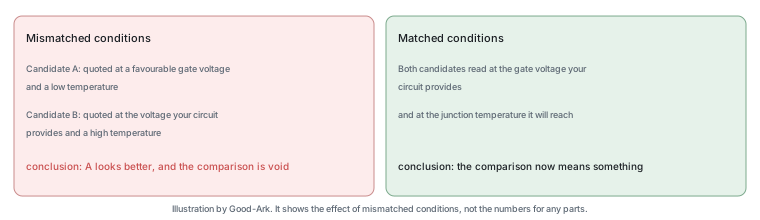
Comparing two datasheets looks like a reading task and is actually an arithmetic one. The work is not in understanding either document; it is in getting the two sets of numbers onto the same conditions so that a comparison means something. Most comparison mistakes happen before any numbers are compared. Rule one: compare like with … Read more

Fifteen Datasheet Terms Beginners Actually Meet (and What They Mean)

Fifteen Datasheet Terms Beginners Actually Meet (and What They Mean)

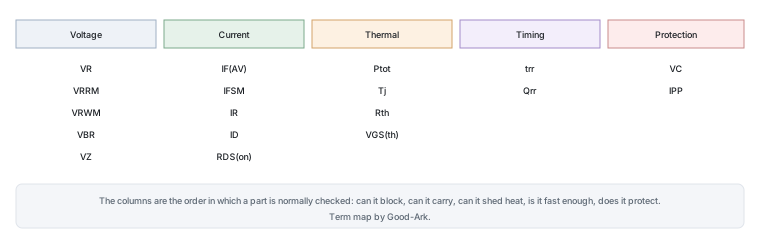
A datasheet uses a vocabulary that is almost never explained in one place. The terms below are the fifteen that a beginner meets in the first few documents they read, grouped by the question each one answers: how much voltage, how much current, how much heat, how fast, and how much protection. How to use … Read more

What the Numbers in a Semiconductor Part Number Actually Mean

What the Numbers in a Semiconductor Part Number Actually Mean

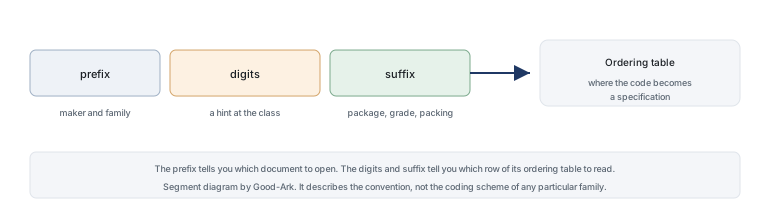
A semiconductor part number is a code that points at a row in a table. That is its whole job. It identifies a specific orderable variant, and the table in the datasheet for that family is where the meaning lives. Treating the code as a description is the source of most part-number confusion. Part numbers … Read more

How to Read Any Semiconductor Datasheet: A Beginner’s Walkthrough

How to Read Any Semiconductor Datasheet: A Beginner’s Walkthrough

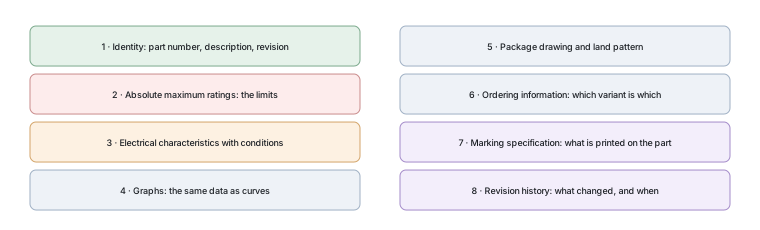
A datasheet looks intimidating because it is dense, and it is dense because it has to be complete. The trick is that it has a structure, and once you know the order of the sections you can answer most questions in a few minutes without reading the rest. What a datasheet is for A datasheet … Read more

How Modern Car Headlights Work: The Electronics Behind LED and Matrix Lighting

How Modern Car Headlights Work: The Electronics Behind LED and Matrix Lighting

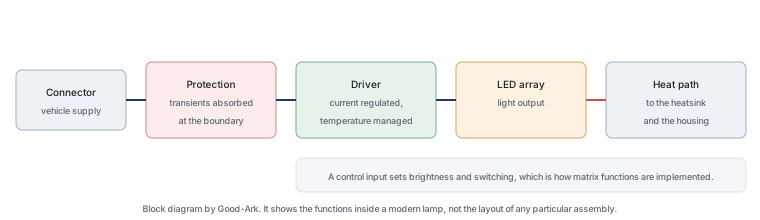
A modern headlight is not a bulb in a reflector. It is a sealed assembly containing light sources, the electronics that drive them, a thermal path to carry heat away, and protection components at the connector. Understanding those four parts explains why the assembly costs what it does and why changing one of them is … Read more

Why Automotive Electronic Parts Cost More: Testing, Traceability and Warranty

Why Automotive Electronic Parts Cost More: Testing, Traceability and Warranty

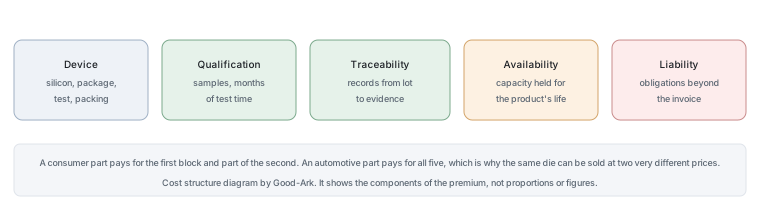
The price of an automotive component is not mostly the cost of making it. It is the cost of demonstrating that it works, of keeping it available, and of standing behind it in a way that a consumer part never has to. Understanding that split explains why the premium exists, and when it does not … Read more

From 12 V to 800 V: A Simple Map of Car Electrical Systems

From 12 V to 800 V: A Simple Map of Car Electrical Systems

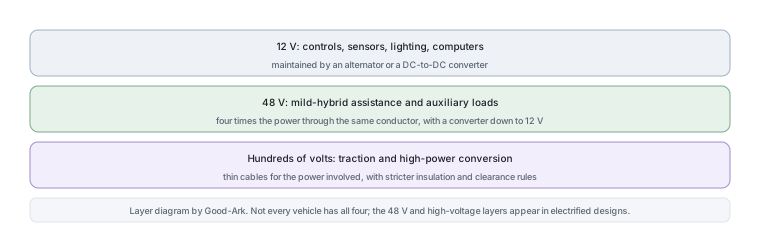
A car does not have “a” voltage. It has at least three, and in an electrified vehicle four, because different jobs are served best by different potentials. Treating them as one system is the source of a great deal of confusion, both for people diagnosing faults and for people designing components. Why a car has … Read more

How Does an Electric Car Charge? AC, DC and What Happens Inside

How Does an Electric Car Charge? AC, DC and What Happens Inside

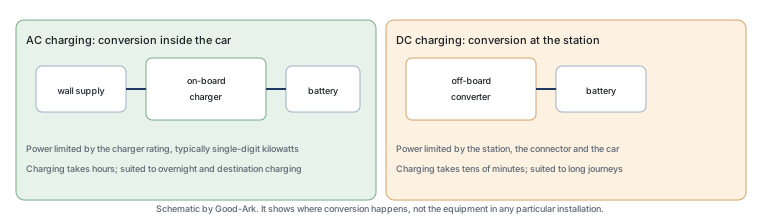
An electric car can be charged in two fundamentally different ways, and the difference is not the shape of the plug. It is where the conversion from alternating to direct current happens: inside the car for one kind of charging, and inside the charging equipment for the other. Two kinds of charging cable Alternating-current charging … Read more

Inside an Electric Car: Where the Power Electronics Sit

Inside an Electric Car: Where the Power Electronics Sit

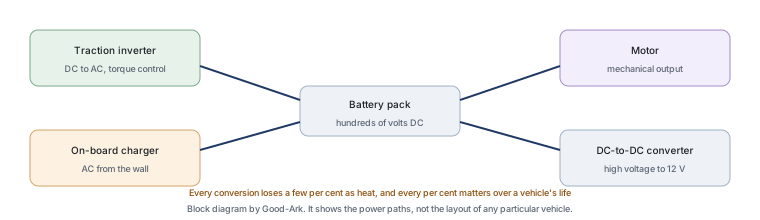
An electric car has three jobs that involve power electronics rather than computing: moving energy from the battery to the motor, moving it from the wall into the battery, and moving a small amount of it from the high-voltage system into the low-voltage one. Those three jobs are performed by five blocks of hardware, and … Read more

How Many Chips Are in a Car? The Quiet Explosion of Automotive Electronics

How Many Chips Are in a Car? The Quiet Explosion of Automotive Electronics

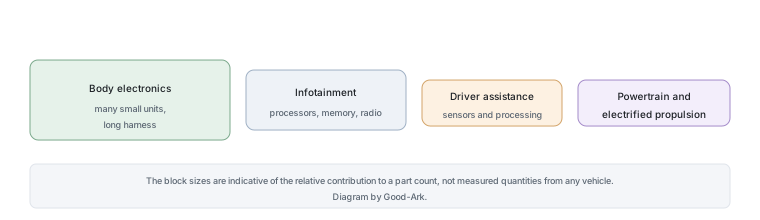
Ask how many chips are in a car and you will find published answers ranging from a few hundred to well over a thousand. The range is not a mistake; it reflects three different definitions, and understanding them is more useful than choosing one number. A short answer with real uncertainty The honest short answer … Read more

Where to Find Official Good-Ark Datasheets (and Avoid Lookalike Files)

Where to Find Official Good-Ark Datasheets (and Avoid Lookalike Files)

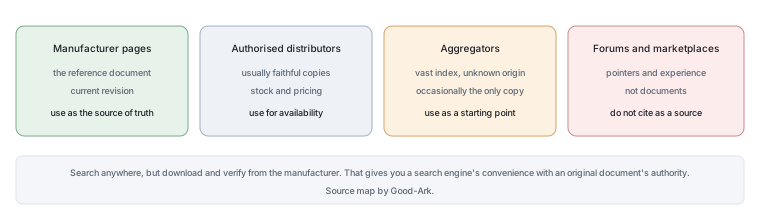
The difference between a useful datasheet and a dangerous one is provenance. A file with the right part number but the wrong revision, or no issuing manufacturer at all, will look correct and lead to a wrong design decision. Establishing where a document came from takes about two minutes and is worth doing every time. … Read more

Need a part number checked against your design?

Send the topology, current and voltage class. Good-Ark sales and application engineering will confirm the closest device, package and qualification status.

Copyright Suzhou Good-Ark Electronics Co., Ltd. All Rights Reserved