How to Read Any Semiconductor Datasheet: A Beginner’s Walkthrough
How to read a semiconductor datasheet: what each section is for, why the revision history is not decoration, and a ten-line routine that works anywhere.
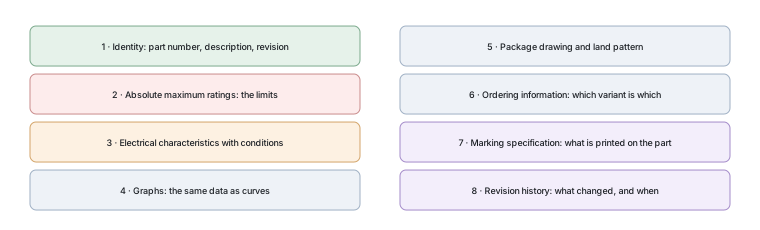
A datasheet looks intimidating because it is dense, and it is dense because it has to be complete. The trick is that it has a structure, and once you know the order of the sections you can answer most questions in a few minutes without reading the rest.
What a datasheet is for
A datasheet is a contract of sorts. It states what the manufacturer guarantees, under what conditions, and within what limits. That is a narrower purpose than most beginners expect: it is not a tutorial, it is not a selection guide, and it is not written to persuade you to use the part.
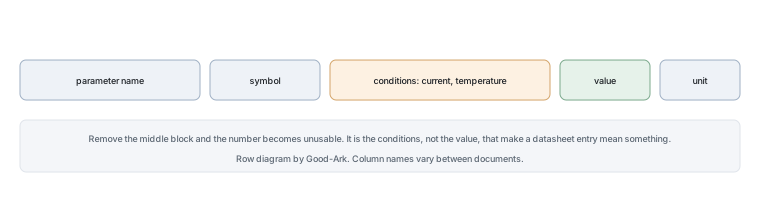
Understanding that changes how you read it. Every number in the document is an answer to the question “under what conditions”, and a number that appears without conditions is usually a summary rather than a specification. The practical skill is to find the conditions before you use the value.
Page one: the identity card
The first page tells you what the part is and what it is broadly capable of. It carries the manufacturer, the part number, a one-line description, a feature list, and usually a small table of headline ratings. It also carries the revision identifier and date, which is the detail most readers skip and the one that matters most when two versions of the same document disagree.
Two useful habits belong here. Check that the part number on the page matches the one you have in front of you, including any suffix, because the same document often covers a family with several variants. And note the revision date, so that when you compare two sources you can tell which is newer.
Absolute maximum ratings: the do-not-cross line
This section lists the limits the device can survive without damage. It is the section beginners are most likely to misuse, because a value in it looks like an operating point. It is not: it is the boundary beyond which the part is no longer specified, and a design that runs at one of those values is relying on luck.
One detail is worth internalising. Many absolute maximum values are quoted at a specific temperature or for a specific duration. A current that is survivable for a millisecond is not the same as a current that is survivable continuously, and the two may appear in the same table on different lines.
Electrical characteristics: typical versus guaranteed
This is where the useful numbers live, and where the most common misreading happens. Parameters usually appear with three kinds of value: a minimum, a maximum and a typical. The minimum and maximum are guarantees across the stated conditions, and the typical is what a sample of parts usually measured.
A design checked against typical values will work with most units and fail with some, and the failure will look like a bad component rather than a bad design. The rule is therefore simple: design to the guaranteed limit and use the typical value only to understand where the middle of the distribution sits.
| Value | What it means | When to use it |
|---|---|---|
| Minimum | Guaranteed lower bound across the stated conditions | When the circuit needs at least this much |
| Maximum | Guaranteed upper bound across the stated conditions | When the circuit cannot tolerate more than this |
| Typical | What a sample usually measured | For understanding behaviour, never for a guarantee |
Graphs: which ones matter first
The curves are the same data as the tables, drawn across a range rather than at a point, and they are where you see how a parameter behaves away from its nominal condition. For most parts, three kinds of graph repay early attention: the parameter against temperature, the parameter against the operating variable such as current or voltage, and any graph that shows how a rating must be reduced as conditions worsen.
Read the axes before reading the curves, including whether either is logarithmic. Then find your operating point rather than admiring the whole shape, and check whether several curves are drawn on the same axes because they usually represent different temperatures, and the one you need is the one matching your worst case.
One further distinction is worth carrying through the whole document. A rating describes a limit, and a characteristic describes behaviour; the two appear in different tables and are read differently. Beginners tend to treat both as the same kind of information, which is how a part can appear to meet a specification while being operated outside its limits in practice. Keeping the two categories separate in your head makes the rest of the document much faster to navigate.
Two internal references connect this reading method to the practical tasks around it. Finding a document you can trust is covered in our guide to finding official datasheets, and the selection method that decides which parameters you even need is in searching by parameter.
Package drawings and land patterns
The package section answers a question that has nothing to do with electronics: will this part fit, and how much copper does it need. It contains dimensions with tolerances, a recommended land pattern or footprint, and often a note about the thermal pad and how it should be connected.
Two details matter more than they look. The recommended land pattern differs from the package dimensions on purpose, and using the package outline as a footprint produces joints that are marginally too small or too large. And if the package has a thermal pad, the drawing will state whether it is electrically connected to a terminal, which changes how you can route copper underneath.
Revision history is not decoration
The revision history tells you what changed between versions of the document, and it is the first section to check when two sources disagree. A rating can be tightened, a condition clarified, a package drawing corrected, or a variant added — and any of those can invalidate a design that was checked against the previous version.
In production the revision matters commercially as well. If a manufacturer changes a parameter, the part number may stay the same while the specification moves, and the change-notification process exists precisely so that customers find out before the new revision reaches their line rather than afterwards.
A ten-line reading routine
- Check the part number and revision against what you have.
- Read the one-line description to confirm the part class.
- Skim the headline ratings for the two or three numbers you need.
- Read the absolute maximum table, noting the conditions.
- Find your parameters in the electrical characteristics table.
- Identify whether each value you plan to use is guaranteed or typical.
- Check the curves at your temperature and operating point.
- Check the package drawing against your footprint and copper area.
- Check the thermal data against your enclosure.
- Check the revision history for anything that changed recently.
Related reading on our own site covers datasheets and electronic components. The test methods that make two manufacturers’ numbers comparable come from JEDEC, assembly and footprint expectations from IPC, the documentation duties that keep a revision traceable from ISO, and sector-level context from the Semiconductor Industry Association. Document and standards background is published by NIST and IEC.
FAQ
How do I read a datasheet?
Read the sections in a different order from the page order. Start with the identity block to confirm the part and its revision, then the absolute maximum ratings to establish the limits, then the electrical characteristics table for the parameters you need. Only then look at the curves, the package drawing and the thermal data. Reading the tables before the curves is faster because the tables answer most questions at a single point.
How do I understand an integrated circuit datasheet, which is much longer?
The structure is the same, with more sections. An integrated circuit datasheet adds functional description, pin functions, application information, register maps or programming detail, and usually timing diagrams. The reading order is unchanged: identity, limits, then the characteristics that apply to your use. For a complex device, the practical approach is to read the application section first, because it usually tells you which of the other hundred pages you actually need.
What is an example of a datasheet?
Any published component document follows the pattern. A rectifier diode datasheet will list a reverse voltage rating, an average forward current, a forward voltage at a stated current, a surge rating and thermal data, together with the package drawing and the ordering table. A MOSFET datasheet lists blocking voltage, on-resistance at a stated gate voltage, gate charge and thermal resistance. The names differ; the structure does not.
How do I prepare a datasheet, rather than read one?
That is a different task, and it belongs to the manufacturer rather than the user. A datasheet is produced from characterisation data taken across production and temperature, with guaranteed limits derived from that data, and it is reviewed against test methods so that customers can compare it with other manufacturers’ documents. Writing one is a quality and publication process rather than a documentation exercise.
Why do two datasheets for the same part number disagree?
Because a registered part number describes a type rather than a single product, and different manufacturers publish their own guaranteed limits for it. Even within one manufacturer, revisions can tighten limits or clarify conditions. Comparing revisions and comparing guaranteed values rather than typical ones is what makes a comparison meaningful; comparing two typical numbers from different revisions is not.
What to do next
Pick a part you already use and work through the ten-line routine on its datasheet. The exercise takes fifteen minutes and turns the document from an obstacle into the fastest source of answers you have. For the specific case of a diode, our article on reading a diode datasheet applies the same routine to the five entries that decide a diode selection.
Send Good-Ark the part number and the conditions your circuit imposes, and we can confirm which datasheet revision applies and where the margin is thinnest.
Email sales@goodark.com, or start from the datasheet verification guide.
This article is published by Good-Ark, a manufacturer of discrete semiconductor devices. It describes how to read documentation rather than what any specific part’s values are; those belong to the current official datasheet.
Recommended
 Why Do Diodes Get Hot? Conduction and Switching Losses ExplainedInfoStandard, Fast Recovery, and Schottky Diodes: What’s the Difference?Info
 What Is a Fast Recovery Diode? Understanding “Fast Recovery”Info
 What Is a Diode? A Beginner’s Guide to How It WorksInfo
 Automotive Semiconductor Report 2026: Chips Per Car Keep RisingKnowledge