Fifteen Datasheet Terms Beginners Actually Meet (and What They Mean)
Datasheet terms explained as a working glossary, organised by what each term tells you to check: voltage, current, thermal, timing and protection terms.
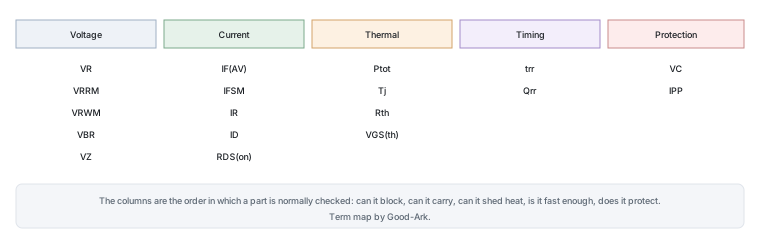
A datasheet uses a vocabulary that is almost never explained in one place. The terms below are the fifteen that a beginner meets in the first few documents they read, grouped by the question each one answers: how much voltage, how much current, how much heat, how fast, and how much protection.
How to use this list
Each entry gives the abbreviation, what it means in one sentence, and the condition that usually accompanies it. That last part matters more than the definition, because every rating in a datasheet applies under stated conditions, and a rating without its condition cannot be used.
The list is organised by category rather than alphabetically, because the categories correspond to the sequence in which you normally check a part: can it block the voltage, can it carry the current, can it shed the heat, is it fast enough, and does it protect what it needs to protect.
Voltage terms
VR, and VRRM. Reverse voltage and repetitive peak reverse voltage. VR is a general reverse rating; VRRM is the repetitive peak value the device can withstand repeatedly, which is normally the number a rectifier’s class is quoted at. Both are limits rather than operating points, and both come with a temperature condition.
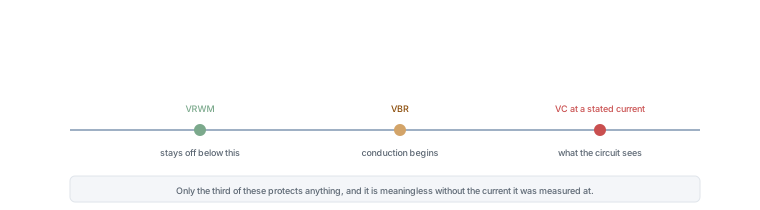
VRWM. Working standoff voltage, used for protection devices. It is the highest continuous voltage at which the device must remain effectively off, so it has to sit above your normal rail including tolerance and below the point at which the device starts to conduct. Beginners often treat it as the protection level, which it is not.
VBR. Breakdown voltage, the point at which a device begins to conduct in reverse. It is specified as a range and at a test current, and it is the beginning of conduction rather than the level the device holds. Confusing it with the clamping voltage is the most common error in protection selection.
VZ. Zener voltage, the level a Zener diode holds while conducting in reverse. It is specified with a tolerance and at a test current, which is why a five per cent part at twelve volts can sit anywhere in a band rather than exactly at twelve.
Current terms
IF(AV). Average forward current, usually quoted at a case temperature and often for a specified waveform. It is the number beginners compare, and it is the one most often unreachable in a sealed enclosure, because the case temperature in the condition is not the case temperature in your box.
IFSM. Non-repetitive surge current, the current the device survives in a single event, quoted for a specific waveform and usually for one occurrence. It matters most at switch-on, when the smoothing capacitor charges and draws a peak far higher than the steady-state current.
IR. Reverse leakage current, what the device conducts while it is supposed to be blocking. It is quoted at the rated voltage and often at an elevated temperature, and it is the parameter that decides whether a device behaves in a hot enclosure. For Schottky devices it rises steeply with temperature, which is why a figure measured cold can mislead.
ID, and RDS(on). Drain current and on-resistance, the two numbers that define a MOSFET’s conducting capability. ID is the current it can carry under stated conditions; RDS(on) is the resistance it presents when fully on, quoted at a specific gate voltage and junction temperature. The gate voltage condition is the one that decides whether the figure applies to your circuit.
Power and thermal terms
VGS(th). Gate threshold voltage, the gate voltage at which the device begins to conduct. It is a threshold rather than a drive requirement: a device that is only just conducting at its threshold is operating in a high-resistance region, which is why a part specified for logic-level drive reaches its rated on-resistance at a voltage comfortably above the threshold.
Ptot. Total power dissipation, the power the package can remove under stated conditions. It is a thermal statement rather than an electrical one, and the conditions attached to it usually include a mounting arrangement and an ambient or case temperature.
Tj. Junction temperature, the temperature inside the device rather than at its surface. It is the number compared against the device’s maximum, and it is the outcome of the loss and the thermal path rather than a property you can measure at the package.
Rth(j-a) or Rth(j-c). Thermal resistance from junction to ambient, or from junction to case. It converts power into a temperature rise: multiply the loss by this figure and you have the number of degrees by which the junction sits above the reference point. The ambient version depends heavily on the copper area and airflow, so the datasheet states the condition it assumes.
Timing and speed terms
trr. Reverse recovery time, the interval during which a diode continues to conduct after the voltage across it reverses. It is a consequence of stored charge, and it produces both a loss and a burst of noise. In a low-frequency circuit it is irrelevant; in a switching supply it can dominate the loss budget.
Qrr. Reverse recovery charge, the amount of charge that has to be cleared during that interval. It is often a more useful figure than the time, because the loss depends on the charge moved rather than on the duration alone. A device with a short recovery time but a large charge can still be a poor choice.
Protection-related terms
VC, and IPP. Clamping voltage and peak pulse current. VC is the voltage the device lets through while it is conducting a specified pulse current, and IPP is that current. The two always belong together: a clamping voltage quoted without a current describes nothing in particular, and it is the pairing that decides whether the protected circuit survives.
| Term | Question it answers | Condition to check |
|---|---|---|
| VR, VRRM | How much reverse voltage can it block? | Temperature, and whether the value is repetitive |
| VRWM | How much continuous voltage can it sit at? | Leakage limit at that voltage |
| VBR | Where does conduction begin? | Test current, and the specified range |
| VZ | What level does a Zener hold? | Test current and tolerance |
| IF(AV) | How much current continuously? | Case temperature and waveform |
| IFSM | What surge can it survive? | Waveform, and number of events |
| IR | What does it leak while blocking? | Voltage and temperature |
| ID, RDS(on) | How much current, at what resistance? | Gate voltage and junction temperature |
| VGS(th) | Where does conduction begin? | Test current used to define the threshold |
| Ptot | How much heat can the package remove? | Mounting and ambient conditions |
| Tj | How hot is the junction? | Lost rather than measured; needs the thermal path |
| Rth(j-a), Rth(j-c) | How much rise per watt? | Copper area, airflow and mounting |
| trr | How long does it keep conducting in reverse? | Forward current, temperature and dI/dt |
| Qrr | How much charge has to clear? | The same conditions as trr |
| VC, IPP | What does it let through, at what current? | The pulse waveform and its duration |
Terms that mislead beginners
Five entries on this list cause most of the damage. VBR is read as a protection level when it is only the start of conduction. IF(AV) is read as achievable current in a sealed enclosure when its condition assumes a specific case temperature. RDS(on) is read from the smallest number on the page, which is the one measured at the highest gate voltage and lowest temperature. Rth(j-a) is read as a property of the part when it is partly a property of your board. And VC is read on its own, without the current it was measured at.
Two further habits prevent the rest. Note the units, because milliohms and ohms, microamps and milliamps, and nanoseconds and microseconds all appear in the same documents. And note whether a value is a minimum, a maximum or a typical, because only the first two are guarantees.
Our own articles cover datasheets, diodes and transient voltage suppressors. The test methods that give these terms consistent meaning come from JEDEC, assembly and thermal expectations from IPC, electrical safety standards from the International Electrotechnical Commission, and sector-level context from the Semiconductor Industry Association. Document and standards background is published by ISO and NIST.
FAQ
How do I understand datasheets in general?
Learn the structure rather than the vocabulary first. A datasheet has an identity block, a table of limits, a table of characteristics with conditions, curves, a package drawing, an ordering table and a revision history. Once you know where each of those lives, the abbreviations become findable rather than intimidating: you know which section to look in. Our walkthrough of how to read a datasheet covers that structure.
What is the most important condition attached to a rating?
Temperature, in most cases. Whether it is a case temperature attached to a current rating or a junction temperature attached to an on-resistance, the value moves with heat, and a figure measured cold describes the best case rather than the operating case. The second most important is the test current or voltage at which the value was established, because the same parameter has many values.
What does VRRM mean?
It is the repetitive peak reverse voltage: the highest reverse voltage the device can withstand repeatedly, which is normally how a rectifier’s voltage class is quoted. It is a limit rather than an operating point, and it is measured at a stated temperature with a stated leakage criterion. A circuit whose transients approach this value has no margin left.
Is datasheet one word or two?
One word. The term is written as a single word in technical use, and the two-word form is occasionally seen in informal writing but is not standard in engineering documentation. This is a rare case where the English usage question has a definite answer.
Two of these questions seem to be about something else entirely.
They probably are. A datasheet is a general word, and searches about it attract questions about other documents that happen to share the name, including data sheets in spreadsheet form and documents in other industries. If your question is about a spreadsheet rather than a component, the answer will come from that domain rather than this one; if it is about a semiconductor, the terms above are the ones you will meet.
What to do next
Open the datasheet for a part you already use and find five of the terms above in it, noting the conditions attached to each. That exercise turns the glossary into something you can use, and it is faster than reading the document end to end. The comparison method that uses these terms is in our article on comparing two datasheets.
Send Good-Ark the parameter and the conditions you are working to, and we can explain what the figure covers and where the margin sits.
Email sales@goodark.com, or start from the datasheet verification guide.
This article is published by Good-Ark, a manufacturer of discrete semiconductor devices. Definitions are given at an introductory level; the precise definition of any parameter, and the conditions attached to it, belong to the standard and to the datasheet of the part.
Recommended
 Why Do Diodes Get Hot? Conduction and Switching Losses ExplainedInfoStandard, Fast Recovery, and Schottky Diodes: What’s the Difference?Info
 What Is a Fast Recovery Diode? Understanding “Fast Recovery”Info
 What Is a Diode? A Beginner’s Guide to How It WorksInfo
 Automotive Semiconductor Report 2026: Chips Per Car Keep RisingKnowledge