Why Automotive Electronic Parts Cost More: Testing, Traceability and Warranty
Why are automotive parts more expensive? The price of a vehicle-grade component includes evidence, availability and liability. When a cheaper part is fine.
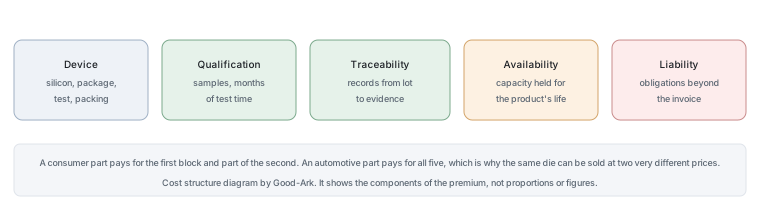
The price of an automotive component is not mostly the cost of making it. It is the cost of demonstrating that it works, of keeping it available, and of standing behind it in a way that a consumer part never has to. Understanding that split explains why the premium exists, and when it does not apply.
The visible and invisible price
The visible part is the device: silicon, package, test, packing. The invisible part is everything that turns a device into a component someone can build a vehicle with. Qualification testing consumes parts and machine time. Traceability requires records that follow a lot from wafer to shipment. Availability commitments mean holding capacity or inventory for years. And liability means accepting obligations that extend far beyond the invoice.
The analogy that fits is buying a component for a bridge rather than for a garden shed. The steel may be the same steel, but the documentation that proves where it came from, what it was tested against and who is accountable is part of the product. In a vehicle those documents are what allow a supplier to be chosen at all.
Qualification: paying for evidence
Qualification means subjecting a defined sample of parts to a defined set of stresses and recording the results. It is expensive for four reasons: samples are destroyed, the tests take weeks or months, the equipment is specialised, and the results have to be documented in a form a customer’s auditor will accept. For discrete semiconductors, the framework commonly referenced for automotive parts specifies the tests and the acceptance criteria.
The cost is not a one-off either. A design or process change invalidates part of the evidence and requires re-qualification, which is why automotive suppliers are careful about changes and why the change-notification agreement exists. From a customer’s point of view that is the value: the qualification they rely on cannot silently stop applying.
Reliability testing hours
The single largest cost in a qualification programme is usually time. Temperature cycling tests run for hundreds or thousands of cycles. Humidity and high-temperature bias tests run for a thousand hours or more. Extended life tests run longer still. Each of those occupies equipment and consumes samples, and none of it can be compressed without weakening the evidence.
That time cost is why automotive programmes start so early, and why a part that is available today may still not be usable in a programme that starts tomorrow. The device is ready; the evidence for the specific revision is not.
Traceability from wafer to vehicle
Traceability means being able to connect a specific shipped lot back to the material, the process and the test data that produced it. That requires marking, records, and systems that survive for the life of the vehicle rather than the life of the order.
The cost is in the administration as much as the technology. Records have to be retained, changes have to be documented, and the link between a part number and its evidence has to remain intact after reorganisations, supplier changes and process improvements. It is unglamorous work, and it is a large part of what a customer is buying when they choose a qualified component.
Long-term supply commitments
A vehicle platform runs for many years, and the components inside it have to remain available for the whole period plus a service tail. That obligation is expensive to honour, because it means holding capacity or inventory against demand that may be small and unpredictable, and because it constrains how freely a manufacturer can change or consolidate its product range.
A consumer part carries no such promise. It can be discontinued when demand falls, and the customer’s remedy is to redesign. In a vehicle the cost of redesigning a module is far higher than the cost of the component, which is why availability commitments are treated as a feature worth paying for.
Warranty and liability
The last component of the premium is the least visible and the most consequential. A defect in a consumer component leads to a replacement; a defect in a vehicle component can lead to a recall, which is measured in millions rather than in units. Suppliers price that exposure, and they also invest in the process control that keeps it small.
This is also why the supply chain is conservative. A module supplier who has qualified a part is reluctant to change it, because the evidence attached to the current part is worth more than a marginal saving on a substitute. That conservatism looks like inertia from outside and is a rational response to the consequences.
| Element | What it protects against | What happens without it |
|---|---|---|
| Qualification testing | Field failures from stresses the vehicle imposes | Unknown behaviour under conditions that will occur |
| Traceability | Inability to investigate or defend a failure | No way to connect a batch to its evidence |
| Availability commitment | Production stopping for want of a component | Redesign of a module because a part disappeared |
| Change notification | Silent revisions entering a qualified product | Requirement for re-qualification after the fact |
| Liability cover | The cost of a large-scale defect | A failure whose financial consequence dwarfs the part |
When a cheaper part is acceptable
Three situations where the premium may not be justified. A prototype or a bench experiment has no field life to protect, and a commercial part with adequate ratings is the sensible choice. A non-safety function in a vehicle that is not exposed to the harshest thermal or transient conditions may be acceptably served by an industrial-grade part, provided the decision is made explicitly and documented. And a repair to a non-critical function, where the alternative is not repairing at all, is a judgement a competent person can make.
What is not acceptable is treating the three tiers as interchangeable because the electrical ratings match. They do not describe the same demonstration of capability, and the difference appears in the field rather than on the bench.
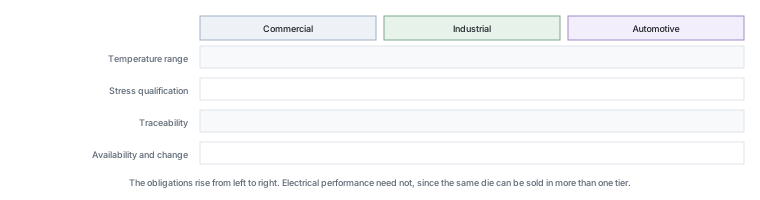
It is also worth noting what the premium does not buy. It does not buy a lower failure rate in every respect, because a consumer part in a benign environment may fail less often than an automotive part in a harsh one. What it buys is a demonstrated capability for the environment the part is actually used in, and the documentation to prove it. Judged against the environment it was qualified for, an automotive part is not over-engineered; it is specified.
Summary
The premium is payment for evidence, availability and accountability rather than for silicon. Qualification consumes samples and months, traceability requires records that last as long as the vehicle, availability commitments constrain a manufacturer’s freedom, and liability prices the consequences of failure. Remove any of those and the component becomes cheaper and less usable in a vehicle programme.
Background written for beginners covers automotive electronics, and the qualification framework for discrete devices is described by the Automotive Electronics Council. Component test methods come from JEDEC, assembly expectations from IPC, quality management requirements from ISO, and sector-level context from the Semiconductor Industry Association. Qualification and standards background is published by IEC.
FAQ
Why are auto parts so expensive right now?
Several factors can push prices up at the same time, and their relative weight differs by market and by part. Component cost inflation, energy and logistics costs, currency movements, and the cost of holding inventory all feed into the price. For electronic parts specifically, the qualification and traceability obligations described above are a permanent component of the price rather than a temporary one, so part of what looks like a recent increase is simply the cost of the evidence. For a specific part in a specific market, the current price is a question for suppliers rather than something this article can state.
What is the 30-60-90 rule for cars?
We are not going to guess at this one, because the phrase is used for several unrelated things: it appears in used-vehicle inspection advice, in financing discussions and in maintenance scheduling, and they mean different things. None of them is a standard term in component qualification, so if the question is being asked in a component context, the relevant framework is the qualification programme and its test durations rather than a rule with that name. If you have a specific usage in mind, it is worth checking the source that used the phrase.
Are certain retailers overpriced for car parts?
We do not comment on any named business’s pricing, because it depends on their costs, their service model and the alternatives available in your market, and because we have no verified data about them. What can be said generally is that a retailer’s price includes availability, warranty handling and returns, so comparing it against a bare component price is not comparing like with like. The comparison that matters for a repair is between the total cost of the outcome, not the unit price of the part.
Why are genuine car parts so expensive?
Three reasons that have little to do with the cost of the material. The part is often a manufacturer-specific variant produced in smaller volumes than a universal equivalent, so it carries higher tooling and logistics costs per unit. It usually comes with a warranty and a fitment guarantee that a generic part does not. And it is often delivered through a distribution chain that includes storage, cataloguing and returns handling. Whether those are worth paying for depends on the vehicle, the function and how long you intend to keep it.
Can I use a cheaper equivalent for a repair?
For non-safety functions, sometimes, provided the electrical ratings are adequate and you accept that the part has not been demonstrated against the vehicle environment. For anything related to safety systems, steering, braking or the high-voltage system, the answer is no: the demonstrated capability is a requirement rather than a preference, and the consequences of getting it wrong are out of proportion to the saving.
What to do next
When comparing two sources for the same function, compare what comes with the part rather than only the price: the qualification evidence, the traceability, the availability commitment and the warranty. That comparison usually explains the price difference, and it also shows you what you would be giving up. The qualification framework itself is covered in our article on what automotive grade means.
Ask Good-Ark which qualification documentation applies to a part number and what traceability accompanies a shipment, so the comparison is between two documented offers rather than two prices.
Email sales@goodark.com, or start from the automotive portfolio page.
This article is published by Good-Ark, a manufacturer of automotive-qualified discrete devices. It describes cost structure rather than quoting prices, does not comment on any named business, and does not provide guidance on safety-critical vehicle repairs.
Recommended
 Why Do Diodes Get Hot? Conduction and Switching Losses ExplainedInfoStandard, Fast Recovery, and Schottky Diodes: What’s the Difference?Info
 What Is a Fast Recovery Diode? Understanding “Fast Recovery”Info
 What Is a Diode? A Beginner’s Guide to How It WorksInfo
 Automotive Semiconductor Report 2026: Chips Per Car Keep RisingKnowledge