Good-Ark — discrete power semiconductors: rectifiers, Schottky, TVS, MOSFETs, SiC and IGBT
Request a Quote

How to Find a Replacement for a Discontinued Diode
How to Find a Replacement for a Discontinued Diode

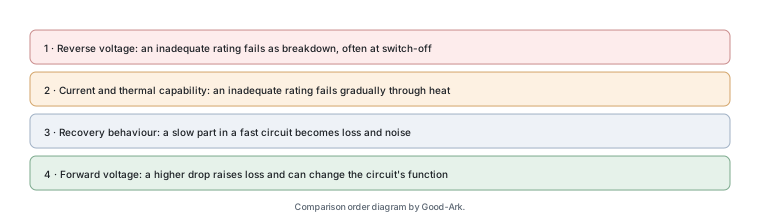
Replacing a discontinued diode is a specification exercise rather than a search exercise, and the difference matters because the obvious approach — finding something with a similar number — produces false confidence. The method below takes about twenty minutes per part and produces a substitution you can defend. When replacement is the right move Replacement … Read more
What Does “Automotive Grade” Actually Mean? AEC-Q101 Without the Jargon

What Does “Automotive Grade” Actually Mean? AEC-Q101 Without the Jargon

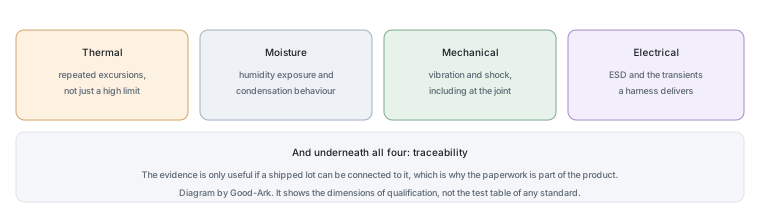
“Automotive grade” is one of the most misused phrases in component buying. It does not mean better quality in general, it does not mean the part is more accurate, and it does not describe a single test. It describes a qualification programme: a set of stress tests, and a traceability chain that connects a shipped … Read more

What Is the GSD Series Used For? A Plain-Language Guide for Buyers and Beginners

What Is the GSD Series Used For? A Plain-Language Guide for Buyers and Beginners

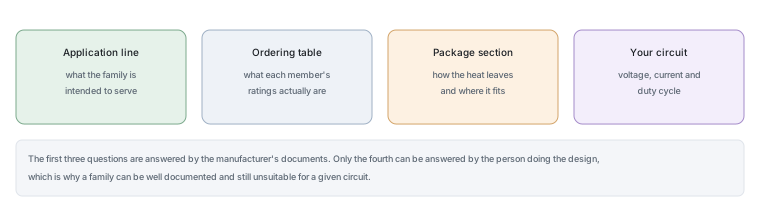
The useful question about any component family is not what its name means but what the parts in it are specified to do. That answer lives in two documents — the family’s product page for its intended application, and its datasheet for the member ratings — and both are more reliable than any summary written … Read more

Bridge Module or Four Discrete Diodes: A Sourcing and Assembly Decision

Bridge Module or Four Discrete Diodes: A Sourcing and Assembly Decision

Your SMT line costs the same whether it places one component or four, but the board underneath does not: a bridge module concentrates heat in one footprint, while four discrete diodes spread it across the layout, and the qualification trail follows the same split. Engineers who choose by electrical equivalence alone discover the difference at … Read more

Good-Ark Automotive Parts in Plain Language: What Actually Goes Into a Car

Good-Ark Automotive Parts in Plain Language: What Actually Goes Into a Car

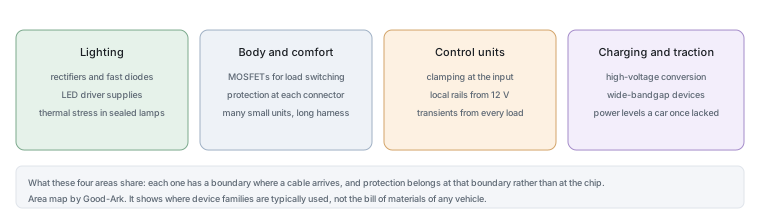
A car is not one electronic product; it is dozens of small ones sharing a wiring harness and an electrical environment that is unusually hostile. Understanding that environment explains why a diode that costs a few cents in a phone costs considerably more in a vehicle, and why the qualification paperwork matters as much as … Read more

Low RDS(on) Explained: Why It Decides Your Battery Life

Low RDS(on) Explained: Why It Decides Your Battery Life

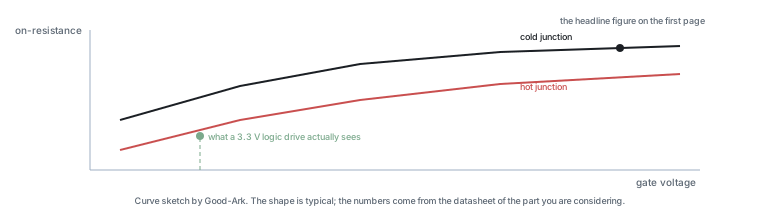
On-resistance is the toll a MOSFET charges on every amp that passes through it, and in a battery-powered product that toll is paid out of the battery. The size of the toll depends on two conditions the datasheet states and that beginners routinely ignore: the gate voltage and the junction temperature. Battery life is a … Read more

MOSFET vs BJT vs IGBT: Three Transistors, Three Very Different Jobs

MOSFET vs BJT vs IGBT: Three Transistors, Three Very Different Jobs

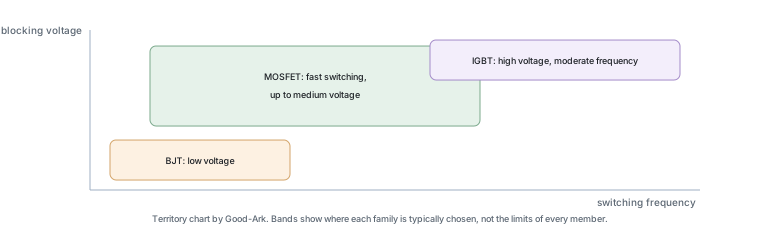
Three transistor families exist because one design could not do every job well. The bipolar junction transistor switches cleanly and cheaply at low voltage, the MOSFET switches quickly with almost no drive power, and the IGBT combines a field-effect input with a bipolar output to handle very high power at moderate speed. Knowing which is … Read more

Choosing a MOSFET for Your First Project: A Beginner Checklist

Choosing a MOSFET for Your First Project: A Beginner Checklist

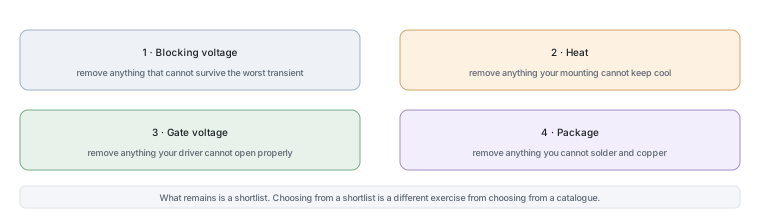
Four questions answer most first-project selections, and three of them are about the circuit rather than the part. Answer those before opening a catalogue and the choice usually narrows to a handful of candidates that are all capable of doing the job. Four questions before you open a catalogue What voltage must the device block, … Read more

Why Do MOSFETs Get Hot? On-Resistance Explained Without the Maths

Why Do MOSFETs Get Hot? On-Resistance Explained Without the Maths

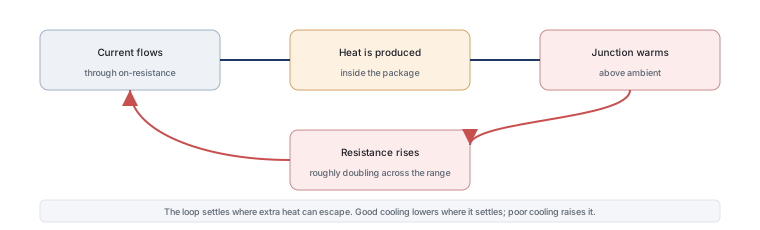
A MOSFET does not get hot because it is faulty. It gets hot because it is a resistance while it conducts and a lossy transition while it switches, and both of those produce heat in proportion to the current you push through it. The interesting part is that the heating tends to accelerate itself. A … Read more

N-Channel and P-Channel MOSFET Wiring: A Beginner Practice Circuit

N-Channel and P-Channel MOSFET Wiring: A Beginner Practice Circuit

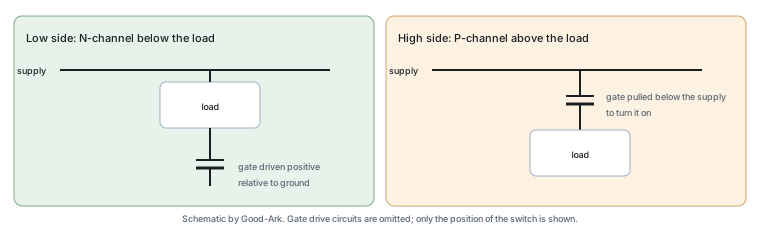
For a beginner wiring exercise, identify the source reference and the load connection before choosing an N-channel or P-channel MOSFET. The gate must be driven relative to its own source. Performance, voltage, loss, and driver requirements still matter when selecting the actual part. Last updated: October 16, 2026 Two polarities in one picture An n-channel … Read more

GSD Series, GSMDJ Series and Their Cousins: A Beginner’s Map of Good-Ark MOSFET Families

GSD Series, GSMDJ Series and Their Cousins: A Beginner’s Map of Good-Ark MOSFET Families

A series name is a shelf label. It tells you which family of parts shares a process, a package range or a target market, and it exists so that engineers can find a shortlist quickly. What it does not tell you is what any individual part does, and that distinction is where beginners lose the … Read more

MOSFET vs Relay: Which Switch Should Your Project Use?

MOSFET vs Relay: Which Switch Should Your Project Use?

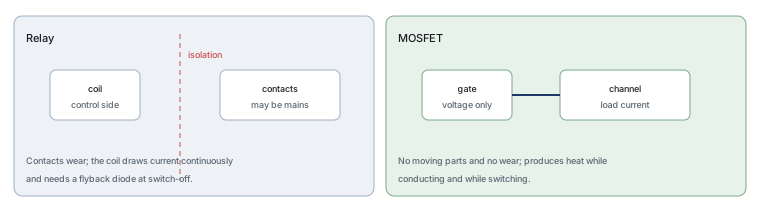
The choice between a relay and a MOSFET usually comes down to one question that has nothing to do with performance: does the load need to be electrically isolated from your control circuit? Where it does, the relay wins outright. Where it does not, the MOSFET usually wins on everything else. Two ways to switch … Read more

Need a part number checked against your design?

Send the topology, current and voltage class. Good-Ark sales and application engineering will confirm the closest device, package and qualification status.

Copyright Suzhou Good-Ark Electronics Co., Ltd. All Rights Reserved