Automotive Power Electronics Hub
Use the Automotive Power Electronics Hub to choose devices, check ratings, solve failures, verify alternatives, and reach the right Good-Ark technical support path.
45 guides
Follow the guides for the part of the vehicle you are working on: the supply rail, control input, lighting circuit or electric drive. Start with the event or load, then read the component, qualification and thermal checks that apply to it.
Protect the vehicle supply and control inputs
These guides cover the supply conditions and protection decisions at the entry to vehicle electronics.
ASMBJ28CA: 600 W Automotive TVS in SMB for Lighting Drivers
The ASMBJ28CA is a 28 V, 600 W transient voltage suppressor in an SMB (DO-214AA) package from Good-Ark, positioned on the site for automotive lighting-driver applications. The site publishes the class and the…
Automotive ECU Power Design: From 12 V Transients to Low-Voltage Rails
An ECU power tree runs from the battery’s 12 V through protection, buck converters, and down to 3.3 V logic rails, and every stage has a rectifier or protection diode with a different job. This guide walks the…
Automotive Grade Rectifiers: Applications, Ratings and Validation
A diode that survives on a bench can still run too hot inside a sealed vehicle controller. Choosing an automotive grade rectifier means matching its electrical characteristics, package and qualification to a…
Automotive MOSFET Design-In: AEC-Q101, Load Dump, SOA, and Mission Profiles
Key Takeaways AEC-Q101 is the entry ticket, not the whole story: the mission profile (temperature cycles, load dump, SOA) decides whether the MOSFET survives a decade in a vehicle. Load-dump and transient…
Automotive Schottky Rectifier: Selection, Losses and Protection
An automotive Schottky rectifier is a Schottky diode selected for a defined role in vehicle electronics and supported by the required device qualification. It can reduce forward-conduction loss in converter,…
AWSS10H100: A 10 A, 100 V Schottky for ECU and Lighting Power
The AWSS10H100 is a 10 A, 100 V Schottky barrier rectifier in an eSGC (TO-277) package from Good-Ark, positioned on the Good-Ark site for automotive lighting and ECU power. It is the top of the AWSS current…
AWSS5H60: A 5 A, 60 V Schottky for Automotive Lighting and ECU Power
The AWSS5H60 is a 5 A, 60 V Schottky barrier rectifier in an eSGC (TO-277) package from Good-Ark, positioned on the Good-Ark site for automotive lighting and ECU power. The site publishes the ratings, the…
Choosing a TVS for 24 V Inputs: Industrial and Automotive Rail Protection
The 24 V rail in an industrial cabinet and the 24 V rail in a truck look alike on a label and behave very differently under transients. The industrial rail carries switching spikes from contactors and motor…
Co-Designing Rectifier and TVS for 12 V ECU Input Protection
The 12 V ECU input protection is a three-layer chain: the TVS clamps the transient, the rectifier blocks the wrong polarity and the residual, and the filter absorbs what passes. This guide covers the threat…
Cranking Voltage Dips and Starter Loads: How the 12 V Rail Diodes Stay Alive
Cranking is the two-second blackout of the 12 V rail. The starter motor pulls hundreds of amps, the battery voltage collapses toward 6-8 V, and every module on the rail — the ECU, the lighting, the pump —…
ECU Input Protection: From ISO 7637 Pulses to the Last Diode Before the MCU
An ECU input is a guard chain, not a single component. From the connector, the voltage travels through a TVS, a series diode, a filter, and finally lands on the pin of the MCU — and each guard stops a…
How do TVS diodes solve automotive load dump issues?
Load dump delivers hundreds of joules over tens of milliseconds. What ISO 16750-2 test A actually specifies, and why a 600 W TVS is not the answer.
Load Dump De-Mystified: The 87 V Spike, Why It Happens, and How Components Survive
Every automotive engineer has heard of load dump, and most have heard only one number: 87 V. Fewer can explain why the rail spikes that high, why the spike has an energy and not just a voltage, and what…
Load Dump Explained: The 87 V Spike Your Car Electronics Must Survive
Load dump is the reason automotive electronics are specified and tested differently from consumer electronics. It is not a fault and it is not rare in the sense of being impossible: it is a normal consequence…
Reverse Polarity Protection in Vehicles: Diodes, Ideal Diodes, and the Fuse-Blow Trap
A reversed battery connection is one of the most common and most destructive mistakes in vehicle electrical work, and the irony of the standard protection is that it can make the failure worse. Connect a…
The 12 V Automotive Rail: Transients It Sees, Components That Survive Them
The 12 V automotive rail is the one power bus nearly every electronic module on a car shares, and it is also the least “regulated” rail an engineer will ever design against. Over a single day of driving, the…
TVS Placement and Layout for Automotive Lighting Lines
The TVS’s placement decides whether the datasheet’s clamp is the circuit’s clamp: close to the connector, short to ground, and a small loop are the rules, and the parasitic inductance is the enemy. This guide…
Design lighting, motors and electric drives
Follow the reading for the load you need to drive. Keep the operating duty and device choice in the same review.
AMBRP5100: 5 A, 100 V Schottky in PDFN56 for T-BOX and Lighting Control
The AMBRP5100 is a 5 A, 100 V Schottky barrier rectifier in a PDFN56 package from Good-Ark, with 0.70 V typical forward drop at 5 A, a 120 A surge rating, and 3 °C/W junction-to-case resistance. It targets…
Automotive Lighting Driver Rectifier Design: Efficiency in a Sealed Lamp Module
An automotive lamp module seals its electronics in a small, hot housing, and the rectifier—often the smallest component—carries the efficiency and thermal story. This guide covers the driver architectures, the…
Automotive Lighting Electronics: From Halogen to Matrix LED Power Needs
Automotive lighting moved from halogen to LED and now to matrix and adaptive systems, and the Good-Ark device families are part of the power-stage roadmap, and each step changed the power stage: more current,…
Automotive Lighting: Elevating Vehicle Efficiency With Good-Ark
Automotive lighting parts are qualified, not just specified. What AEC-Q101 evidence to request, and how a lamp module’s heat budget decides the device.
AWSS10H60: 10 A, 60 V Schottky for High-Current Automotive Lighting
The AWSS10H60 is a 10 A, 60 V Schottky barrier rectifier in an eSGC (TO-277) package from Good-Ark, positioned for high-current automotive lighting. It is the 60 V cell of the 10 A AWSS row, and its full…
AWSS5H100: 5 A, 100 V Schottky for Automotive Lighting Modules
The AWSS5H100 is a 5 A, 100 V Schottky barrier rectifier in an eSGC (TO-277) package from Good-Ark, positioned on the site for automotive lighting modules. It is the 100 V cell of the 5 A AWSS row, and its…
Electric Power Steering Rectifier Design: Surviving the Steering Load Profile
Electric power steering runs a motor whose load swings from a light cruise current to a full stall current in seconds, and the freewheeling diode must survive both. This guide covers the load profile, the…
Electric Power Steering: The Load-Pulse Profile a Diode Must Survive
Electric power steering (EPS) is the rare automotive load that goes from gentle assist to full stall within seconds. One moment the motor is drawing a few amps to help a light turn; the next it is holding a…
LED Lighting Drivers in Cars: Where the Diode Fails First and How to Design Against It
An automotive LED lamp module is a small, sealed electronics box that runs hot, vibrates, and is expected to outlive the warranty with no maintenance access. The diode is usually the first part to give up…
MOSFETs and IGBTs in Electric Drives: Voltage Class, Frequency, and the Traction Trade
An electric vehicle is not one power stage; it is a map of them. A traction inverter, a DC-DC converter, an on-board charger, a set of auxiliary loads — each stage runs at a different voltage, frequency, and…
Solder Joint Reliability for TO-277 in Automotive LED Modules
In an automotive lamp module, the solder joint under the TO-277 exposed pad is the weakest connection: thermal cycling and vibration fatigue it long before the die fails. This guide covers the mechanism, the…
Check automotive parts and qualification evidence
Use the component and qualification guides to connect a proposed part to the conditions in the application.
60 V vs 100 V Schottky for Automotive Loads: Margin Has a Price
The 100 V Schottky class buys more transient margin than the 60 V class, and it charges for it: higher forward drop at a given current and a different leakage picture at the operating point. This guide maps…
AEC-Q101 Explained: What Automotive Grade Really Means
“Automotive grade” is one of the most misused phrases in component buying. It does not mean better quality in general, it does not mean the part is more accurate, and it does not describe a single test. It…
AEC-Q101 in Practice: How to Verify an Automotive Part Beyond the Datasheet
“AEC-Q101 compliant” is one of the most reassuring phrases on a semiconductor datasheet and one of the least examined. The stamped claim promises a part survived a specific set of accelerated stress tests, but…
AMBRB30200CT: 30 A, 200 V Schottky in D2PAK for OBC
The AMBRB30200CT is a 30 A, 200 V common-cathode Schottky dual diode in a D2PAK package from Good-Ark, with 0.84 V typical forward drop per die at 15 A and a 200 A per-die surge rating. It targets the 200…
Automotive Applications: Powering Safer, More Efficient Vehicle Electronics
Automotive electronics selection guide: what AEC-Q101, ISO 26262 and IATF 16949 require, and which device answers each electrical disturbance.
Automotive-Grade vs Commercial-Grade Semiconductors: A Selection Framework
Automotive grade means the part is qualified to the automotive expectation—the AEC-Q101-style stress set and the vehicle temperature range—while commercial grade is qualified to less demanding conditions. The…
Body Control Modules: Power Budgets, Wake-Up Currents, and the Diode Roles in Between
A body control module (BCM) is a list of loads with a power budget attached: lights, locks, wipers, and relays, each with a peak and an idle current, all sharing one rail. The diode plan follows that budget.…
EPS: Efficient Power Rectification for Modern Power Electronics
An EPS power chain loses watts, not percentages. How to model rectification loss on a 12 V or 48 V steering path and pick a device that stays cool.
Good-Ark Automotive Portfolio: Qualified Discretes by Function
An automotive program does not buy a diode; it buys a part with qualification evidence, a mission-profile fit and a traceable supply chain. Good-Ark’s automotive discrete portfolio spans rectifiers, Schottky…
OBC Architecture Trends: Bidirectional, High-Voltage, and Power-Dense
The on-board charger is moving in three directions at once: bidirectional power flow, higher bus voltages, and higher power density. Each trend changes the rectifier story, and this guide traces the three…
OBC Diode Design: PFC and DC-DC, Two Mindsets, One Efficiency Number
The on-board charger (OBC) is a box with two very different power stages inside it, and the efficiency number on the datasheet hides both of them. Up front, the PFC stage wants speed — fast diodes that can…
T-BOX Power Design: Quiescent Current and Wake-Up Bursts in Telematics
A telematics box is always on: its standby power is counted in milliwatts and its wake-up communication bursts in amps, and the rectifier sits in both regimes. This guide covers the quiescent budget, the burst…
The AWSS Family by the Numbers: Matching 5/10 A and 60/100 V Schottkys to Automotive Loads
The AWSS family answers most automotive Schottky selection questions with a single table. Four parts — built from 5 A or 10 A current classes and 60 V or 100 V voltage classes — cover the lighting, ECU, and…
The AWSS Family: Matching 5/10 A and 60/100 V Parts to Your Automotive Load
The AWSS family covers the automotive lighting and ECU domain with four parts in one footprint: 5 A and 10 A, crossed with 60 V and 100 V, all in eSGC (TO-277). This guide maps the lineup, matches the load,…
Thermal Management for a 10 A Automotive Rectifier: A Worked Case
Ten amps continuous in a sealed automotive housing is a thermal case study: the forward-drop loss at temperature, the junction calculation, and the copper-and-housing countermeasures. This guide walks the…
TO-277 vs SMB/SMA: The Power Rating Gap in Automotive SMDs
SMD power packages look interchangeable and are not: the capability band runs from SMA through SMB and SMC to TO-277, and each rung carries a different current and a different thermal contract. This guide…
What Is an Automotive ESD Suppressor?
Device ESD immunity is quoted to IEC 61000-4-2, vehicle testing to ISO 10605, and parts to AEC-Q101. What an automotive ESD suppressor must prove.
Need help with a particular circuit?
Include the circuit position, operating conditions and the part number or marking when you contact Good-Ark technical support.
Recommended
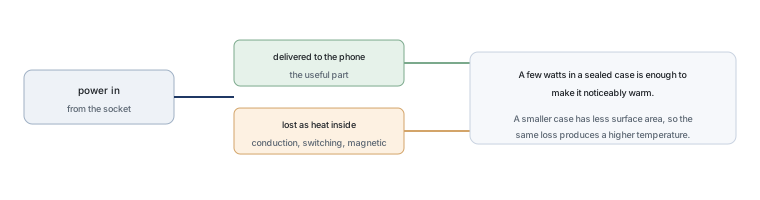 Why Does Your Phone Charger Get Warm?Knowledge
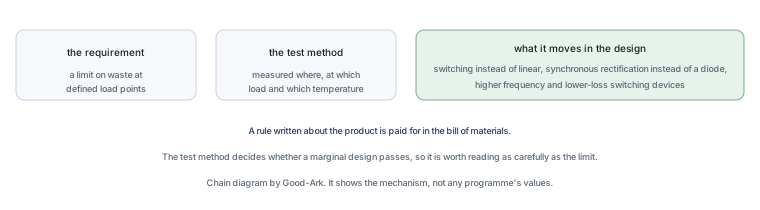 Energy Efficiency Rules Worldwide: How Regulations Shape Component ChoicesKnowledge
 Wide-Bandgap Semiconductors: Adoption Report 2026Knowledge
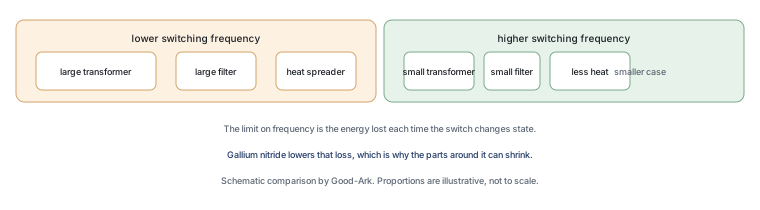 The GaN Charger Market: Why Your Next Adapter Is SmallerKnowledge
 Component Lead Times in 2026: What Is Actually Normal NowKnowledge
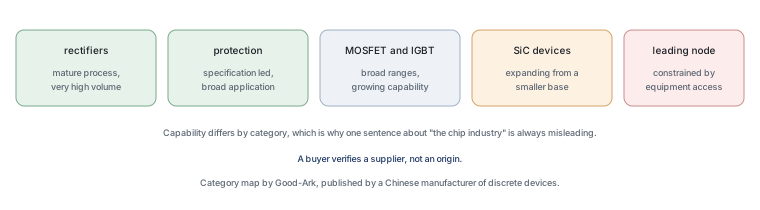 China’s Power Semiconductor Industry: Where It Stands in 2026Knowledge