Inside an Electric Car: Where the Power Electronics Sit
Electric car power electronics: five power blocks turn a battery into motion and back. What each one does, why heat connects them, and which parts fail first.
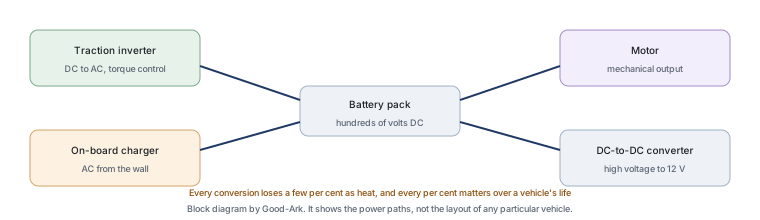
An electric car has three jobs that involve power electronics rather than computing: moving energy from the battery to the motor, moving it from the wall into the battery, and moving a small amount of it from the high-voltage system into the low-voltage one. Those three jobs are performed by five blocks of hardware, and almost everything that limits an electric car — cost, weight, charging speed, range — runs through them.
Last updated:
The five power blocks of an EV
The five blocks are the battery pack, the traction inverter, the electric motor or motors, the on-board charger, and the DC-to-DC converter. Three carry the vehicle’s traction power, one handles charging from an alternating-current supply, and one maintains the low-voltage system that every car needs regardless of how it is propelled.
The analogy that fits is a water system with a reservoir, a turbine, a pump to refill the reservoir, and a small tap for the building’s ordinary needs. Energy is stored, spent, replenished and redistributed, and each stage has losses that appear as heat. In a vehicle those losses matter more than in a building because every kilogram of cooling hardware is a kilogram that reduces range.
Battery pack: storage
The pack stores direct current at a high voltage — nominally in the hundreds of volts in most current designs — and it is never managed alone. A battery management system monitors cell voltages and temperatures, balances the cells and enforces the limits that keep the pack safe, which is why the pack is a system rather than a container.
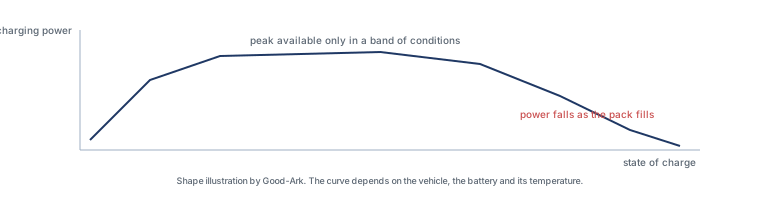
The pack’s constraints propagate through the whole vehicle. Its voltage sets the class of every device connected to it. Its acceptance rate limits how fast it can be charged, which is why a vehicle with a powerful charger can still charge slowly at certain states of charge. And its temperature affects both available power and available range, which is the mechanism behind the reduction in performance that drivers notice in cold weather.
Inverter: battery to motor
The traction inverter converts direct current from the pack into the alternating current the motor needs, and it controls the torque by adjusting the frequency and amplitude of that current. It is the hardest-working block in the vehicle: high current, high voltage, continuous operation and a switching frequency in the kilohertz range.
It is also where wide-bandgap devices earn their place. Because the inverter runs continuously whenever the car moves, a small efficiency difference accumulates over every kilometre. That is why silicon carbide MOSFETs have become common in traction inverters, and why the design of those inverters leans heavily on thermal engineering: the device that converts the most energy is also the device with the most heat to remove.
On-board charger: wall to battery
The on-board charger is what makes alternating-current charging possible. A wall supply delivers alternating current; the battery accepts direct current. The charger performs the conversion and, in the process, also performs power-factor correction — shaping the current it draws so that it is compatible with the supply.
Its power rating sets the practical limit for home and destination charging, which is why an alternating-current charge takes hours rather than minutes. It is also one of the blocks where the trade between size, weight and power is most visible: a more efficient charger can deliver more power in the same box, which is where wide-bandgap devices help.
DC-to-DC converter: high voltage to 12 V
The fourth block replaces the alternator of a conventional vehicle. It takes power from the high-voltage pack and produces the low-voltage rail that lights, controls, sensors and comfort systems use. It runs whenever the car is in use, and it is often the quietest of the four blocks in terms of engineering attention, despite being essential.
Its design challenge is the ratio involved. Stepping several hundred volts down to around twelve is a large conversion, and the converter must do it efficiently across a wide range of loads, from a few watts when the car is idle to hundreds when everything is on.
Where heat goes
Every block produces heat, and each has a different path for removing it. The inverter and motor are usually liquid-cooled because their losses are concentrated and continuous. The on-board charger is often liquid-cooled as well, since it operates at high power and sits in a sealed enclosure. The DC-to-DC converter can sometimes be air-cooled. And the battery has its own thermal management, which is as much about keeping cells in their comfortable range as about removing heat.
The reason heat dominates the engineering is that it is a compounding problem. Higher temperature reduces efficiency, which produces more heat. It also accelerates the ageing of every joint, connection and insulation material in the assembly. Over a vehicle’s life, a design that runs ten degrees cooler may last materially longer than one that does not, which is why thermal design is treated as a primary requirement rather than as a packaging detail.
Which parts fail and why
The parts that fail first are usually the ones that combine high stress with difficult conditions. Semiconductor devices in the inverter fail when they are driven beyond their ratings or when their cooling path degrades. Capacitors fail through a combination of heat and age, and are a common cause of end-of-life failure in power electronics generally. Connectors, seals and cooling components fail through thermal cycling and vibration rather than through electrical stress, and their failures often look like electrical faults.
That last point is worth emphasising for anyone diagnosing a fault: in a vehicle, an intermittent electrical symptom is more often a connection, a ground or a cooling problem than a failed semiconductor. The diagnosis starts with evidence rather than with parts.
There is one more consequence of the five-block structure that is worth stating, because it explains a lot of vehicle design decisions. Because each block has its own efficiency, the losses multiply rather than add. A pack-to-wheel efficiency of ninety per cent across two stages is different from ninety per cent at each of three, and the difference appears as heat that has to be removed somewhere in an already crowded underbody. That is why improvements in power electronics are pursued even when each one looks small.
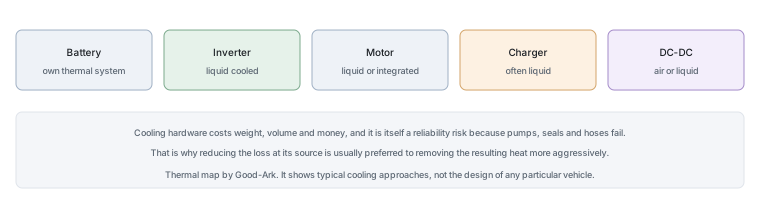
Map summary
| Block | Job | What limits it | Typical cooling |
|---|---|---|---|
| Battery pack | Stores direct current at high voltage | Cell chemistry, temperature and state of charge | Its own thermal management |
| Traction inverter | Converts DC to AC and controls torque | Device ratings and thermal path | Liquid |
| Motor | Converts electrical to mechanical energy | Magnetic and copper losses, rotor temperature | Liquid or integrated |
| On-board charger | Converts wall AC to battery DC | Its power rating and thermal design | Often liquid |
| DC-to-DC converter | Produces the low-voltage rail | Load range and conversion ratio | Air or liquid |
Related reading on our own site covers electric vehicles, power electronics and battery management systems. Charging standards come from the International Electrotechnical Commission, vehicle test expectations from the ISO automotive standards series, vehicle and charging programmes from the US Department of Energy, and sector-level reporting from the Semiconductor Industry Association.
FAQ
What is the biggest problem with electric cars?
That depends on the criteria, so the honest answer is to name the engineering constraints rather than declare a verdict. The cost of the battery and the power electronics dominates the vehicle price. Charging speed is limited by the battery and by the available supply rather than by the car’s electronics alone. Cold weather reduces both available power and range. And the supply chain for the specialised components is concentrated, which makes production sensitive to disruption. Different buyers weight those differently, which is why the question attracts such different answers.
Is an EV battery AC or DC?
Direct current. Every battery stores and delivers direct current, because the electrochemical reaction has a fixed polarity. That is why the vehicle needs an inverter to drive its alternating-current motors, and an on-board charger to accept alternating current from a wall socket. Those two blocks exist precisely because the battery cannot use alternating current.
What are the major components of an electric vehicle’s power system?
The battery pack, the traction inverter, the motor or motors, the on-board charger for alternating-current charging, and the DC-to-DC converter that supplies the low-voltage system. Around them sit the battery management system, the thermal management system and the contactors that isolate the high-voltage system in a fault. Those supporting systems are what turn a collection of blocks into a vehicle.
What power supply do I need for an electric car?
For charging at home, the requirement is a dedicated circuit rated for continuous current, installed by a qualified electrician, with a supply that matches the vehicle’s on-board charger capability. Installing a higher-rated supply than the charger can use does not charge the car faster, which is a common misunderstanding. The two numbers to establish first are the charger’s rating and the capacity of your installation.
Do electric cars have a 12 volt battery?
Yes, most do, and the DC-to-DC converter maintains it from the high-voltage pack rather than an alternator. The low-voltage system still powers lighting, controls, sensors and the computers, and it is also what wakes the vehicle up. That is why a failing low-voltage battery can produce symptoms that look like a high-voltage fault.
For external background on the standards behind charging, three references are useful. Connector and charging system definitions come from the International Electrotechnical Commission, vehicle-level test expectations from the ISO automotive standards series, and charging and grid programmes from the US Department of Energy. The general technology is described under charging stations and battery chargers, and sector-level reporting comes from the Semiconductor Industry Association. Qualification and standards background is published by the Automotive Electronics Council and JEDEC.
What to do next
If you are designing any of these blocks, the useful first step is to establish the voltage class, the current and the thermal path, because those three determine everything else. If you are trying to understand a vehicle you own, the useful mental model is the five blocks and their losses: most of what limits an electric car’s performance comes from one of them rather than from the battery alone. The charging path is covered in more detail in our article on how an electric car charges.
Tell Good-Ark the bus voltage, the switching frequency and the thermal budget for each block, and we can point to the SiC or silicon families that fit and the documentation that covers them.
Email sales@goodark.com, or start from the SiC portfolio page.
This article is published by Good-Ark, a manufacturer of discrete devices used in power conversion. It describes the general architecture of electric vehicles rather than the design of any specific model, and no vehicle manufacturer or customer relationship is claimed.
Recommended
 Why Do Diodes Get Hot? Conduction and Switching Losses ExplainedInfoStandard, Fast Recovery, and Schottky Diodes: What’s the Difference?Info
 What Is a Fast Recovery Diode? Understanding “Fast Recovery”Info
 What Is a Diode? A Beginner’s Guide to How It WorksInfo
 Automotive Semiconductor Report 2026: Chips Per Car Keep RisingKnowledge