Good-Ark — discrete power semiconductors: rectifiers, Schottky, TVS, MOSFETs, SiC and IGBT
Request a Quote

Automotive Semiconductor Report 2026: Chips Per Car Keep Rising
Automotive Semiconductor Report 2026: Chips Per Car Keep Rising

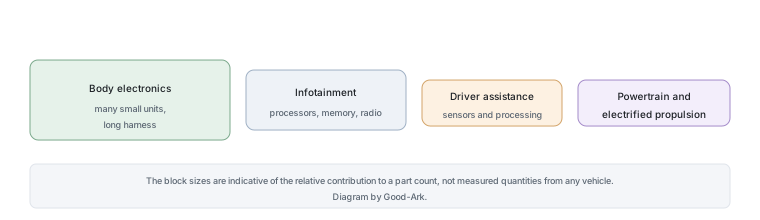
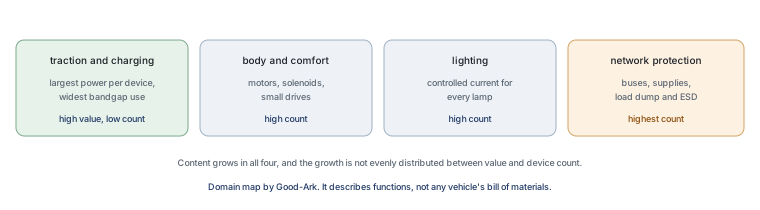
The simplest way to describe what has happened to vehicle electronics is that computing and power conversion have both moved into parts of the car that used to be mechanical. That shift adds semiconductors in two directions at once: control electronics to run systems that were previously cable-operated, and power electronics to drive actuators that … Read more
Electric Vehicles and Power Electronics: An Industry Report for Non-Specialists

Electric Vehicles and Power Electronics: An Industry Report for Non-Specialists

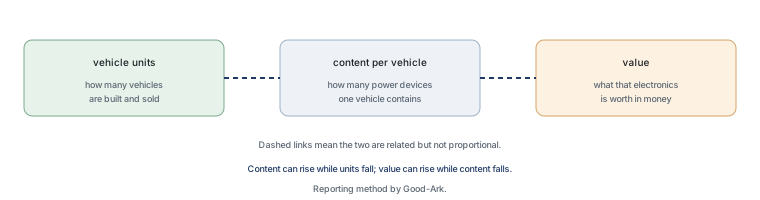
An electric vehicle report becomes misleading the moment three different numbers are put in the same sentence. Vehicle sales are counted in units, semiconductor content is counted in devices or in value per car, and the semiconductor market is counted in money. Each answers a different question, and a change in one does not imply … Read more

How Modern Car Headlights Work: The Electronics Behind LED and Matrix Lighting

How Modern Car Headlights Work: The Electronics Behind LED and Matrix Lighting

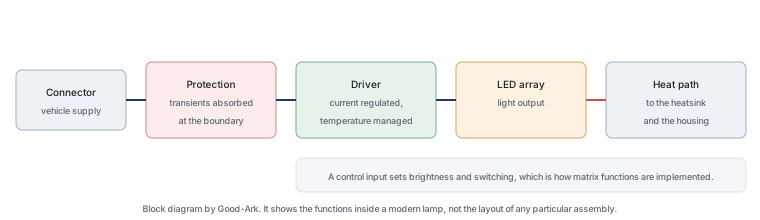
A modern headlight is not a bulb in a reflector. It is a sealed assembly containing light sources, the electronics that drive them, a thermal path to carry heat away, and protection components at the connector. Understanding those four parts explains why the assembly costs what it does and why changing one of them is … Read more

Why Automotive Electronic Parts Cost More: Testing, Traceability and Warranty

Why Automotive Electronic Parts Cost More: Testing, Traceability and Warranty

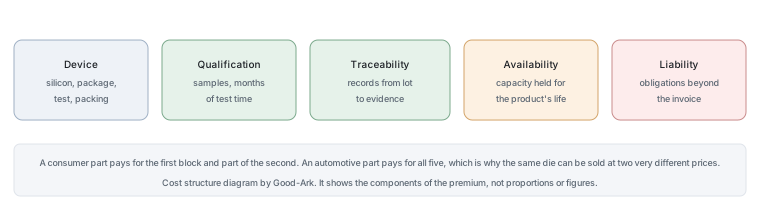
The price of an automotive component is not mostly the cost of making it. It is the cost of demonstrating that it works, of keeping it available, and of standing behind it in a way that a consumer part never has to. Understanding that split explains why the premium exists, and when it does not … Read more

From 12 V to 800 V: A Simple Map of Car Electrical Systems

From 12 V to 800 V: A Simple Map of Car Electrical Systems

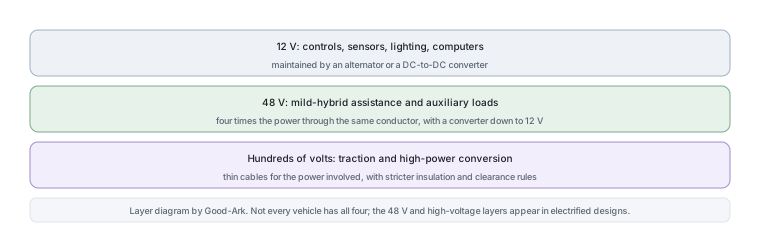
A car does not have “a” voltage. It has at least three, and in an electrified vehicle four, because different jobs are served best by different potentials. Treating them as one system is the source of a great deal of confusion, both for people diagnosing faults and for people designing components. Why a car has … Read more

Inside an Electric Car: Where the Power Electronics Sit

Inside an Electric Car: Where the Power Electronics Sit

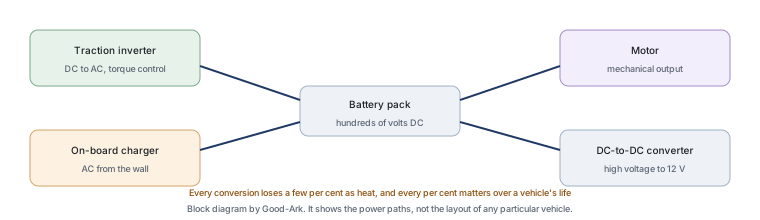
An electric car has three jobs that involve power electronics rather than computing: moving energy from the battery to the motor, moving it from the wall into the battery, and moving a small amount of it from the high-voltage system into the low-voltage one. Those three jobs are performed by five blocks of hardware, and … Read more

How Many Chips Are in a Car? The Quiet Explosion of Automotive Electronics

How Many Chips Are in a Car? The Quiet Explosion of Automotive Electronics

Ask how many chips are in a car and you will find published answers ranging from a few hundred to well over a thousand. The range is not a mistake; it reflects three different definitions, and understanding them is more useful than choosing one number. A short answer with real uncertainty The honest short answer … Read more

What Does “Automotive Grade” Actually Mean? AEC-Q101 Without the Jargon

What Does “Automotive Grade” Actually Mean? AEC-Q101 Without the Jargon

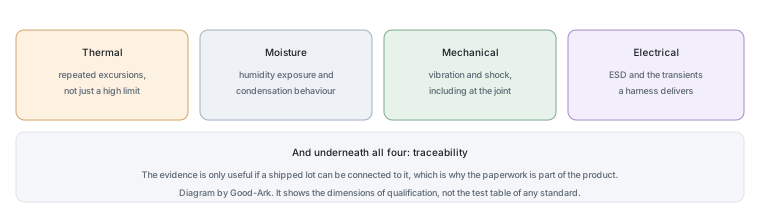
“Automotive grade” is one of the most misused phrases in component buying. It does not mean better quality in general, it does not mean the part is more accurate, and it does not describe a single test. It describes a qualification programme: a set of stress tests, and a traceability chain that connects a shipped … Read more

Good-Ark Automotive Parts in Plain Language: What Actually Goes Into a Car

Good-Ark Automotive Parts in Plain Language: What Actually Goes Into a Car

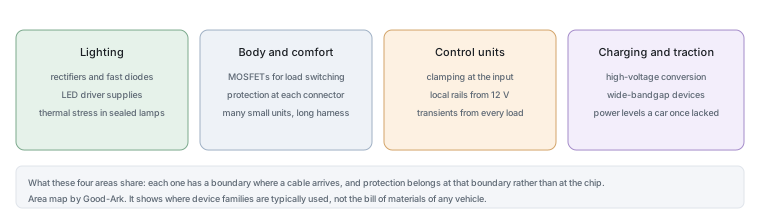
A car is not one electronic product; it is dozens of small ones sharing a wiring harness and an electrical environment that is unusually hostile. Understanding that environment explains why a diode that costs a few cents in a phone costs considerably more in a vehicle, and why the qualification paperwork matters as much as … Read more

Load Dump Explained: The 87 V Spike Your Car Electronics Must Survive

Load Dump Explained: The 87 V Spike Your Car Electronics Must Survive

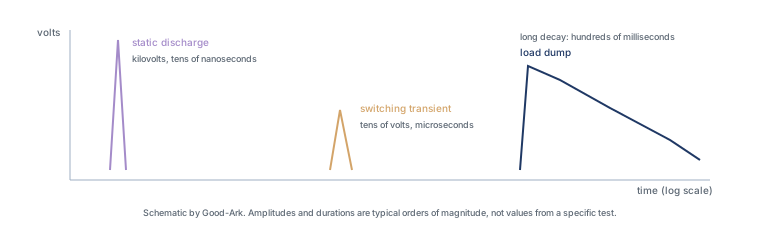
Load dump is the reason automotive electronics are specified and tested differently from consumer electronics. It is not a fault and it is not rare in the sense of being impossible: it is a normal consequence of how a charging system behaves when a heavy load is suddenly removed, and its duration is what makes … Read more

Need a part number checked against your design?

Send the topology, current and voltage class. Good-Ark sales and application engineering will confirm the closest device, package and qualification status.

Copyright Suzhou Good-Ark Electronics Co., Ltd. All Rights Reserved