How Many Chips Are in a Car? The Quiet Explosion of Automotive Electronics
How many chips are in a car? Published counts range from a few hundred to well over a thousand, and why they disagree is more useful than one figure.
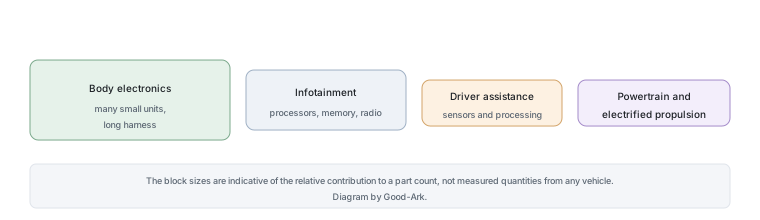
Ask how many chips are in a car and you will find published answers ranging from a few hundred to well over a thousand. The range is not a mistake; it reflects three different definitions, and understanding them is more useful than choosing one number.
A short answer with real uncertainty
The honest short answer is that it depends on what you count and which car. If the count includes only packaged integrated circuits, the figure is in the hundreds for a modern vehicle. If it includes discrete devices — diodes, transistors, MOSFETs — the figure is in the thousands, because power conversion and protection use large numbers of individual parts.
The second source of variation is the vehicle. A small car with basic equipment carries far fewer electronic systems than a large one with driver assistance, a large infotainment system and electrified propulsion. Quoting a single number for “a car” therefore averages across a range that spans several multiples, which is why the industry prefers to describe semiconductor content by value rather than by count.
The systems that consume chips
The count is dominated by a handful of systems rather than spread evenly. Powertrain control uses a few powerful devices. Body electronics uses many small ones, because every window, seat, mirror, light and lock has a control function somewhere. Infotainment and connectivity use memory, processors and radio devices in quantity. Driver assistance adds sensors and the processing to interpret them. And electrified propulsion adds power electronics that a conventional vehicle does not have at all.
The analogy that fits is a building’s electrical installation. The main board has a handful of large circuits, but the number of sockets, switches and sensors around the building is what makes the parts count large. In a car, the equivalent of sockets and switches is body electronics, and it is where most of the small parts live.
Why the count keeps rising
Four forces push the number up. Emissions rules require precise control of combustion, which needs sensors and computation. Safety expectations add sensing and the processing to act on it. Convenience features add a control function to every mechanism that used to be mechanical. And electrification replaces mechanical systems with electrical ones, adding power electronics that have no equivalent in a conventional vehicle.
Against those, integration pulls in the other direction: a function that once needed several chips may now fit into one microcontroller, and consolidating control units reduces the number of boxes even when the total function count rises. That is why counts published a decade apart cannot be compared directly, and why “more chips” is a weaker statement than it sounds.
Electric cars versus combustion cars
An electric vehicle removes some components and adds others. It has no engine management system for combustion, no ignition system and a simpler transmission, so those functions disappear. It adds a traction inverter, an on-board charger, a high-voltage distribution system and a battery management system, each with its own electronics and each handling far more power than the equivalent conventional parts.
The net effect on part count is not obvious, and published comparisons disagree depending on what is counted. The effect on semiconductor value is clearer: electric vehicles use substantially more power semiconductor content, because they convert large amounts of electrical energy rather than controlling a small number of actuators. That is the statistic the industry watches, and it is one reason the power device category has grown with electrification.
| Function | Conventional vehicle | Electrified vehicle |
|---|---|---|
| Energy source | Fuel with combustion control electronics | Traction battery with management electronics |
| Main conversion | Not required | Inverter and charger converting high power |
| Auxiliary supply | Alternator and regulator | DC-to-DC converter from the high-voltage pack |
| Part count effect | Reference | Ambiguous; depends on what is counted |
| Power semiconductor content | Modest, mostly low voltage | Substantially higher, with high-voltage devices |
What this means for supply chains
A vehicle’s production depends on thousands of component types arriving on time, and most of them are not the expensive processors that attract attention. A shortage of an inexpensive part can stop a production line as effectively as a shortage of an expensive one, which is precisely what happened in 2020 and 2021.
That episode is worth describing accurately rather than as a permanent condition. Vehicle manufacturers reduced orders during the early part of the pandemic, and when demand recovered, capacity had been reallocated to consumer electronics. The resulting shortage affected vehicle production for an extended period and changed how the industry thinks about supply. Whether any particular part is constrained today varies by family and by month, so the useful habit is to check current lead times rather than to rely on the memory of a shortage.
There is a second reason the discrete side is easy to overlook, and it is structural rather than technical. Integrated circuits are bought by function: a designer chooses a microcontroller or a memory device and specifies it by name. Discretes are often chosen by requirement, so they appear on a bill of materials as a specification — a voltage class, a package, a current — rather than as a part that anybody outside the project recognises. That is why demand for the category is real and visible in the market but invisible in most descriptions of vehicle electronics.
A third reference point is worth adding for the supply side: the Automotive Electronics Council publishes the qualification framework that discrete devices for vehicles are commonly tested against, which is the document a buyer should ask for a summary of when assessing a candidate part. The management systems that most factory audits refer to are described by ISO, and the electrical safety and testing standards that apply at the vehicle and equipment level come from the International Electrotechnical Commission.
Where discrete parts fit
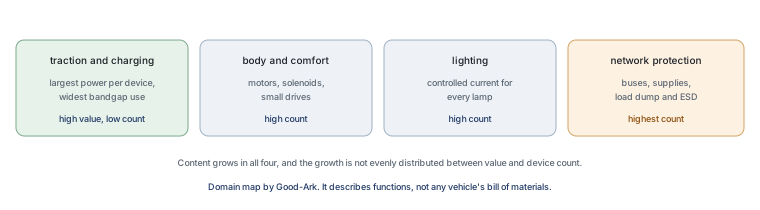
Discrete devices do not appear in the headline counts, and they are a large share of the actual part numbers. Every control unit has protection at its inputs, rectification to produce local rails and switching devices to drive its loads, and each of those functions uses individual components rather than integrated ones.
The company publishes an automotive product line covering rectifiers, Schottky rectifiers, MOSFETs, protection devices and small-signal parts, grouped by vehicle function on its automotive portfolio page. That grouping reflects the same point: the reason a car needs many small parts is that it has many small electrical functions.
How to read the numbers you find online
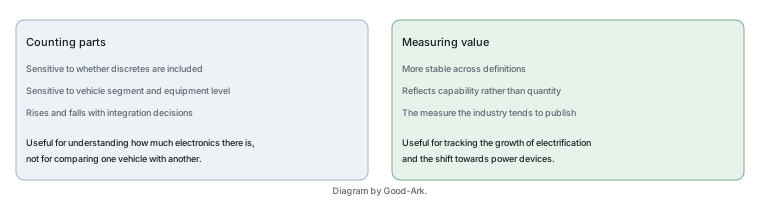
Three checks make a published figure interpretable. Does the definition include discrete devices, or only integrated circuits? Which vehicle does the figure describe, since a compact car and a fully equipped electric vehicle are not comparable? And on what date was it published, because integration decisions move the count over time.
A fourth check is worth applying to your own reasoning: decide whether the question you care about is answered by a count at all. If you are trying to understand supply risk, the number of part types matters more than the total quantity. If you are trying to understand growth in the semiconductor industry, value is the better measure. Counts and values answer different questions.
Takeaways
There is no single correct number, because the answer depends on the definition and the vehicle. The count is driven by many small functions rather than a few large ones. Electrification changes the mix more clearly than the total. And the episode that made the industry think about this was a supply disruption rather than a technical one, which is why the useful habit is to check current lead times rather than to rely on a remembered narrative.
The related reading on this site covers automotive electronics. Sector-level reporting is published by the Semiconductor Industry Association, device test methods come from JEDEC, and automotive qualification is described by the Automotive Electronics Council. Qualification and standards background is published by NIST.
FAQ
How many semiconductor chips are in a car?
It depends on what is counted. Counting only packaged integrated circuits gives a figure in the hundreds for a modern vehicle; including discrete devices takes it into the thousands. Vehicle segment and equipment level change the answer by a large multiple as well, which is why the industry tends to report semiconductor content by value rather than by count, and why we do not quote a single number here.
Is there a microchip shortage for cars?
There was a severe and well-documented shortage beginning in 2020 and lasting into 2022, caused by a combination of reduced orders early in the pandemic, capacity reallocated to consumer electronics, and a recovery in vehicle demand. Whether a particular part is constrained today varies by family and by month, so the honest guidance is to check current lead times with suppliers rather than to assume that the conditions of 2021 still apply.
What year were chips put in cars?
Electronics entered vehicles gradually from the 1960s onwards, with the significant shift coming in the 1970s when emissions rules required precise control of fuel metering and ignition timing. That is when the engine control unit became standard rather than optional. Since then the number of control functions has grown continuously, from engine management to body electronics to driver assistance.
What are chips used for in cars?
Four broad jobs: sensing conditions, computing what to do about them, controlling actuators, and converting or protecting electrical power. The first three are handled by integrated circuits, and the fourth by the discrete devices that this site manufactures. The fourth category is often overlooked in descriptions of automotive electronics, yet it accounts for a large share of the individual parts in a vehicle.
Do electric cars use more chips than petrol cars?
They use more power semiconductor content, and fewer of some engine-related components. Whether the total part count is higher depends on the definitions used and the vehicles compared, which is why published statements disagree. The effect on semiconductor value is clearer and is a large part of why power devices have grown in importance as vehicles have electrified.
What to do next
Next time you see an automotive chip-count figure, apply the three checks: does it include discretes, which vehicle, and what date. Those three questions turn a memorable number into a useful one, and they reveal why the disagreement in the sources is not a contradiction. The functional view of the discrete side is in our article on Good-Ark automotive parts in plain language.
Tell Good-Ark the rail voltage, the transient profile and the qualification your module requires, and we can point to the families that fit and the documentation that covers them.
Email sales@goodark.com, or start from the automotive portfolio page.
This article is published by Good-Ark, a manufacturer of discrete semiconductor devices. It deliberately does not quote a specific chip count or a current supply position, because both depend on definitions and on conditions that change; the sources for each are linked above.
Recommended
 Why Do Diodes Get Hot? Conduction and Switching Losses ExplainedInfoStandard, Fast Recovery, and Schottky Diodes: What’s the Difference?Info
 What Is a Fast Recovery Diode? Understanding “Fast Recovery”Info
 What Is a Diode? A Beginner’s Guide to How It WorksInfo
 Automotive Semiconductor Report 2026: Chips Per Car Keep RisingKnowledge