How Does an Electric Car Charge? AC, DC and What Happens Inside
How does an electric car charge? Two kinds of cable, two places where conversion happens, three limits in series, and why faster charging is not guaranteed.
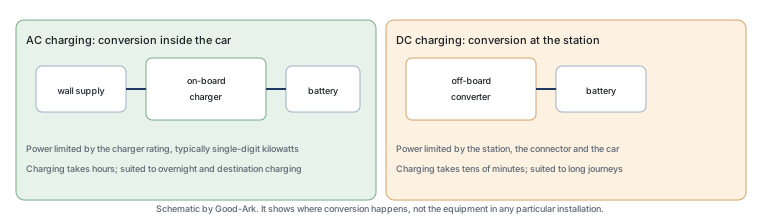
An electric car can be charged in two fundamentally different ways, and the difference is not the shape of the plug. It is where the conversion from alternating to direct current happens: inside the car for one kind of charging, and inside the charging equipment for the other.
Two kinds of charging cable
Alternating-current charging supplies mains power to the vehicle and lets the car’s own on-board charger do the conversion. Direct-current charging performs the conversion in the charging station and delivers direct current straight to the battery. That single difference explains the power ratings, the equipment cost and the physical size of the cables.
The analogy that fits is bringing ingredients versus bringing a finished meal. In the first case you need a kitchen in your house; in the second, the kitchen is at the other end and you simply accept the delivery. The vehicle needs the on-board charger because it cannot assume a DC station will always be available, and the DC station needs to be large and expensive because it contains the conversion equipment permanently instead of once per car.
Who converts the power
In alternating-current charging, the on-board charger performs two jobs. It converts alternating current to direct current, and it performs power-factor correction, which shapes the current it draws so that it is compatible with the supply. It then raises the voltage to whatever the pack requires, which varies with state of charge and temperature.
In direct-current charging, all of that happens in the cabinet beside the parking bay. The vehicle’s role reduces to negotiating a current and voltage profile with the station and enforcing its own battery limits. That is why a DC station is expensive equipment and why its power rating can exceed any on-board charger by a large factor.
Why DC charging is faster
Three factors. The station can be built with a large converter, because it is not carried in the vehicle and does not have to be paid for once per car. The cable carries direct current at a high voltage, so a given current delivers more power than the same current at a lower voltage. And the vehicle’s own conversion stage is bypassed, which removes its losses and its rating limit from the path.
The second factor is the one people underestimate. Charging power is voltage multiplied by current, so raising the pack voltage raises the achievable power through the same connector, without needing a heavier cable or a connector too large to handle. That is the physical reason the industry moved towards higher-voltage platforms, and it is why the charging benefit appears even though the connector is unchanged.
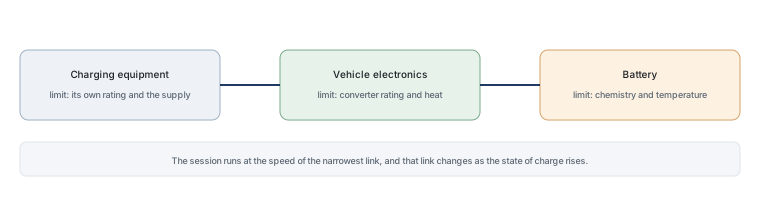
It is worth adding that the three limits are not independent. Raising the pack voltage raises what the connector can deliver, which changes what the station needs to provide and what the battery has to accept. Changing one of the three therefore shifts the bottleneck rather than removing it, and that is why charging improvements arrive in generations rather than all at once.
Heat, cables and current limits
Charging generates heat in three places. The battery warms as current flows through its internal resistance. The cable and connector warm as current passes through them. And the conversion equipment warms in proportion to its losses. Each has a limit, and charging stops being faster when the first of them is reached.
That is why a vehicle’s charging curve falls away as the battery fills. The pack generates more heat at high states of charge, and the charging rate is reduced to keep it inside its thermal limits. The shape of the curve matters more in practice than the peak figure, because the peak may only be available for a short window.
What the car does during charging
The vehicle is not a passive recipient. It negotiates with the charging equipment, using a signalling protocol to agree what the supply can provide and what the vehicle can accept. It monitors cell voltages and temperatures continuously and reduces the current when either reaches a limit. It manages the thermal system, sometimes drawing power to cool or warm the pack before charging begins, which is why a car plugged in on a cold morning may take some minutes to reach full rate.
It also protects itself. Charging stops if a fault is detected, if a cell exceeds its voltage limit, or if the connection is interrupted. Those protections are the reason a charging session is a negotiation rather than a simple connection, and they are implemented partly in the battery management system and partly in the charging equipment.
Battery limits you cannot bypass
No amount of charging power will make a battery accept more than its chemistry and temperature allow. Two limits dominate. The first is the maximum charge rate at a given state of charge, which is high when the pack is partly empty and falls as it fills. The second is temperature: a cold pack charges slowly until it is warmed, and a hot one is slowed to protect it.
The practical consequence for a driver is that the fastest strategy on a long journey is usually to charge to somewhere in the middle of the pack’s range rather than to full, because the last portion is the slowest. The second consequence is that the advertised peak charging power is a best-case figure, achieved only within a band of conditions that includes temperature.
Where semiconductors fit
Two blocks in the charging path are built from power semiconductors. The on-board charger contains a conversion stage and a rectification stage, both of which have efficiency limits. The charging station contains a much larger version of the same functions. In both cases, lower-loss devices allow more power in the same enclosure, which is why wide-bandgap components appear in the newer equipment.
The vehicle’s charging inlet also contains protection, and that protection is a discrete device rather than part of an integrated circuit. It is the least visible part of the charging path and it is the one that decides whether a surge on the supply reaches the electronics behind it.
| Property | AC charging | DC charging |
|---|---|---|
| Where conversion happens | Inside the vehicle | In the charging station |
| Practical power level | Limited by the on-board charger | Limited by the station, the connector and the car |
| Typical use | Home and destination, overnight stays | Long journeys and rapid top-ups |
| Effect of pack voltage | Raises the charger’s achievable output for a given current | Raises the power delivered through the same connector |
| Main thermal limit | Charger and cable | Battery, cable and connector |
| What the driver controls | Which circuit they install | Which station they stop at |
Four external references are useful for the standards and background side. Charging connector and system definitions come from the International Electrotechnical Commission, vehicle-level test expectations from the ISO automotive standards series, and charging and grid programmes from the US Department of Energy. The general technology is described under charging stations and battery chargers, and sector-level context comes from the Semiconductor Industry Association. Qualification and standards background is published by the Automotive Electronics Council and JEDEC.
FAQ for new EV owners
How long does an electric car last on a full charge?
It depends almost entirely on how you drive and in what conditions, not on a single fixed figure. Speed has a large effect because aerodynamic drag rises steeply with it. Cold weather reduces usable range because the battery is less efficient and because energy is spent heating the cabin. Load, terrain and the use of air conditioning all contribute. This is why the range figure quoted for a vehicle comes with a stated test cycle rather than describing your journey.
How much does it cost to charge an electric vehicle?
It depends on where you charge and what you pay for electricity, which differ enormously between countries and between home and public charging. The honest way to estimate your own cost is to take your electricity price per kilowatt-hour, multiply by the vehicle’s consumption, and add any network fees for public charging. Because both inputs vary so widely, a figure quoted without them would be misleading.
What are the practical downsides of driving an electric car?
Five recur most often: long journeys need planning around charging rather than around fuel stations; charging rates fall as the battery fills, so the last part of a session is slow; cold weather reduces both range and charging speed; home charging depends on having a suitable supply and a place to park; and repairs to high-voltage components require trained technicians, which limits where work can be done. Whether those matter to you depends on your driving pattern.
Is charging an electric car free?
Sometimes at publicly subsidised points and sometimes as a perk at a workplace or shop, but there is no general answer, and free charging has declined as electric vehicle numbers have grown. Home charging is never free in the sense of costing nothing, because you pay for the electricity, though it is usually cheaper per unit than public rapid charging.
Why does charging slow down as the battery fills?
Two reasons. A nearly full battery generates more heat at a given charging current, and the vehicle reduces the current to keep it inside its thermal limits. And the electrochemical process itself becomes less willing to accept charge as the cell approaches full. The reduction is deliberate protection rather than a defect, and it is why charging to a high state of charge takes disproportionately long.
What to do next
The useful thing to understand about charging is that it is a negotiation between three sets of limits: the supply, the vehicle and the battery. A driver who knows which one is binding on a given occasion can plan a journey sensibly, and a designer who knows which one is binding can see where the next improvement has to come from. The architecture that performs the conversion is covered in our article on the power electronics inside an electric car.
Tell Good-Ark the input voltage range, the output requirement and the thermal budget, and we can point to the rectifier and switching families that fit the stage you are building.
Email sales@goodark.com, or start from the product family learning centre.
This article is published by Good-Ark, a manufacturer of discrete devices used in power conversion. It describes charging principles rather than any specific vehicle or network, states no prices or ranges because both depend on local conditions, and does not provide instructions for working on high-voltage equipment.
Recommended
 Why Do Diodes Get Hot? Conduction and Switching Losses ExplainedInfoStandard, Fast Recovery, and Schottky Diodes: What’s the Difference?Info
 What Is a Fast Recovery Diode? Understanding “Fast Recovery”Info
 What Is a Diode? A Beginner’s Guide to How It WorksInfo
 Automotive Semiconductor Report 2026: Chips Per Car Keep RisingKnowledge