How Modern Car Headlights Work: The Electronics Behind LED and Matrix Lighting
How do LED car headlights work? A sealed box holding a driver, a heat path and protection parts, which is why a bulb swap is not like-for-like.
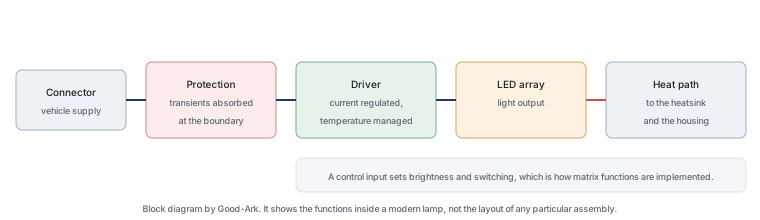
A modern headlight is not a bulb in a reflector. It is a sealed assembly containing light sources, the electronics that drive them, a thermal path to carry heat away, and protection components at the connector. Understanding those four parts explains why the assembly costs what it does and why changing one of them is not a like-for-like substitution.
From filament to LED
A filament lamp is simple: pass current through a wire, the wire glows, and a reflector and lens aim the light. The source is a glowing line, and the optics are designed around that shape. It is inefficient, hot and short-lived, but it is electrically simple and it produces a broad, continuous spectrum that human eyes have evolved to see by.
An LED produces light from a semiconductor junction, which changes three things. It is far more efficient, so less energy becomes heat. Its light is directional, so the optics can be designed differently. And it cannot be connected directly to the vehicle’s supply, because it needs a controlled current rather than a controlled voltage. That last point is what brings electronics into a part that used to be purely mechanical.
Why LEDs need a driver
An LED’s brightness is set by the current through it, and the relationship between voltage and current is steep and temperature-dependent. Apply a fixed voltage and a small change in temperature can produce a large change in current, which produces more heat, which increases current again. That is why an LED is driven by a current-controlled supply rather than by a resistor and the battery voltage.
The driver in a headlight therefore does several jobs at once. It regulates current rather than voltage, so brightness stays constant as the supply moves between roughly the battery’s range. It protects the LEDs from the voltage transients a vehicle produces, which would otherwise destroy them. It often provides dimming and, in some designs, the switching needed for matrix functions. And it manages the temperature response, reducing current if the assembly gets too hot.
What matrix lighting changes
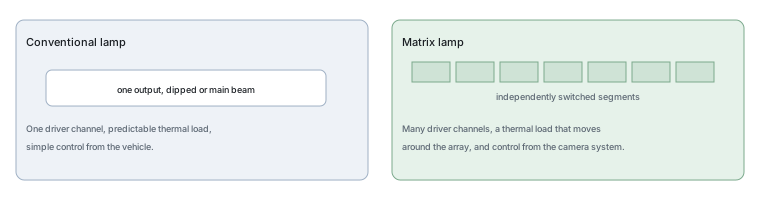
A conventional lamp has one light output and, at most, a mechanism to switch between dipped and main beam. Matrix lighting replaces the single output with an array of individually controlled segments, so the vehicle can illuminate most of the road while leaving specific areas dark. That is how a car can keep its main beam on without dazzling the driver ahead.
The electronics consequence is a large increase in the number of switching elements. Instead of one driver there are many, each switching separately at a rate set by the vehicle’s camera and control system. That multiplies the number of devices in the assembly, increases the switching losses, and makes thermal behaviour harder because the active segments are not always the same ones. It is the clearest example of driving functions moving from mechanical to electronic, and of the component count rising with them.
Heat in a sealed lamp
LEDs are more efficient than filaments but they are not efficient enough to ignore the heat, and they are more sensitive to it. A filament tolerates being hot; a semiconductor junction degrades faster when it is hot, and its light output falls as the temperature rises. In a headlight the heat has nowhere convenient to go, because the assembly is sealed against weather and is often located where airflow is poor.
Designers solve that with a thermal path: a metal core board or a metal bracket that carries heat from the emitter to a heatsink, and sometimes a small fan. The driver’s temperature management reduces current when the assembly is hot, which is why a lamp may dim slightly on a long drive in summer. That reduction is protective rather than a fault, and it is also why a lamp that has been modified or poorly sealed can fail early: the thermal path was designed for a specific amount of heat.
Protection parts behind the light
The connector is a boundary, so the assembly carries protection there. Transients on a vehicle’s 12 volt rail arrive from many sources: load switching elsewhere on the harness, motors, relays and the vehicle’s own charging behaviour. A headlight is an exposed load with a long harness, so the protection at its input is not optional.
Protection also appears inside the driver, where the LEDs themselves need guarding against events that reach past the input stage. Those components are small and unglamorous, and they are the difference between a lamp that survives a vehicle’s electrical environment and one that fails in the first year. Our article on what a TVS diode does explains the principle.
Why headlights fail in wet climates
Moisture is the most common enemy of a headlight assembly, and its failures are indirect. Water ingress degrades the seals and the conformal coatings, which lets corrosion reach the circuit board and the connectors. Condensation forms on cold surfaces and, with contamination present, can create leakage paths. And the thermal cycling that accompanies wet and cold conditions stresses the joints between the board and its components.
That is why a lamp can appear to fail for no electrical reason. The electronics were fine; the assembly’s ability to keep water out of them was not. When a vehicle has repeated lamp failures on one side, the housing and its seals are worth examining before the electronics are replaced.
| Property | Filament lamp | LED and matrix lamp |
|---|---|---|
| Light source | A glowing wire | A semiconductor junction |
| Supply requirement | Voltage, within a wide tolerance | Regulated current, with protection |
| Heat behaviour | Tolerates heat; loses life slowly | Degrades quickly when hot; output falls |
| Control | On or off, and a beam mechanism | Individually switched segments |
| Component count | One bulb and a socket | Driver, emitters, protection, thermal hardware |
| Failure pattern | The filament breaks | Driver, seal or thermal path fails; the emitter is rarely first |
External references are useful when checking the claims around automotive lighting. The technology is described under headlamps and light-emitting diodes, and the component-level thermal reasoning under thermal management in electronics. Vehicle lighting requirements and electrical standards come from the International Electrotechnical Commission and the ISO automotive standards series, board assembly expectations from IPC, and sector-level context from the Semiconductor Industry Association. Qualification and standards background is published by the Automotive Electronics Council and JEDEC.
What drivers notice
Three things. The light is whiter and more sharply defined, because the source is narrow-band rather than a broad spectrum. The lamp reaches full brightness immediately rather than warming up. And the beam can change shape, because matrix functions are adjusting which areas are lit while the car is moving. Some drivers find the sharper cutoff and the whiter colour less comfortable than the older smooth output, which is a perceptual matter rather than a performance one.
The fourth thing drivers notice is cost, when a lamp fails. Because the emitter, driver and thermal path are integrated into a sealed assembly, replacing one component is usually not the repair; the assembly is. That is the practical consequence of integrating electronics into a part that used to contain a consumable item.
FAQ
What is the downside of LED headlights?
Four practical ones. The assembly costs more to replace, because the electronics and thermal hardware are integrated rather than being a consumable bulb. The whiter, more sharply cut beam is less comfortable for some drivers. Performance falls if the thermal path degrades, since the driver reduces current when the assembly runs hot. And repairs are usually assembly-level rather than component-level. The efficiency, lifetime and controllability that made them standard are real advantages; the downsides are about cost of ownership rather than performance.
Can I replace regular headlights with LEDs?
A lamp housing is designed around a specific light source, and changing the source changes the beam pattern that the optics were designed to produce. Whether that is permitted depends on the regulations where you drive, and in many jurisdictions it is not, whatever the product claims. Even where it is allowed, the relevant question is whether the beam still meets the required pattern without dazzling other road users. That is a question for the applicable regulation and for a qualified inspection, not for a product listing.
Are LED headlights just plug and play?
No. A complete LED headlight is an assembly that includes a driver, a thermal path and protection components, all designed together. Substituting only the light source leaves the housing, the optics and the vehicle’s own lamp monitoring unchanged, and those are the parts that determine the beam pattern and whether the vehicle reports a fault. Systems designed to detect bulb failure may also misreport a lamp that draws a different current.
Which is better, HID or LED?
They are different technologies with different trade-offs rather than a ranking. Discharge lamps were the earlier route to a bright, efficient beam, and they need a high-voltage ballast that takes time to reach full output. LED assemblies reach full brightness immediately, are more controllable and suit matrix functions, and have largely displaced discharge lamps in new designs. Which is better for a particular vehicle depends on the housing and the regulations rather than on the technology alone.
Why do some LED headlights dim slightly after a while?
Because the driver reduces current as the assembly warms, to protect the emitters. That is deliberate behaviour rather than a fault, and the amount of reduction depends on the thermal design and the ambient temperature. If the dimming becomes pronounced or the lamp starts flickering, the more likely causes are a degrading thermal path, a failing driver or moisture in the assembly rather than the emitters themselves.
What to do next
If you are designing a lamp, the driver, the thermal path and the protection are the three things worth getting right first, because the emitters are the reliable part of the system. If you own a vehicle, the useful habit is to treat a headlight fault as a system problem: check the housing and seals, check for moisture, and only then consider the electronics. The thermal and protection principles behind the driver are covered in our articles on why components get hot and on what a TVS diode does.
Tell Good-Ark the supply range, the current per channel and the thermal conditions inside the housing, and we can point to the rectifier, switching and protection families that fit.
Email sales@goodark.com, or start from the automotive portfolio page.
This article is published by Good-Ark, a manufacturer of discrete devices used in automotive lighting electronics. It does not recommend modifying a vehicle’s lighting and gives no legal advice; requirements differ by jurisdiction and are enforced through inspection.
Recommended
 Why Do Diodes Get Hot? Conduction and Switching Losses ExplainedInfoStandard, Fast Recovery, and Schottky Diodes: What’s the Difference?Info
 What Is a Fast Recovery Diode? Understanding “Fast Recovery”Info
 What Is a Diode? A Beginner’s Guide to How It WorksInfo
 Automotive Semiconductor Report 2026: Chips Per Car Keep RisingKnowledge