Good-Ark Product and Sourcing Hub
Use the Good-Ark Product and Sourcing Hub to choose devices, check ratings, solve failures, verify alternatives, and reach the right Good-Ark technical support path.
41 guides
Use these guides to understand the Good-Ark product families, verify a part number or data sheet, and evaluate a purchasing source. Keep a catalog match separate from the evidence needed to accept a replacement or a supplier.
Jump to the article collection
Good-Ark product lookup: turn a marking into a verifiable part
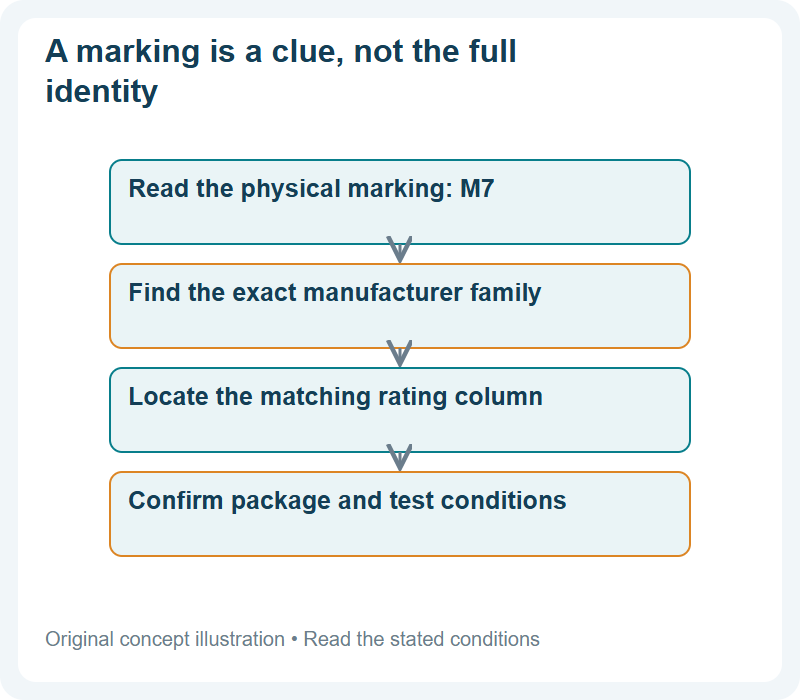
Finding a semiconductor begins with identifying exactly what is being ordered or replaced. A short package marking, a distributor description and a complete manufacturer part number can contain different amounts of information. Similar lettering does not establish identical electrical behavior, and a familiar family name does not confirm the supplied package or qualification status. The useful endpoint is an orderable device connected to its current documentation and to the requirements of the circuit.
This hub organizes the lookup process into product-family understanding, datasheets and replacement checks, and sourcing evidence. It can help a beginner make sense of an unfamiliar code or help a buyer prepare a more precise component request. Use it to identify what is known, what remains uncertain and which document can settle the next question. The blog provides explanations and navigation; the exact product specification must come from documentation covering the candidate device.
Collect more than the letters printed on the package
Start with a clear photograph of the component, its package dimensions and its location in the circuit. Record all visible characters, including suffixes and logos, without silently correcting a character that looks ambiguous. Note whether the component is a two-terminal diode, a multi-diode package or a transistor. The number and arrangement of leads can narrow the possibilities, but they are not enough to establish the pinout.
Short top markings can be reused across different manufacturers and package families. A matching search result is therefore a candidate, not a confirmed identity. Compare the manufacturer logo, package drawing, marking information and electrical role. If the available evidence cannot establish a unique part, preserve that uncertainty in the request. A guessed full part number can move through purchasing and repair records until it appears authoritative, even though its starting assumption was never verified.
Read a datasheet as a description of one defined device
Confirm that the document names the exact part or includes it in an explicitly identified family table. Check the manufacturer, revision, package options and ordering information before extracting headline ratings. Then separate absolute maximum ratings from electrical characteristics, typical curves and application suggestions. A maximum rating defines a boundary under stated conditions; it is not the normal operating point that every design should target.
Test conditions are part of the specification. Forward voltage belongs to a current and temperature, reverse leakage belongs to an applied voltage and temperature, and thermal data belongs to a mounting arrangement. Comparing values stripped of those conditions can make two unlike devices appear equivalent. Keep a local reference to the document used for the decision so that a later revision or substitution can be reviewed against the same evidence.
Prefixes and suffixes help only within their documented system
Manufacturers use ordering codes to distinguish families and variants, but those conventions are not universal languages. A prefix may identify a product group without encoding all of its ratings. A suffix may refer to package, packing or another variant whose meaning depends on the ordering table. Do not infer automotive status, lead finish or electrical equivalence solely from a letter that has that meaning in another manufacturer's catalog.
When the requirement is a replacement, make a comparison table around the circuit rather than around the names. Include voltage blocking, current waveform, surge duty, forward or conduction loss, switching behavior, temperature limits and thermal mounting. Add the package outline and pinout. A candidate with apparently better electrical ratings can still fail a footprint, polarity or assembly requirement. Conversely, a close code match can hide a materially different recovery or leakage characteristic.
Documentation and traceability support the purchase decision
A purchase request should identify the complete manufacturer part number, approved package and any application-specific documentation requirements. Clarify whether substitutions are permitted and what evidence is required before approval. If qualification, conformity or traceability records matter to the project, tie them to the exact supplied item and shipment. A general supplier statement does not automatically cover every product or establish the history of an individual lot.
Commercial details also need precise wording. Distinguish quoted lead time from confirmed shipment availability, and clarify quantity, packing and date-code requirements where relevant. A listing that appears available may not mean the required quantity and variant are ready to ship. Record the supplier and quotation context so that a later ordering change does not become an undocumented engineering change. Avoid treating a marketplace description as a substitute for the manufacturer's technical information.
Inspect incoming parts against the approved identity
Receiving checks can compare labels, quantities, packaging and visible markings with the purchase record. Where the application requires additional inspection or testing, define the sampling and acceptance method beforehand. Appearance can reveal inconsistencies, but visual similarity alone cannot prove electrical performance or authenticity. Likewise, a simple diode-mode reading cannot confirm high-voltage blocking, recovery behavior or the long-term suitability of a power device.
Keep questionable material identifiable while its status is being resolved. Preserve photographs, labels and the supplier communication rather than mixing it into stock and trying to reconstruct its history later. If testing is performed, state what the test establishes and what it does not. Matching one static reading does not demonstrate that two parts are interchangeable across switching, temperature and surge conditions.
Choose the guide that answers the missing question
Use the brand and family guides when identifying the area of the catalog to explore. Use the datasheet and code explanations when turning a marking into an exact specification. Use the sourcing articles when the issue is documentation, availability, supplier evidence or receiving control. These are connected stages of one process, but a technical identity problem should be resolved before a purchase is approved on price and availability alone.
For a technical inquiry, provide the photograph or complete code, package information, circuit position and the operating conditions that matter. For a proposed replacement, add the original datasheet and the reason a change is needed. That information creates a reviewable comparison instead of a request to guess from a fragment of text. The articles below provide the narrower checks needed to move from an initial search to a documented component decision.
Understand the brand, product families and manufacturing
Start here if you need to understand the names, device families or manufacturing context.
Auditing a Diode Manufacturer: The Factory Visit Checklist That Finds Real Problems
A factory audit finds the real problems by following one part from the wafer to the box, because the failures appear at the hand-offs between the stages. The wafer that looked clean, the assembly that looked…
Do Semiconductor Brands Actually Matter? An Honest Answer for Beginners
Ask an experienced engineer and you usually get a shrug followed by a question: which part, at what temperature, in what volume? That is not evasion. Brand is a proxy for a set of things that matter in…
Good-Ark Company History: Riding a Century of Electronics, From Radio Valves to Electric Cars
Every generation of electronics leaves a layer behind, and those layers are still on the board. The adapter on your desk contains the descendants of parts invented to make radio work, and the fuse-box logic of…
Good-Ark Semiconductor Explained for People Who Do Not Work in Electronics
Most explanations assume you already know what a discrete device is, which is why they are hard to read if you do not. This one starts from zero: what the words mean, what the company produces, where those…
Good-Ark, Good-Ark Semi, or Good-Ark Semiconductor? Sorting Out the Names
Search the short name and you will get a wall of datasheet archives, a distributor page and a social post before you get anything that looks like a company. That happens because the short form is what fits in…
How to Audit a Rectifier Diode Manufacturer: Quality, Traceability and Supply Continuity
A low unit price has limited value if a supplier cannot prove lot traceability, disciplined product-change notification, stable process control, and qualified capacity. This guide is a B2B manufacturer-audit…
Inside a Diode Factory: How Diodes Are Manufactured, Explained Without Jargon
Most explanations of diodes start with the junction and stop there, which leaves out the part that determines whether the part in your hand behaves like the one in the datasheet. The junction is a few…
Is Good-Ark Legit? How to Judge Any Component Brand in Ten Minutes
The question is reasonable, and the honest answer is that “is this brand legit?” cannot be settled by reading opinions. Forum threads collect the loudest experiences rather than the typical ones, and review…
The Good-Ark Product List You Already Own: Ten Everyday Gadgets and the Parts Inside Them
There is no way to see the components inside a sealed product without opening it, and opening it is usually the wrong first step. What you can do is learn the pattern: a small number of everyday objects…
What Does Good-Ark Electronics Actually Make? A Beginner’s Look at the Product Line
A catalogue tells you what exists; it does not tell you which family you need, which is the question beginners actually have. So this is a map rather than a list: each family is described by the job it does,…
What Is Good-Ark? A Plain-Language Guide to the Brand Behind Millions of Tiny Parts
If you searched the name and landed on a stock chart, a forum argument or a datasheet site you have never heard of, you did not search badly. Component brands live in an odd corner of the internet: the…
Find part numbers, data sheets and replacement information
These guides help turn a name, marking or parameter request into a documented candidate.
Good-Ark Cross Reference: Finding Equivalents for Legacy Part Numbers
Replacing a discontinued diode is a specification exercise rather than a search exercise, and the difference matters because the obvious approach — finding something with a similar number — produces false…
Good-Ark Datasheets: Finding Official Documents and Verifying What You Read
The difference between a useful datasheet and a dangerous one is provenance. A file with the right part number but the wrong revision, or no issuing manufacturer at all, will look correct and lead to a wrong…
How to Search for a Part Number and Confirm It Is Real
Searching for a part number is not the same as searching for information. The goal is to reach a document issued by whoever made the part, and most search results are not that. Knowing which result types exist…
Incoming Inspection for Rectifiers: Datasheet Verification in Practice
Incoming inspection is where the datasheet becomes the acceptance line: the visual and mechanical checks catch the obvious, the electrical spot checks verify the ratings, and the traceability ties every lot to…
Searching by Parameter Instead of by Name: A Beginner’s Guide
Beginners search for a part number because a tutorial used one. Engineers search for a set of requirements because a circuit has them. Learning the second habit is what turns component selection from guesswork…
What the Numbers in a Semiconductor Part Number Actually Mean
Decode part-number clues and verify the complete orderable variant in the official datasheet.
Review suppliers, distribution and purchasing evidence
Use these references when you need to verify the source, documents or sourcing conditions around the component.
Authorized Distributor vs Online Marketplace: What Is the Real Difference?
An authorised distributor is a business with a contract that entitles it to sell a manufacturer’s parts. A marketplace is a platform on which anyone can list anything. The difference is not quality or price;…
Avoiding Counterfeit Power Semiconductors: Sourcing and Verification
Counterfeit power semiconductors enter the supply chain through gray-market listings, recycled parts, and forged documents, and the defense is a process: know the entry paths, check the signals, verify with…
Buying Power Semiconductors from China: Contracts, Verification, and What to Check First
The price advantage of buying discrete power parts from China is real, and so is the hidden cost of getting it wrong. The difference between a good purchase and a bad one is decided before the money moves: the…
electronica Exhibitor Guide: How Buyers Can Work With Good-Ark At Global Trade Shows
electronica is one of the most important global platforms for electronics and semiconductor professionals to connect with suppliers, discover new technologies, and make procurement decisions. For buyers and…
electronica Visitor Guide: How to Plan a Productive Semiconductor Sourcing Visit
electronica is a major meeting point for the global electronics industry, bringing together component manufacturers, system designers, distributors, buyers, engineers, and technology decision-makers. For…
Good-Ark Compliance Documentation: RoHS, REACH and Quality Certificates
A component purchase often depends on documents as much as on electrical data: the RoHS declaration, the REACH substance statement, the conflict minerals response and the quality certificates that back the…
Good-Ark Semiconductor: A Practical Guide to Sourcing Discrete Devices
Finding a Good-Ark semiconductor part is the start of a sourcing decision. The useful next step is to establish which exact ordering code, datasheet revision and supply channel apply, then confirm that the…
Power Semiconductor Sourcing Strategy: Second Sources and Long-Term Supply
A second source for a power semiconductor is an engineering decision, not a purchasing shortcut: the alternative must be qualified electrically, thermally, and mechanically before it earns a place on the BOM.…
Power Semiconductors in 2026: Trends Shaping Diodes, SiC, and the Supply Chain
The power semiconductor market in 2026 assembles itself around three demand centers — electric vehicles, solar and storage, and AI data-center compute — and the interesting news is not which of the three grew,…
RoHS and Halogen-Free Compliance for Power Components: A Practical Guide
RoHS compliance for a power component means the part stays within the substance limits of the EU directive, and a halogen-free claim adds material-level limits on chlorine and bromine. This guide covers the…
Second-Sourcing Semiconductors: The Strategy That Keeps Your Board Shipping
A single source is one fire away from stopping the line. A fire, a strike, a trade restriction, or a supplier’s own quality problem can all take a sole-sourced part off the market, and the board stops shipping…
Solar Inverter Component Selection Guide Design Choices and Supplier Evaluation
Solar inverter component selection starts with the DC bus voltage, then switching devices and protection diodes. See how SiC and IGBT classes are chosen.
Spotting Counterfeit Semiconductors: Packaging Clues, Data Checks, and the Milliscope Test
A counterfeit semiconductor is usually bought for a reason that sounds sensible — a price below the market, a part in stock when nobody else has it — and the counterfeit is revealed by clues that are visible…
What Does the GS Prefix Mean in MOSFETs?
The GS prefix generally identifies a Good-Ark Electronics device-family or part-number convention rather than one universal semiconductor specification. Engineers should use the full part number and datasheet…
What Is Suzhou Good-Ark Electronics?
Suzhou Good-Ark Electronics is a major China-based manufacturer of discrete semiconductor devices for power conversion, circuit protection, switching, and renewable-energy systems. Its portfolio includes…
What Is the GSD Series?
The GSD Series is a family of compact, high-voltage, small-signal switching diodes designed for fast signal steering, voltage isolation, and switching applications. Devices such as dual in-series and…
What Is the GSMDJ Series Used For?
The GSMDJ Series is designed for surge and transient-voltage protection in power and electronic circuits. It helps clamp harmful voltage spikes before they reach sensitive components, supporting dependable…
Where to Buy Good-Ark Parts: Authorized Channels, Samples and Quotes
The difference between a smooth prototype and a two-week delay is often not the part — it is the buying path. A sample request without the application details, a quote without the volume tier, or a distributor…
Common Diode Part Numbers
A practical cheat sheet of diode part-number families you will see on BOMs and cross-reference lists.
Datasheet Terms Explained
Plain definitions of the voltage, current, and thermal terms that show up on diode datasheets.
Why Not to Trust Every Datasheet
How to spot incomplete, copied, or mismatched datasheets before you design-in a part.
Component Lead Times in 2026: What Is Actually Normal Now
Evaluate component availability and lead-time claims before setting purchasing and buffer-stock plans.
China's Power Semiconductor Industry: Where It Stands in 2026
Read the power-semiconductor industry landscape as context for capacity, sourcing and qualification decisions.
The Discrete Diode Market Explained: Size, Players and Trends
Understand the discrete-diode market through applications, suppliers and component purchasing needs.
What Documents Should Come With a Semiconductor Order?
Check order paperwork, conformity information and lot traceability when receiving semiconductor components.
MOQ and Lead Time: What Beginners Should Know Before Their First Component Order
Clarify minimum order quantity, lead time and ordering details before a first component purchase.
RoHS vs REACH: Two Compliance Words Everyone Mixes Up
Distinguish RoHS and REACH documentation when reviewing component compliance evidence.
Need help with a particular circuit?
Include the circuit position, operating conditions and the part number or marking when you contact Good-Ark technical support.
Recommended
 NPN Transistor Pinout Habits: E-B-C Variations and How to VerifyKnowledge
 MOSFET Avalanche Rating: What UIS Specs Mean for Real SpikesKnowledge
 MOSFET Gate Pull-Down Resistor: Keeping the Gate Off When Drivers FloatKnowledgeMOSFET Body Diode: What It Is and When Not to Rely on It AloneKnowledgeMOSFET Gate Resistor: Why It Exists and How to Choose a Starting ValueKnowledge
 Schottky Reverse Leakage vs Temperature: Why Hot Boards MisbehaveKnowledge