Good-Ark — discrete power semiconductors: rectifiers, Schottky, TVS, MOSFETs, SiC and IGBT
Request a Quote

Why You Should Not Trust Every Datasheet PDF You Find Online
Why You Should Not Trust Every Datasheet PDF You Find Online

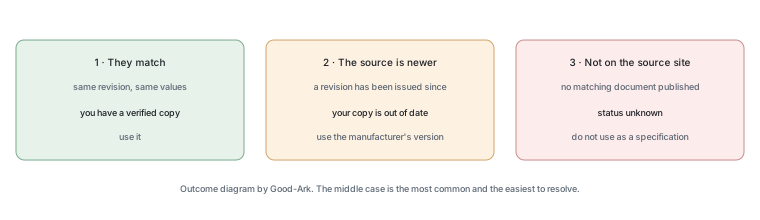
A wrong datasheet is more dangerous than a missing one, because it produces confidence rather than caution. The failure modes are mundane: a file edited by a seller, a page that never made it into the scan, a version number that only exists on one website. None of them looks suspicious, and all of them … Read more
How to Compare Two Datasheets Without Getting Lost

How to Compare Two Datasheets Without Getting Lost

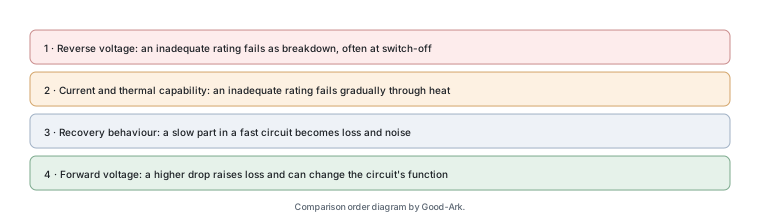
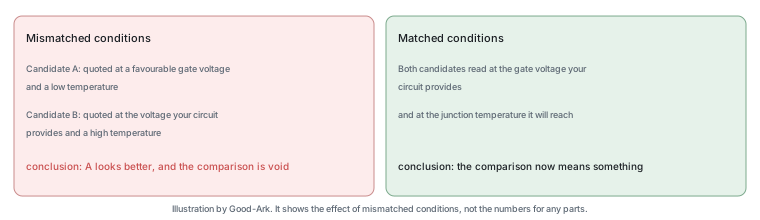
Comparing two datasheets looks like a reading task and is actually an arithmetic one. The work is not in understanding either document; it is in getting the two sets of numbers onto the same conditions so that a comparison means something. Most comparison mistakes happen before any numbers are compared. Rule one: compare like with … Read more

Fifteen Datasheet Terms Beginners Actually Meet (and What They Mean)

Fifteen Datasheet Terms Beginners Actually Meet (and What They Mean)

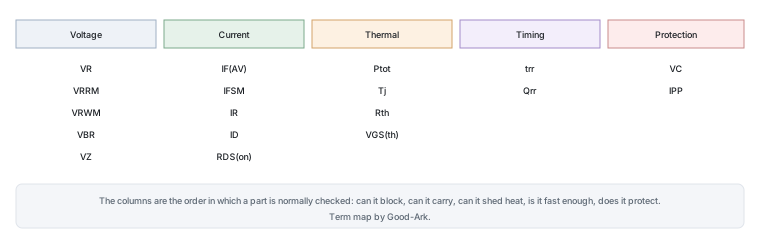
A datasheet uses a vocabulary that is almost never explained in one place. The terms below are the fifteen that a beginner meets in the first few documents they read, grouped by the question each one answers: how much voltage, how much current, how much heat, how fast, and how much protection. How to use … Read more

What the Numbers in a Semiconductor Part Number Actually Mean

What the Numbers in a Semiconductor Part Number Actually Mean

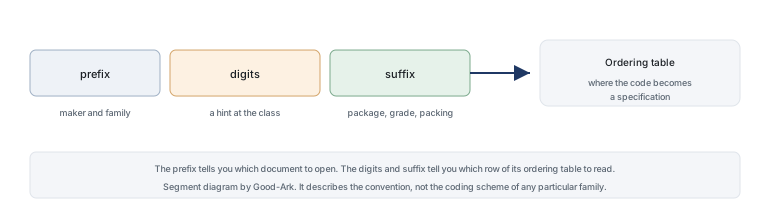
A semiconductor part number is a code that points at a row in a table. That is its whole job. It identifies a specific orderable variant, and the table in the datasheet for that family is where the meaning lives. Treating the code as a description is the source of most part-number confusion. Part numbers … Read more

How to Read Any Semiconductor Datasheet: A Beginner’s Walkthrough

How to Read Any Semiconductor Datasheet: A Beginner’s Walkthrough

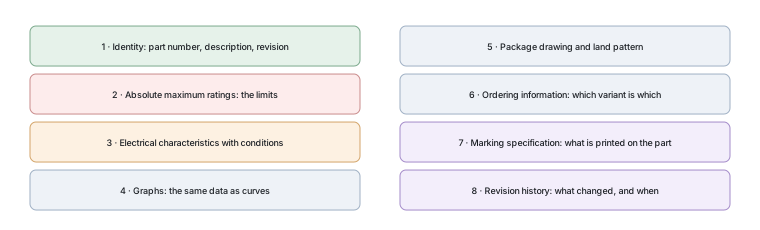
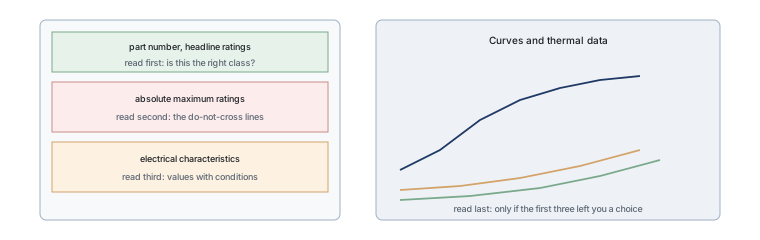
A datasheet looks intimidating because it is dense, and it is dense because it has to be complete. The trick is that it has a structure, and once you know the order of the sections you can answer most questions in a few minutes without reading the rest. What a datasheet is for A datasheet … Read more

Where to Find Official Good-Ark Datasheets (and Avoid Lookalike Files)

Where to Find Official Good-Ark Datasheets (and Avoid Lookalike Files)

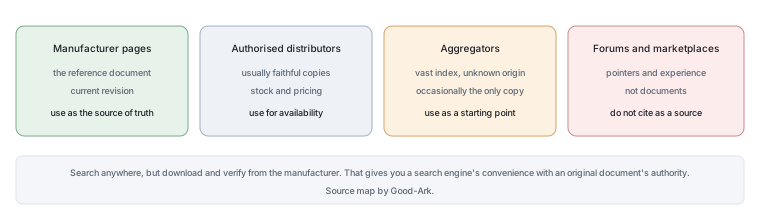
The difference between a useful datasheet and a dangerous one is provenance. A file with the right part number but the wrong revision, or no issuing manufacturer at all, will look correct and lead to a wrong design decision. Establishing where a document came from takes about two minutes and is worth doing every time. … Read more

How to Find a Replacement for a Discontinued Diode

How to Find a Replacement for a Discontinued Diode

Replacing a discontinued diode is a specification exercise rather than a search exercise, and the difference matters because the obvious approach — finding something with a similar number — produces false confidence. The method below takes about twenty minutes per part and produces a substitution you can defend. When replacement is the right move Replacement … Read more

The Diode Part Numbers Everyone Eventually Meets: 1N4007, 1N4148, SS14 and Friends

The Diode Part Numbers Everyone Eventually Meets: 1N4007, 1N4148, SS14 and Friends

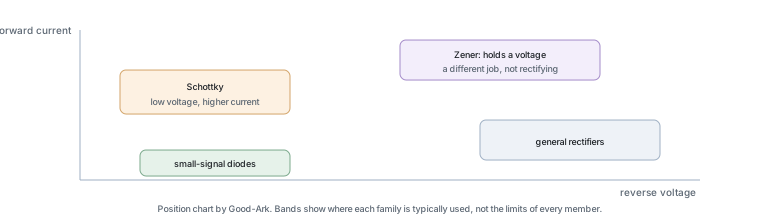
Four or five diode types turn up in almost every beginner project and in a large share of commercial ones, and knowing what each is for removes most of the guesswork from buying parts. This is a map of those types rather than a catalogue: what they are designed to do, where they stop being … Read more

How to Read a Diode Datasheet When You Have Never Read One Before

How to Read a Diode Datasheet When You Have Never Read One Before

A diode datasheet runs to several pages of tables and curves, and most of it is not needed to make a first decision. Five entries settle whether a part is suitable, and the rest refine the answer. This article walks through those five in the order you should read them, then explains the two traps … Read more

Diode Markings Decoded: Reading the Numbers on a Component You Found in a Drawer

Diode Markings Decoded: Reading the Numbers on a Component You Found in a Drawer

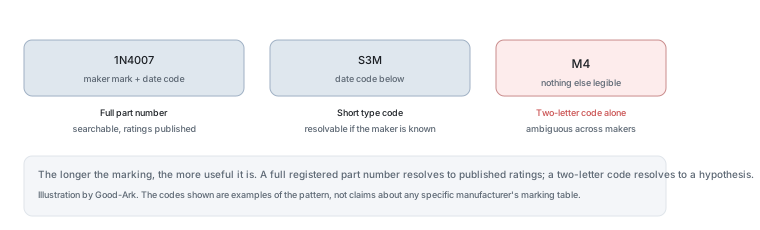
Sooner or later everybody ends up with a handful of loose diodes and no idea what they are. The codes on the body look like they should be enough, and sometimes they are — but the same short code can mean different parts from different manufacturers, which is the trap worth understanding before you trust … Read more

How to Search for a Part Number and Confirm It Is Real

How to Search for a Part Number and Confirm It Is Real

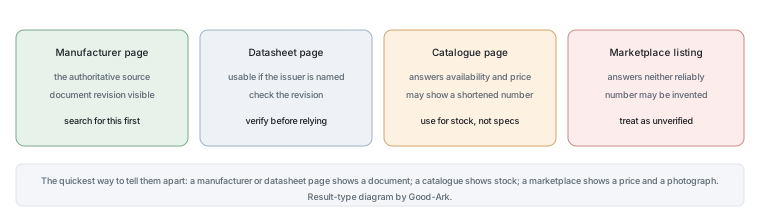
Searching for a part number is not the same as searching for information. The goal is to reach a document issued by whoever made the part, and most search results are not that. Knowing which result types exist and what each can tell you turns a frustrating search into a two-minute routine. Last updated: October … Read more

Need a part number checked against your design?

Send the topology, current and voltage class. Good-Ark sales and application engineering will confirm the closest device, package and qualification status.

Copyright Suzhou Good-Ark Electronics Co., Ltd. All Rights Reserved