Good-Ark — discrete power semiconductors: rectifiers, Schottky, TVS, MOSFETs, SiC and IGBT
Request a Quote

Solar and Energy Storage Power Electronics: Report 2026
Solar and Energy Storage Power Electronics: Report 2026

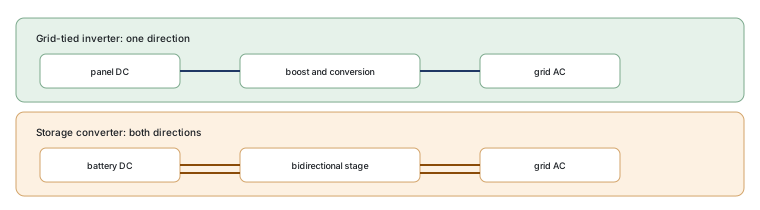
A solar installation and a battery storage system both convert electricity, but they do it differently, and the difference explains most of what is inside them. A grid-tied solar inverter changes direct current from the panels into alternating current for the grid. A storage system has to do that in both directions, which means the … Read more
Electric Vehicles and Power Electronics: An Industry Report for Non-Specialists

Electric Vehicles and Power Electronics: An Industry Report for Non-Specialists

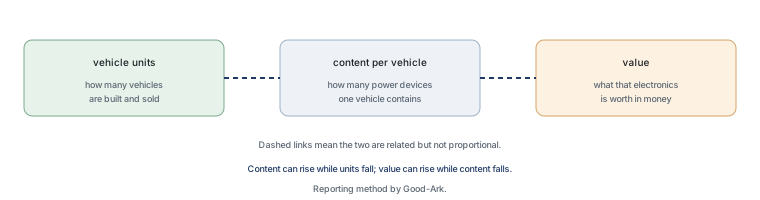
An electric vehicle report becomes misleading the moment three different numbers are put in the same sentence. Vehicle sales are counted in units, semiconductor content is counted in devices or in value per car, and the semiconductor market is counted in money. Each answers a different question, and a change in one does not imply … Read more

How Does an Electric Car Charge? AC, DC and What Happens Inside

How Does an Electric Car Charge? AC, DC and What Happens Inside

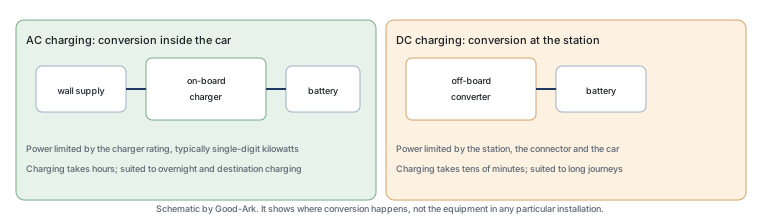
An electric car can be charged in two fundamentally different ways, and the difference is not the shape of the plug. It is where the conversion from alternating to direct current happens: inside the car for one kind of charging, and inside the charging equipment for the other. Two kinds of charging cable Alternating-current charging … Read more

Inside an Electric Car: Where the Power Electronics Sit

Inside an Electric Car: Where the Power Electronics Sit

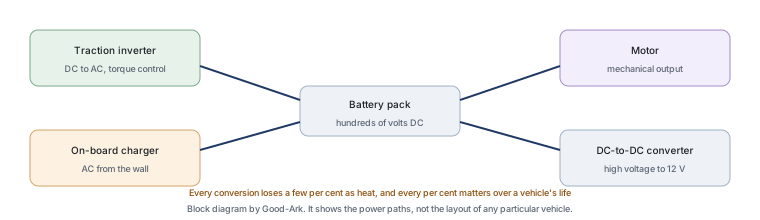
An electric car has three jobs that involve power electronics rather than computing: moving energy from the battery to the motor, moving it from the wall into the battery, and moving a small amount of it from the high-voltage system into the low-voltage one. Those three jobs are performed by five blocks of hardware, and … Read more

Why 800 V Electric Cars Need Silicon Carbide

Why 800 V Electric Cars Need Silicon Carbide

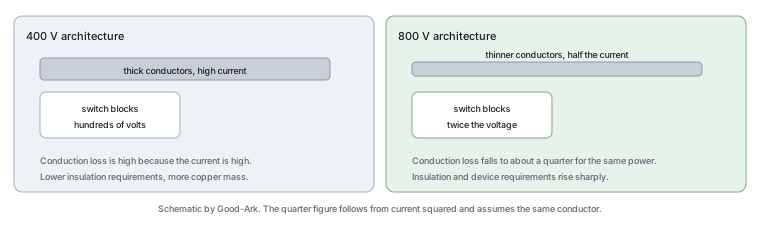
Doubling the battery voltage looks like a simple change and behaves like a redesign. It halves the current needed for the same power, which is why it is attractive; it also changes what the semiconductors have to block, which is why silicon carbide ends up in the design rather than silicon. Last updated: October 11, … Read more

Wide-Bandgap Semiconductors Explained in One Sitting

Wide-Bandgap Semiconductors Explained in One Sitting

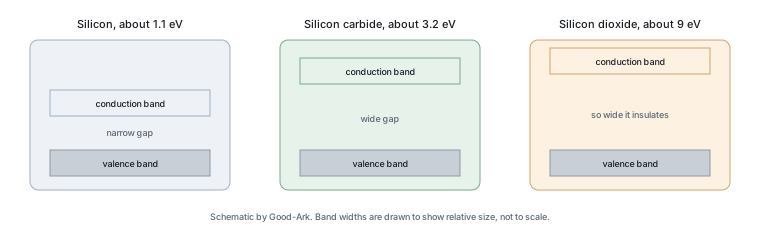
Every material used to make a semiconductor device can be described by one number: the energy an electron must gain to break free of the atomic lattice and start conducting. That number, the band gap, predicts how much voltage the material can hold, how much current it leaks when hot, and even what colour light … Read more

SiC in Solar Inverters: Why a Few Percent of Efficiency Matters

SiC in Solar Inverters: Why a Few Percent of Efficiency Matters

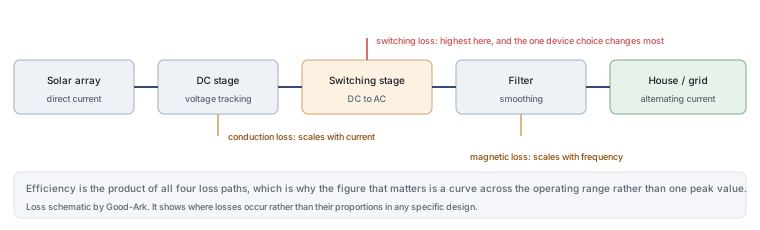
An inverter is the only part of a home solar system that works every day the sun rises, and it is usually the first major component to be replaced. Its efficiency is therefore not a laboratory number: every per cent is energy that either reaches your house or becomes heat inside a box mounted on … Read more

Why Are SiC Devices Expensive, and When Are They Worth It?

Why Are SiC Devices Expensive, and When Are They Worth It?

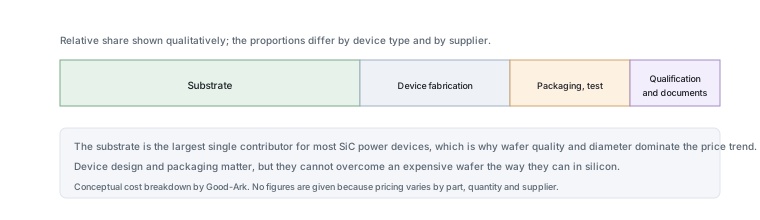
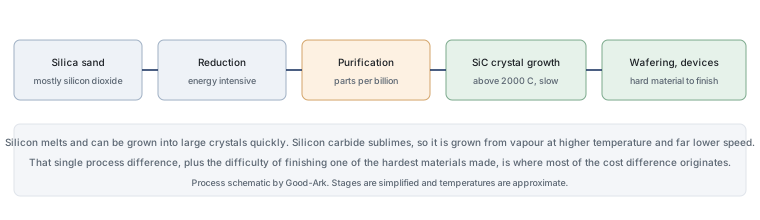
The reason a silicon carbide device costs several times what an electrically comparable silicon part costs is not difficult to understand, and it is almost entirely upstream of the device. The expensive part is the wafer, and the wafer is expensive because growing this crystal is slow, hot and difficult. Last updated: October 16, 2026 … Read more

SiC vs GaN: Two Wide-Bandgap Materials Compared Simply

SiC vs GaN: Two Wide-Bandgap Materials Compared Simply

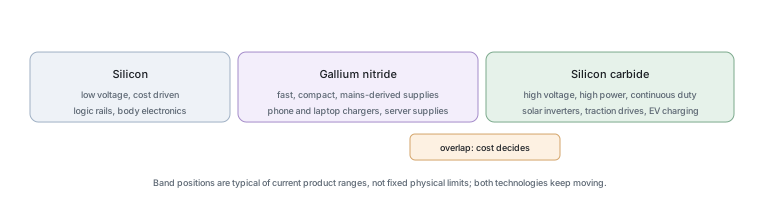
Both materials are described as wide bandgap, both switch faster than silicon, and both appear in products you can buy today. The reason they are not competitors in most designs is simple: they occupy different voltage territory, and the boundary between them is where most of the engineering decisions live. Last updated: October 16, 2026 … Read more

SiC vs Silicon: Why Some Electric Cars Charge Faster

SiC vs Silicon: Why Some Electric Cars Charge Faster

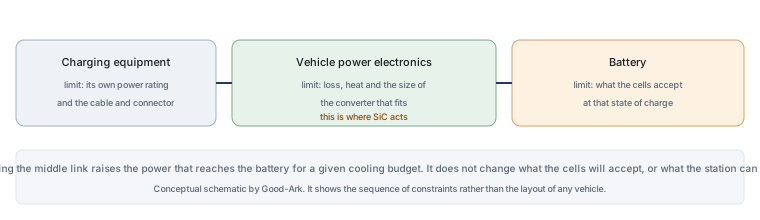
Two cars with similar batteries can charge at noticeably different rates, and part of the difference sits in the power electronics rather than in the cells. Silicon carbide is one reason a converter can handle more power in a smaller, cooler box — but it is an enabler rather than the cause, and understanding where … Read more

What Is Silicon Carbide (SiC)? A Beginner’s Introduction

What Is Silicon Carbide (SiC)? A Beginner’s Introduction

There is a reasonable chance you have held silicon carbide in your hand without knowing it, because the same material that makes an abrasive disc also makes a power transistor. The difference between the two is not chemistry but crystal quality: a bonded mass of hard grains and a single crystal grown for electronics are … Read more

The Silicon Carbide Market in 2026: Capacity, Prices and Adoption

The Silicon Carbide Market in 2026: Capacity, Prices and Adoption

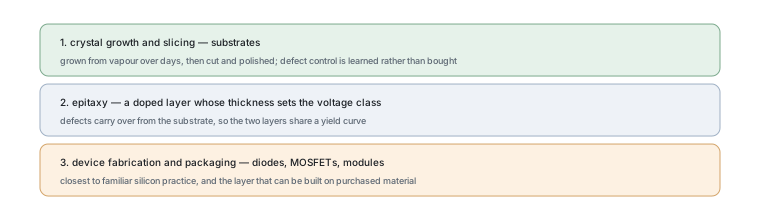
Silicon carbide is the material behind the power devices that made high-voltage switching efficient, and the market around it is best understood as three separate businesses stacked on top of each other: growing the crystal and cutting it into substrates, growing an epitaxial layer on top, and fabricating devices on that. Each layer has its … Read more

Need a part number checked against your design?

Send the topology, current and voltage class. Good-Ark sales and application engineering will confirm the closest device, package and qualification status.

Copyright Suzhou Good-Ark Electronics Co., Ltd. All Rights Reserved