Zener and Signal Diode Hub
Zener and small-signal diode hub: breakdown behavior, reading Zener ratings, designing regulator circuits and choosing switching diodes for signals.
20 guides
Separate the job of a Zener reference or clamp from the job of a small-signal switching diode. These guides connect basic behavior, ratings and comparisons with the practical circuit that uses the device.
Jump to the article collection
Zener and small-signal diodes: begin with the intended operating region
Zener diodes and small-signal switching diodes share familiar diode symbols and packages, but they are chosen for different tasks. A Zener device is specified for useful behavior in reverse breakdown, commonly supporting a reference, simple regulation or a clamp. A small-signal diode is often used to steer, switch or limit relatively small currents. Their similar appearance does not establish equivalent electrical behavior or make one an automatic replacement for the other.
This hub connects diode-job comparisons with Zener circuit design and small-signal selection. Start by asking how the component is meant to conduct: forward biased, reverse blocking or deliberately operating in breakdown. Then establish the voltage, current and timing requirements. That sequence prevents common mistakes such as substituting a general-purpose rectifier for a fast signal diode or treating a Zener's nominal voltage as a perfectly fixed output under every load.
A Zener voltage belongs to a specified current
The voltage printed in a Zener description is tied to defined test conditions and tolerance. The reverse characteristic changes through the knee and has a finite slope in the operating region. If the available current becomes too small, the voltage may no longer behave as a useful reference. As current changes, voltage and dissipation change as well. Temperature dependence must also be considered where the circuit needs a controlled threshold or reference over a broad environment.
Read the test current, voltage tolerance, dynamic impedance and power information together. A nominal-voltage comparison is only the first step in choosing a replacement. Two parts with the same nominal value may differ in behavior at the current supplied by the actual circuit. If the application needs tighter regulation, lower noise or better efficiency than a simple Zener arrangement can provide, the appropriate solution may be a reference or regulator circuit designed for that requirement.
The series resistor must support both the load and the Zener
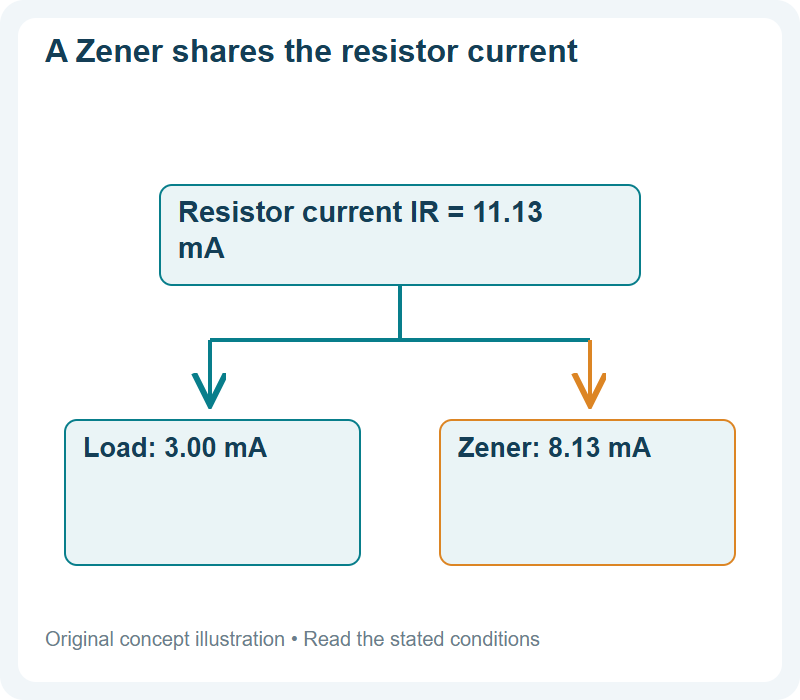
In a simple shunt regulator, the resistor carries the combined load and Zener current. Changes in input voltage and load therefore change the current available to the Zener. At low input and high load, enough current must remain for the required regulation behavior. At high input and low load, the Zener and resistor must not exceed their permitted dissipation. Checking only the nominal input and one load value leaves both corners unresolved.
The resistor itself needs a suitable power rating and voltage capability under the defined operating conditions. Startup and load disconnection can also alter the current distribution. Treat those states as part of the design rather than as exceptions to be ignored. A useful worksheet records the input range, load range, target voltage behavior and thermal assumptions before choosing standard component values. The detailed circuit guides below explain those checks without assuming that one resistor value fits every supply.
Regulation and transient clamping are different duties
A Zener can limit voltage in a suitable low-energy circuit, but a steady reference function and a transient protection function impose different requirements. The disturbance's source impedance, duration and energy determine the stress on a clamp. The voltage reached during a pulse can differ from the nominal low-current Zener value. A component's steady dissipation rating is not a complete description of its permitted transient behavior.
For larger or specified surge events, a dedicated protection device may be appropriate, with pulse ratings and clamping data matched to the intended disturbance. The protected circuit still needs a complete current path and, where necessary, upstream limiting or disconnection. Neither a Zener nor a TVS should be expected to absorb an unlimited continuous supply fault. Identify whether the task is reference generation, signal limiting or power-rail protection before selecting the device category.
Small-signal switching depends on more than forward conduction
A signal diode can influence timing through junction capacitance, stored charge, leakage and its forward characteristic. These properties matter in switching, detection, steering and high-impedance circuits. A power rectifier may conduct correctly in a slow meter test yet disturb the intended signal waveform. The replacement should preserve the relevant circuit behavior rather than merely exceed the original part's voltage rating.
Check the current level, reverse voltage, switching conditions and signal impedance. A diode used in a timing network may need different attention from one providing a logic clamp. Leakage that is negligible in a power circuit can matter at a sensitive high-impedance node. Likewise, capacitance that seems small in isolation can alter a fast edge. Compare the specified conditions of candidate devices and verify the waveform in the installed circuit when timing or amplitude is important.
Review tolerances as a circuit window
For a simple reference or clamp, the useful output is a range established by component tolerance, current and temperature. Compare that range with what the connected circuit can accept. If the limits overlap poorly, replacing the Zener with a slightly different nominal value may improve one condition while worsening another. Reviewing the complete window makes clear when the circuit needs a different bias arrangement or a more controlled reference approach.
Identify orientation and interpret tests in context
For an ordinary axial diode, a band commonly identifies the cathode, but package-specific documentation remains the authority when markings or pin assignments are uncertain. A Zener used as a shunt regulator operates in reverse bias, so its intended orientation differs from a forward-conducting series rectifier in a similar-looking sketch. Trace the circuit nodes instead of deciding orientation from which end seems intuitively positive.
Diode mode can help check forward conduction and find obvious shorts or opens. It may not provide enough reverse voltage to reach a Zener's specified breakdown region, so an apparently open reverse reading does not establish the Zener voltage. Any separate characterization setup needs controlled current, suitable instrumentation and operation within the part's limits. Use the grouped guides below to connect the basic device behavior with the exact regulation, switching or protection question you need to resolve.
Understand breakdown and compare diode jobs
Start with the operating behavior and the distinctions between regulation, clamping and switching.
What Is a Voltage Regulator Zener Diode?
A Zener regulator is sized by its worst case, not its typical load. What a real low-power Zener specifies, and how the series resistor is chosen from those numbers.
Zener Diodes in Plain Language: Breakdown Voltage, Zener Knee, and the Three Things to Check
A Zener diode is the component that looks like a normal diode and behaves like a voltage gate in reverse. Every diode blocks reverse voltage until a limit; a Zener is engineered to break down cleanly at a…
1N4007 vs 1N4148: Rectifier vs Switching Diode (Do Not Swap Blindly)
Compare a general-purpose rectifier with a small-signal switching diode before approving a substitution.
Read ratings and design Zener circuits
These references explain how the relevant ratings, bias conditions and circuit requirements fit together.
1N4728A in Practice: Datasheet Numbers, Real Measurements, and Safe Replacements
The 1N4728A is a 3.3 V Zener diode that a buyer and a repair bench read in two completely different ways. The buyer sees a part number, a voltage rating, and a price; the bench sees a curve to measure, a…
From 3.3 V to 12 V: Matching Zener Part Numbers to Your Voltage and Power Needs
The 1N47xx ladder is the fastest route from “I need a Zener at this voltage” to “I have the part number.” A single table maps the voltage ladder from the 3.3 V 1N4728A up to the 12 V parts, with the power…
Precision Zener Reference Diode: Stable Voltage In Demanding Power Designs
A precision Zener reference is a tolerance grade: 33 mV at 1 % against 165 mV at 5 % on a 3.3 V rail. What that means for a 12-bit measurement.
SMD Zener Voltage Regulator: Reliable Board-Level Protection And Stabilization
An SMD Zener regulator is rated by its pad: 350 mW standard footprint against 590 mW with 1 cm2 of cathode copper. How the layout sets the budget.
Zener Datasheet Language: Turning Vz, Iz, Izk, and rz Into a Working Design
A Zener datasheet looks shorter than a rectifier datasheet — a few voltage numbers, a current or two, a temperature coefficient — yet it is one of the easiest spec sheets to misread. The nominal voltage is…
Zener Reverse-Current Ratings in H-Bridges: The Freewheeling Path Nobody Sizes
An H-bridge drive for a motor has two hidden electrical paths: the switching path that everyone sizes, and the freewheeling path that nobody does. When the H-bridge releases a motor, the back-EMF drives…
Zener Shunt Regulator by Hand: Choosing the Series Resistor for Worst Case, Not Typical
A Zener shunt regulator is the cheapest voltage regulator you can build — one Zener, one resistor, no active components — and the reason so many of them fail on the bench is that they are designed for the…
Zener, LDO, or DC-DC for a 5 V Rail: The Honest Loss-and-Cost Comparison
There are three ways to make a 5 V rail from a higher supply, and they are not equivalent. A Zener shunt is simple and cheap but wastes power as soon as the load is small; a linear LDO is cleaner but burns the…
Zeners as Precision References: Tolerance, Temperature, and the 4 V Rule
The Zener’s reputation as a “voltage reference” suggests it holds its voltage like a calibration standard, and the honest answer is that it does not — a Zener holds its voltage within a tolerance, it drifts…
Zener Diodes: Voltage Regulation, Circuit Protection, and Procurement
Connect Zener regulation and clamping duties to dissipation, pulse requirements and procurement checks.
Select and apply small-signal diodes
Follow the guide for the switching task, package or common part family you need to identify.
Good-Ark Schottky Portfolio: From Small-Signal to Power Rectifiers
An engineer searching for “Schottky rectifier” faces a catalog problem, not a physics problem: the same technology appears in SOD-123 packages for signal clamping and in TO-220 dual-die parts for 20 A outputs,…
High Speed Switching Diode: Optimizing Fast Recovery for Power Electronics and Signal Integrity
A high-speed switching diode is specified by a 4 ns recovery at 10 mA and defined conditions, plus 1.5 pF of capacitance. What the test line decides.
Small-Signal Diodes and Switching Speed: From BAS16 and 1N4148 to Fast-Switching Trains
Small-signal diodes are everywhere in a board — logic inputs, I/O protection, level shifters, and switching trains — and their datasheet rarely tells you the thing you actually need to know. The…
SOD-123 Switching Diode: Fast, Reliable Signal Control for Compact Electronics
A SOD-123 switching diode is a package choice: the same 100 V, 4 ns silicon comes in seven outlines. What the outline changes, and what it does not.
What Is a Low Leakage Small Signal Diode?
A low leakage small signal diode is a low-current semiconductor device engineered to minimize reverse current while switching, steering, clamping, or protecting sensitive signals. It helps preserve accuracy in…
What Is a Small Signal Schottky Barrier Diode?
A small-signal Schottky diode trades leakage for a 410 mV forward drop. What three real parts specify, and the calculation that decides whether it fits.
What Is a SOT-23 Switching Diode?
SOT-23 is a package, not a specification: the same 100 V, 4 ns switching silicon ships in six outlines. What the outline decides, and what it does not.
Good-Ark Zener Diodes in Plain Language
A brand-level plain-language map of Good-Ark Zener uses before you open a datasheet.
Need help with a particular circuit?
Include the circuit position, operating conditions and the part number or marking when you contact Good-Ark technical support.
Recommended
 NPN Transistor Pinout Habits: E-B-C Variations and How to VerifyKnowledge
 MOSFET Avalanche Rating: What UIS Specs Mean for Real SpikesKnowledge
 MOSFET Gate Pull-Down Resistor: Keeping the Gate Off When Drivers FloatKnowledgeMOSFET Body Diode: What It Is and When Not to Rely on It AloneKnowledgeMOSFET Gate Resistor: Why It Exists and How to Choose a Starting ValueKnowledge
 Schottky Reverse Leakage vs Temperature: Why Hot Boards MisbehaveKnowledge