Energy Efficiency Rules Worldwide: How Regulations Shape Component Choices
Energy efficiency regulations for power supplies: why efficiency is regulated, how to read a label, and how a rule changes the bill of materials.
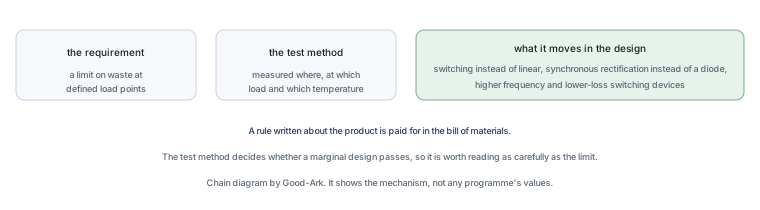
An energy efficiency regulation is a rule about how much electricity a product may waste, and it reaches the component list because waste is decided by the parts. A requirement on no-load consumption decides what the controller must do when the load is disconnected. A requirement on average efficiency at several load points decides whether a synchronous rectifier replaces a diode, and whether a small switching supply replaces a linear one. The regulation is written about the product and paid for in the bill of materials.
Why efficiency is regulated at all
Two reasons are given, and they are different. The first is that a product’s running cost is paid by the user while its purchase price is paid by whoever chooses the product, so a buyer comparing two similar products will take the cheaper one even if it costs more to run. The second is scale: a small waste multiplied by the number of units in service becomes a large amount of generation, and a rule that removes it applies to every unit sold afterwards.
The comparison that makes the logic clear is a leaking tap. One tap in one house wastes nothing worth measuring; the same leak in every house on a street is a reservoir problem. Efficiency regulation exists because individual buyers cannot act on the aggregate, so the aggregate is addressed by requiring a minimum standard of every product.
The main programmes you will meet
Several programmes cover this ground, and they differ in what they regulate and how they verify it. The European Union’s ecodesign framework sets mandatory requirements for products placed on its market, including external power supplies, and it determines what may legally be sold. The United States Department of Energy sets mandatory standards for external power supplies and many appliances, with a separate voluntary labelling programme that goes beyond the minimum. Other major markets have their own instruments, and there are voluntary programmes and industry labels that add a further layer.
Three practical consequences follow. A product sold in several markets has to satisfy the strictest applicable requirement, which is why a manufacturer tends to build one design rather than several. A programme that is voluntary in one market can become a de facto requirement in another because retailers or customers require it. And the requirements are revised, so a design that was compliant when it was created may not be compliant when it is next produced.
| Requirement type | What it constrains | Where it bites in the design |
|---|---|---|
| No-load consumption | Power used with no device attached | Standby control, controller choice, bleeder circuits |
| Average efficiency | Conversion efficiency across defined load points | Topology, rectification method, switching devices |
| Power factor | How the supply draws current from the mains | Whether a power factor correction stage is required |
| Marking and declaration | What must be stated and documented | Testing, records, and the technical file |
Reading an efficiency label
An efficiency label is a compressed statement, and the compression is where readers go wrong. Two conventions are common. The first describes efficiency at defined load points, which is why a supply can look excellent at full load and poor at a quarter load. The second describes a weighted average across several points, which better reflects how a supply is actually used, because most equipment spends most of its time below full power.
The desktop computer supply label programme is a familiar example with tiers named after metals, and the tiers differ in how demanding the efficiency requirement is at those defined load points. The label is a statement about a test method rather than a guarantee of anything else: it says nothing about the lifetime of the components, the noise of the fan or the protection features, and a well-made supply from a low tier can be more reliable than a poorly made one from a high tier.
How rules change the bill of materials
A requirement on average efficiency moves three decisions. It pushes a design from a linear regulator to a switching converter, because a linear regulator’s efficiency is roughly the ratio of output to input voltage and cannot be improved by better parts. It pushes the rectification on the output side from a diode to a synchronous switch, because a diode’s forward drop is a loss that a switch can substantially reduce. And it pushes the switching frequency up, which requires devices with lower switching loss, which is where wide bandgap materials enter.
A requirement on no-load consumption moves a different set of decisions. It constrains how much a controller may draw in standby, it discourages bleeder resistors that are always conducting, and it may require the supply to drop into a burst mode where it switches intermittently rather than continuously. Because the quantities are small, the engineering effort is often larger than the material saving, which is the pattern across this whole subject: a regulation written about watts is paid for in design time.
Standby power: the sneaky requirement
Standby consumption is the requirement that surprises manufacturers most often, because it is invisible in normal operation and it applies to a state the product is designed to be in for most of its life. A device that is connected to the mains but not charging continues to draw current to run its controller, sense the output and keep the communication alive if the standard requires it.
The tension is between two obligations. A charger must not waste power when nothing is connected, and it must also respond immediately when something is. The compromise is usually a periodic wake-up rather than continuous operation, which costs a small amount of power at intervals and requires the control circuit to be able to detect a connection quickly. That is a design problem, and it is measured by the same rule that governs the running efficiency.
What happens to non-compliant products
Non-compliance in a mandatory programme has commercial consequences before it has legal ones. A product that cannot be placed on a market cannot be sold there, and a product that is placed without meeting the requirement can be withdrawn, which is expensive in a way that a test at the design stage is not. Retailers and large customers also apply their own requirements, which can be stricter than the law.
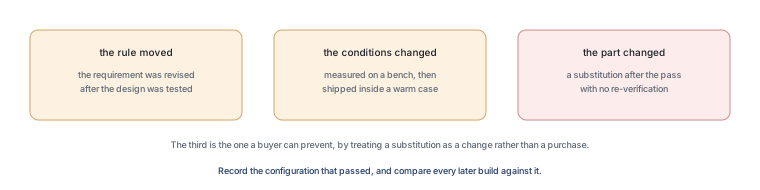
Three failure patterns appear repeatedly. A design that was compliant against an older version of a requirement, produced after the requirement changed. A design that passes at the ambient temperature of the laboratory but not in a warm enclosure, because efficiency and no-load consumption both depend on temperature. And a design that meets the requirement with a component that is later substituted, changing the measured result without anyone re-testing. The third is the one that component buyers can most easily prevent, by treating a substitution as a change that requires verification rather than as a purchasing decision.
How to check your own product
Four steps are enough for a first pass. Find out which programmes apply in each market you sell into, and note that they may not be the same. Read the applicable test method, because it defines the load points, the voltages and the temperature at which the measurement is taken. Measure the product as it will be enclosed and shipped, not as a bare board. And record the result with the design, so that a later component substitution can be compared against the configuration that passed.
A safety note belongs at the end of that list. Efficiency measurements are taken on a product connected to mains voltage, and the measurement itself can be dangerous if the test setup is improvised. The relevant practice is described in the safety standards for the product category and in our comparison of switching and linear supplies, which covers where the losses come from in the first place.
Comparison table
| Ask | Why it matters |
|---|---|
| Is the programme mandatory or voluntary? | A voluntary label can still be required by customers or retailers |
| Which load points are measured? | A design can be strong at full load and weak at part load |
| At what temperature is it measured? | Efficiency and standby consumption change with temperature |
| What has to be declared, and kept on file? | The technical record is what survives an audit or a customer question |
| When was it last revised? | A compliant design can become non-compliant without a change |
FAQ
What are the efficiency requirements for a power supply?
They fall into three kinds: a limit on the power the supply may draw with no load connected, a minimum average efficiency measured at defined load points, and for larger supplies a requirement on the power factor of the current it draws. The applicable values depend on the market, the power level and the version of the rule, so they have to be read from the current text rather than from a summary.
How do I calculate the efficiency of a power supply?
Efficiency is output power divided by input power, expressed as a percentage. In practice it is measured at several load points and often reported as a weighted average, because a single measurement at full load says little about how the supply behaves in service. Measuring both powers accurately requires proper instruments, because the input includes the power factor and the waveform is not a clean sine wave.
What is an efficiency rating on a power supply?
It is a statement that the supply achieved a defined efficiency at defined load points under a specified test method. It describes performance under that method and says nothing about lifetime, protection features, noise or build quality. Two supplies with the same rating can differ considerably in those other respects, which is why a rating is a starting point rather than a verdict.
Why does my charger use power when nothing is plugged in?
Because it still has to sense whether a device has been connected, and because a controller and its support circuits need some current to stay in that state. The requirement in most markets constrains how much that may be, which is why modern supplies use periodic wake-up rather than continuous operation. Some consumption is normal; a supply that is warm with nothing attached is worth replacing.
Does a higher efficiency rating mean a longer-lasting supply?
Not directly. Lower losses mean less heat inside the enclosure, which is generally good for the life of the components, so there is a relationship rather than a guarantee. The parts that fail most often in power supplies are the electrolytic capacitors and the solder joints, and their lifetime depends on temperature, ripple and build quality rather than on the rating alone.
What to do next
Identify the programmes that apply to your product in each market, read the test method rather than only the limit, and measure a production-intent sample inside its enclosure. The component consequences of those rules are covered in the comparison of switching and linear supplies and rectifier choices in a modern adapter.
Official material is published by the US Department of Energy on appliance and equipment standards, the European Commission on environmental requirements for products placed on its market, IEC on electrotechnical standards, ISO on quality management, JEDEC on device test methods, and our overview of switched-mode power supplies. Sector and energy background is published by the Semiconductor Industry Association.
Tell Good-Ark the power level, the load points you have to meet and the topology, and we will tell you which rectifiers and switches suit the target and what documentation accompanies them.
Email sales@goodark.com, or start from the quality knowledge section.
This article is published by Good-Ark, a manufacturer of discrete semiconductor devices. It describes the structure of efficiency requirements at a general level and quotes no threshold or limit; the applicable values belong to the current legal texts of each market.
Recommended
 Why Does Your Phone Charger Get Warm?Knowledge
 Wide-Bandgap Semiconductors: Adoption Report 2026Knowledge
 The GaN Charger Market: Why Your Next Adapter Is SmallerKnowledge
 Component Lead Times in 2026: What Is Actually Normal NowKnowledge
 China’s Power Semiconductor Industry: Where It Stands in 2026KnowledgeHow to Read a Diode Datasheet: Key Parameters for BeginnersInfo