Authorized Distributor vs Online Marketplace: What Is the Real Difference?
Authorized distributor vs marketplace: one is a contractual channel, the other a platform. What each promises, and when a marketplace is an acceptable choice.
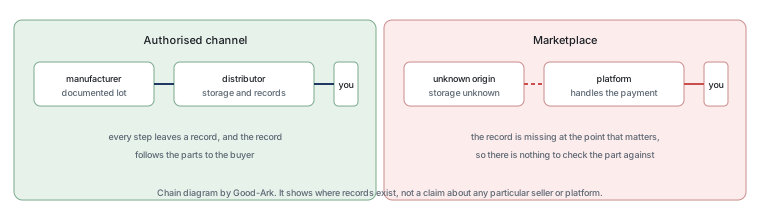
An authorised distributor is a business with a contract that entitles it to sell a manufacturer’s parts. A marketplace is a platform on which anyone can list anything. The difference is not quality or price; it is whether the chain of custody is known, and that is decided before the part reaches you.
Last updated:
Two ways to buy the same part
Both routes can deliver a genuine component, and both can deliver a problem. The distinction that matters is who is accountable for what you receive. In the distributor case, the chain runs from the manufacturer to a business that has agreed to conditions. In the marketplace case, the chain runs from an unknown seller through a platform that handles the transaction but does not warrant the goods.
The analogy that fits is buying a part from a franchised dealer versus a noticeboard. One comes with a documented history and a route back if something is wrong; the other comes with a price and a phone number. Neither is inherently dishonest, and only one of them lets you answer questions about where the part came from.
What distributors agree to
An authorised distributor normally agrees to buy through the manufacturer’s own supply chain, to store parts within the manufacturer’s conditions, to maintain traceability from lot to customer, to handle returns and warranty claims through a defined process, and to pass on technical support questions. Those obligations are commercial rather than moral, and they exist because the manufacturer’s reputation depends on how its parts are handled after they leave the factory.
What that buys a buyer is three things: a known origin, documentation that matches the shipment, and somebody to call who has a relationship with the maker. Those are worth little for a one-off experiment and a great deal for anything that ships.
What marketplaces will not promise
A marketplace promises that a transaction will complete. It does not promise that the seller’s parts came from the manufacturer, that they were stored correctly, that the lot can be traced, or that the part number on the listing corresponds to a manufacturer’s orderable number. Those are gaps in the platform’s role rather than a judgement about the sellers on it, and they are why the same listing pattern can produce excellent results and catastrophic ones.
Three specific gaps matter. Traceability, because a seller who bought surplus stock cannot tell you which production lot it came from. Condition, because parts that have been stored in a hot warehouse are electrically the same and no longer reliable. And identity, because a listing’s part number may be a seller’s own label rather than a manufacturer’s designation.
| Question | Authorised distributor | Marketplace |
|---|---|---|
| Where did these parts come from? | Through the manufacturer’s chain, documented | Unknown unless the seller can prove it |
| Which lot is this? | Recorded on the label and available to you | Usually not recorded |
| Were they stored correctly? | Part of the distributor’s obligations | Unverifiable |
| Does the documents match? | Documentation accompanies the shipment | Documentation is often copied from elsewhere |
| Who do I contact if it is wrong? | The distributor, with a route to the manufacturer | The platform’s dispute process |
| What does it cost? | Higher, reflecting handling and obligation | Lower, reflecting the absence of both |
Price difference explained honestly
The price gap has several causes and only one of them is a better deal. Distributors add handling cost for small orders, hold inventory, and carry administrative overhead for traceability and returns. Marketplaces avoid most of that by not taking responsibility for any of it. And some listings are cheaper because the parts are surplus, older stock or genuine parts being cleared.
What the price does not tell you is which of those applies. A listing at eighty per cent of the distributor price may be a well-run seller clearing excess stock, and it may be a re-marked part. The two look identical in a search result, which is precisely why price alone cannot be the deciding signal.
Where counterfeits enter the chain
Counterfeits enter where responsibility is thinnest. The usual routes are through brokers who buy surplus and relabel, through parts harvested from scrapped equipment, and through low-grade production that is re-marked as a higher grade. Each route relies on the buyer having no way to check the lot, and each route is much harder to operate through an authorised channel because the channel has records.
It is worth being precise about what counterfeiting means here. It rarely means a completely different device; more often it means a lower grade, an older die revision, a recycled part, or a device that failed a screen and was sold anyway. That is why a functional test in a prototype does not detect it: the part works, and it is not what you paid for.
When a marketplace is fine
For a prototype, a bench experiment, a hobby project or a repair where an error is harmless, a marketplace is often the sensible choice. The price advantage is real, the quantity needed is small, and the consequence of a marginal part is a rework rather than a recall.
The condition that makes it acceptable is that the part’s identity is testable. A rectifier you can measure, a resistor you can check, a connector you can inspect: those are things you can verify in ten minutes. The problem cases are the ones where the difference is invisible, such as a grade, a die revision or a stored-too-hot history.
Where a marketplace is dangerous
Four situations are worth naming. Anything that ships inside a product, because traceability becomes a requirement rather than a preference. Anything in a safety-related function, because the qualification evidence is part of the product. Anything where the difference between grades is invisible to a bench test. And anything where the part will operate near a limit, because a marginally lower grade fails exactly where a design has no margin.
None of those is about honesty. A seller can be entirely honest and still unable to tell you which lot you received, and that inability is the risk.
Decision table
| Your situation | Reasonable route | Why |
|---|---|---|
| Learning, breadboard, low voltage | Either, with a bench check | The part is verifiable and the consequence is small |
| Prototype that may become a product | Authorised distributor | You will want the documentation later, and re-sourcing is easier |
| Small production run | Authorised distributor | Traceability and warranty handling are part of the purchase |
| Obsolete or hard-to-find part | Independent distributor, with verification | Specialists find what nobody stocks; the checks move to you |
| Safety-related function | Authorised channel only | The qualification evidence is required, not optional |
| Operating near a limit | Authorised channel only | Grade and revision differences are invisible on a bench |
How to verify a purchase from either route
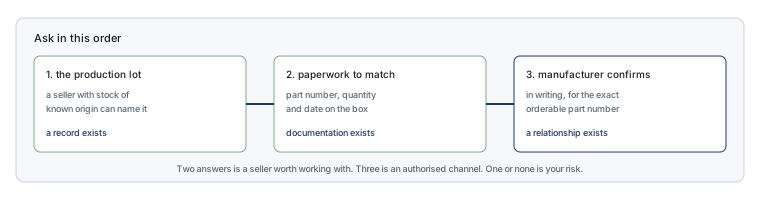
Verification is the same set of questions whichever route you used, and the difference is only who can answer them. Ask for the lot code and check that it appears on the packaging you received. Ask for the documentation that travels with the shipment and check that the part number, the quantity and the date on it match what arrived. Ask the manufacturer to confirm the channel, in writing, for that specific orderable number.
Then do the checks that need no cooperation from the seller. Compare the marking to the manufacturer’s own marking description, compare the part against a trusted sample if you have one, and inspect it under magnification for sanding or re-inking. None of those proves a part is genuine, and each of them reliably catches the crude cases, which are the majority of what reaches small buyers.
The rule of thumb is that the harder a question is to answer, the more it matters. A seller who can produce a lot code has a record. A seller who can produce the manufacturer’s confirmation has a relationship. A seller who has neither is asking you to carry the risk instead, which may still be a reasonable trade for a bench experiment and is not a reasonable trade for a product.
Our own articles cover distribution channels and electronic components. Component test methods come from JEDEC, marking and traceability expectations from IPC, quality management requirements from ISO, the substance restrictions that appear on declarations from the EU RoHS Directive, and sector-level context from the Semiconductor Industry Association. Regulatory and quality background is published by ECHA.
FAQ
Is it better to buy from an authorised dealer?
For anything that ships, usually yes, because the extra cost buys traceability, a documentation set and somebody accountable if the goods are wrong. For an experiment or a repair where an error is harmless, the premium may not be worth it. The useful question is not which route is better but what you need to be able to prove about the part afterwards.
What does “authorised distributor” actually mean?
That the manufacturer has an agreement with that business permitting it to sell its parts. The agreement normally includes buying through the manufacturer’s own supply chain, storing parts to specification, maintaining traceability and handling warranty claims. It is a commercial relationship rather than a certificate, which is why the current list has to come from the manufacturer rather than from a website that claims to hold one.
What are the disadvantages of using a distributor?
Three. Higher unit prices, especially on small orders, because handling and traceability cost money. Minimum order quantities and lead times that a marketplace seller would not impose. And less flexibility on odd quantities and mixed small orders. Those are real costs and they are worth paying when the documentation matters, which is the distinction the decision usually turns on.
Is a named retailer an authorised reseller?
We make no claim about any named company, because authorisation is granted per manufacturer and per agreement, and it changes. The check that settles it is the same for everyone: ask the manufacturer whether that business is an authorised channel, and ask for the answer in writing. A platform selling goods is not the same thing as a distributor with a contract, and the platform’s own name tells you nothing either way.
How can I tell whether a cheaper listing is a genuine bargain?
By asking what comes with it rather than by inspecting the price. Request the lot code, the documentation that accompanies the shipment, and the manufacturer’s confirmation of the channel. A seller who can answer all three is running a real business; a seller who cannot may still be honest, but there is nothing on which to base a decision.
What to do next
Decide before you shop what you need to be able to prove about the part. That single answer routes you to the right channel more reliably than any price comparison, and it is also the answer you will need when somebody asks why the part was chosen. The step that follows it is confirming the part number before you buy, which is where most of the avoidable mistakes are caught.
Ask Good-Ark to confirm whether a named business is an authorised channel for a specific part, and for the documentation that accompanies a shipment.
Email sales@goodark.com, or start from the authorised channels guide.
This article is published by Good-Ark, a manufacturer of discrete semiconductor devices. It makes no claim about any named platform or seller, and it does not publish a distributor list, because channel agreements change and should be confirmed with the manufacturer.
Continue through this engineering topic
For the complete selection, design, verification, and troubleshooting path, explore the Good-Ark Product and Sourcing Hub.
- Practical guide: Good-Ark Company History: Riding a Century of Electronics, From Radio Valves to Electric Cars
- Practical guide: What Does Good-Ark Electronics Actually Make? A Beginner’s Look at the Product Line
- Practical guide: Good-Ark, Good-Ark Semi, or Good-Ark Semiconductor? Sorting Out the Names
- Ask Good-Ark technical support about this application
Recommended
 Why Do Diodes Get Hot? Conduction and Switching Losses ExplainedInfoStandard, Fast Recovery, and Schottky Diodes: What’s the Difference?Info
 What Is a Fast Recovery Diode? Understanding “Fast Recovery”Info
 What Is a Diode? A Beginner’s Guide to How It WorksInfo
 Automotive Semiconductor Report 2026: Chips Per Car Keep RisingKnowledge