What Is Good-Ark? A Plain-Language Guide to the Brand Behind Millions of Tiny Parts
Good-Ark is a Chinese maker of discrete semiconductors. What the brand is, what it makes, and how to tell an official page from everything else.
If you searched the name and landed on a stock chart, a forum argument or a datasheet site you have never heard of, you did not search badly. Component brands live in an odd corner of the internet: the products are invisible, the customers are factories, and most pages that mention the name were not written by the company. This guide covers what the brand is, what it makes, and how to tell an official page from every other kind.
What “Good-Ark” actually refers to
Behind a brand name there is a legal company. Here it is Suzhou Good-Ark Electronics Co., Ltd., which designs and manufactures discrete semiconductor devices and packages them for sale to other businesses. “Good-Ark” is how that business is recognised in catalogues, datasheets and purchase orders; “Suzhou” identifies the city in Jiangsu Province, China, where it is based.
The easiest way to understand this category is to think about a screw. You have probably never chosen a screw manufacturer in your life, yet the chair you are sitting on contains dozens of screws that somebody specified, tested and bought in bulk. Discrete semiconductors work the same way. A phone charger contains a handful of them; a car contains thousands of electronic components of many kinds. The brand matters enormously to the factory that has to guarantee the product works for ten years, and barely registers with everyone else.
That is why the phrase “Good-Ark” is really a pointer to a supplier relationship, not to a product you buy in a shop.
Where the name comes from, and why you see several versions
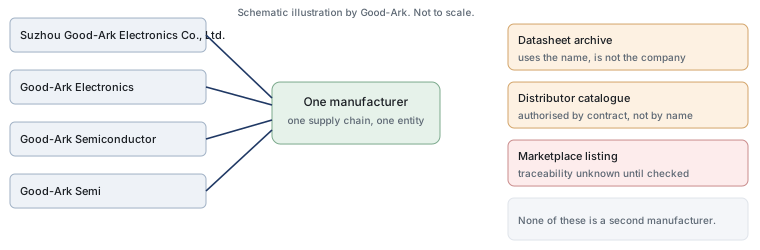
The name appears in several forms because companies use different names for different jobs. One form is the full registered entity, used in contracts and stock exchange filings. Another is the short form used as a product brand on labels and datasheets. A third is the version that appears in a distributor catalogue, where the manufacturer field has room for only a few characters.
So several names can point to one manufacturer, and similar-looking names can point to different websites. The official English-language site is the one the company publishes, and this technical blog is published by the same company. Beyond those you will meet datasheet aggregators, distributor catalogues, marketplaces, finance pages and forum threads — sources with very different authority.
One reason the name spreads so far is structural rather than suspicious. Component catalogues index devices by a manufacturer field, and that field has to be short; distributors copy those records into their own systems; archives collect the resulting documents. The name therefore travels further than the company’s own pages, and it arrives attached to sites that have never spoken to the manufacturer. Understanding that pattern is the difference between seeing a conspiracy and seeing an industry’s plumbing.
What the company makes, in plain words
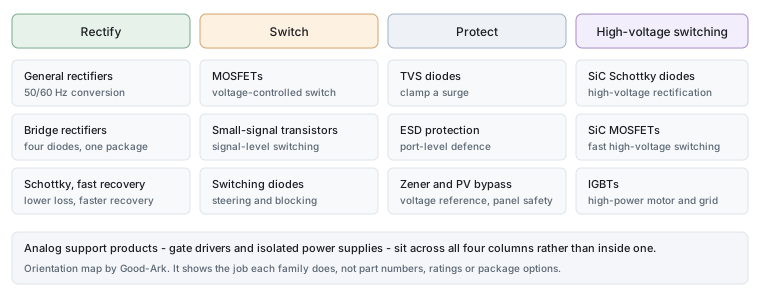
The portfolio sits in one broad category: discrete semiconductor devices. “Discrete” means the part does one job on its own, rather than being one of millions of tiny circuits printed inside a processor. Discretes are the workhorses of power conversion and circuit protection — and usually the parts that fail first when a design is stressed.
| Family | What it does, in one line | Where you would find it |
|---|---|---|
| Rectifier diodes | Act as a one-way valve so current can flow in one direction only | Turning wall power into the direct current a device needs |
| Bridge rectifiers | Four of those valves in one package, doing the same job more neatly | Adapters, appliance power boards, industrial supplies |
| Schottky and fast-recovery diodes | Faster, lower-loss versions of the same idea | Switching supplies, DC-DC converters, LED drivers |
| TVS, ESD and Zener devices | Clamp a sudden voltage spike or hold a voltage steady | Connectors, communication lines, automotive control units |
| Small-signal diodes and transistors | Tiny switches and one-way paths for signals rather than power | Control and sensing circuits |
| MOSFETs | Electronic switches operated by voltage, with no moving parts | Battery systems, chargers, motor drivers |
| SiC and IGBT devices | High-voltage, high-power switching | Electric vehicles, solar inverters, industrial equipment |
| Photovoltaic bypass diodes and modules | Give current an alternative path so a shaded panel does not overheat | Solar modules and arrays |
| Analog products | Gate drivers and isolated power supplies that support switching stages | Power conversion around MOSFETs and IGBTs |
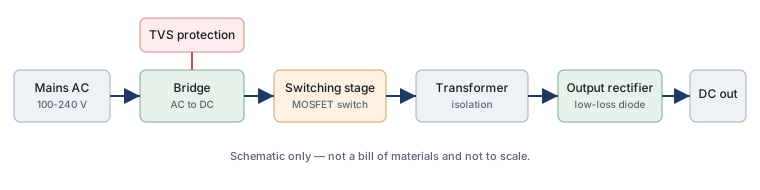
The idea behind that table is portfolio continuity. One power supply may use a bridge rectifier at the input, a TVS device at the connector, a MOSFET in the switching stage and a fast diode at the output. Buying several of those from one manufacturer simplifies qualification and long-term supply — the practical reason broad portfolios exist.
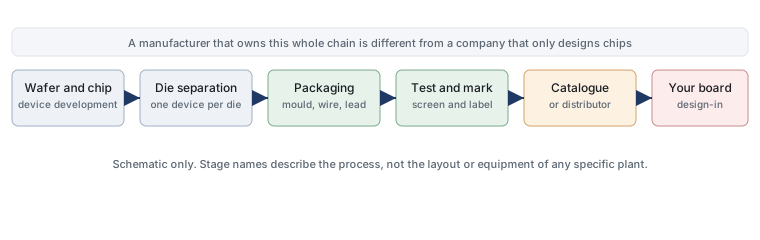
It is also worth knowing where in the chain a part comes from, because that determines what a supplier can tell you. A manufacturer that develops wafers and packages devices in its own plants can answer questions about process control and lot traceability directly; a trading company selling the same part number cannot, and will forward your question instead. That distinction explains why two suppliers of an identical part number behave very differently when something goes wrong.
Everyday places its parts end up
The applications served are not exotic: switching-mode power supplies, solar inverters, automotive electronics, lighting and electric power steering. Translated into objects, that is the charger in your bag, the LED driver in a ceiling panel, the electronics in a car door module and the power board of a rooftop solar installation.
How big is the company, and how should you judge that?
Size claims should be read the way an engineer reads a datasheet: with the measurement conditions attached. Revenue measures commercial scale, capacity measures how much product the company can physically make, and headcount measures support depth. A company can look large on one measure and modest on another.
The reliable route is the company’s own disclosures. Good-Ark was founded in 1990 and has been listed on the Shenzhen Stock Exchange since 2006 under stock code 002079 — a status that matters to a buyer, because a listed manufacturer must publish audited accounts and announce material changes. This guide deliberately does not reproduce revenue or employee figures, because published numbers vary between sources and years. Use the Shenzhen Stock Exchange for financial facts.
How to tell official information from everything else
A search for a component brand returns at least six kinds of page, and they are not equally trustworthy. Learning to recognise the page type takes ten minutes and prevents most purchasing mistakes.
| Page type | What it looks like | Good for | What to check |
|---|---|---|---|
| Official company site | Company-owned domain, product groups, application pages, quality pages | Current product families, package options, official documents | That the domain really belongs to the company, and the page revision date |
| Official technical blog | Explanatory articles, no shopping cart | Understanding a device class or an application | Whether the article is educational or a product claim |
| Datasheet aggregator | Thousands of part numbers, download buttons, advertising | Finding a starting document quickly | Document revision, issuing manufacturer, completeness |
| Distributor catalogue | Stock, price breaks, package options, filters | Availability, lead time, small quantities | Whether stock is real, and whether the part is the same die revision |
| Marketplace listing | Individual sellers, photographs, very low prices | Prototypes and non-critical experiments | Traceability. Treat the cheapest listing as unverified |
| Forum or social post | Opinions, experience, disagreements | Finding out which problems occur in practice | Whether the claim is evidence or anecdote. Useful for questions, not for specifications |
The working rule is short: the datasheet revision is the source of truth about the part; a product page is not. If two pages disagree about a rating, the newer official document wins, and if the document is missing, ask the supplier for it in writing.
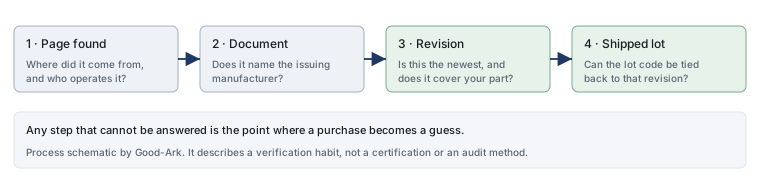
A short routine makes this practical. Pick the part you care about, find the page that describes it, and ask three questions before you use anything on it: who issued this document, when was this revision published, and does the device marking in the photograph match the part number in the text? If all three answers are available, you have something you can file. If any of them is missing, you have a lead rather than a specification, and it should not enter a bill of materials until it is resolved.
Four external references are worth bookmarking, because they are the documents buyers and manufacturers both answer to: JEDEC for device test methods, ISO for quality management systems, IPC for what happens to a part once soldered down, and ECHA’s explanation of REACH for chemical-substance duties. The EU RoHS Directive is the one most often quoted in component questionnaires, sector context sits at the Semiconductor Industry Association, and the field’s basic taxonomy is at the semiconductors.
On our own site, the practical next steps are what the company manufactures, how authorised channels and samples work, and sourcing verification if price is your only filter.
What the brand does not claim to be
What a brand is not is often more useful than what it is. Good-Ark is not a consumer brand with shops and retail packaging, it is not a designer of processors or memory — those are integrated circuits rather than discrete devices — and it does not sell single pieces directly to hobbyists. Parts reach designers through distributors, catalogues and direct business relationships. A page that uses the name is also not automatically connected to the company; the only way to know is to check the source.
FAQ for people new to the brand
Is Good-Ark a Chinese company?
Yes. The operating company is Suzhou Good-Ark Electronics Co., Ltd., based in Suzhou, Jiangsu Province, and listed on the Shenzhen Stock Exchange since 2006. Its customers are international — power supply, solar, automotive and lighting manufacturers — and it runs sales and support outside China as well.
Can I buy a single part from Good-Ark directly?
In practice, no: the company sells to businesses. For one or two pieces, a distributor is the normal route, and the quickest place to see whether a part number is still active. For production volumes, the company’s own sales channel is the contact point.
Why do forum threads argue about component brands?
Because a component brand attracts opinions from both directions. Engineers who have seen field failures distrust everything; buyers who found cheap parts that worked distrust premium pricing. Neither is evidence about your circuit. The useful question is specific: does this part, at this revision, meet this requirement, with documents that can be checked?
If the name is printed on the part, is it genuine?
Not necessarily. Marking is easy to copy, and counterfeiting affects every well-known brand in this industry. What is hard to copy is consistency: the same die, the same package, and documents that match the shipped lot. That is why professional buyers check packaging, marking, datasheet revision and traceability together rather than looking for a logo.
Where do I get official documents?
Start with the manufacturer’s own site for the product family, and take the document from the source rather than a mirror. Our guide to finding official datasheets and verifying what you read walks through the checks in order.
What to do next
If you came here asking whether the name is trustworthy, the honest answer is that trust in this industry is not a property of a name — it is a property of documents, revisions and traceability. Check the datasheet, check the source of supply, and check that whoever answers your question can point to a document. That applies to this brand and to every other one you will meet.
Good-Ark publishes product families, package information and quality documentation for design teams. If you need a datasheet revision, a compliance document or a sample request, contact sales@goodark.com or start from the product family learning centre.
This article is published by Good-Ark, the company described in it. It is written for people who want to understand the category; where a claim depends on the company’s own information, that is stated. Figures that require audited disclosure are not reproduced here by design.
Recommended
 What Does Good-Ark Electronics Actually Make? A Beginner’s Look at the Product LineKnowledge
 Suzhou Good-Ark: Why a Component Maker’s Home City Matters More Than You ThinkKnowledge
 Good-Ark, Good-Ark Semi, or Good-Ark Semiconductor? Sorting Out the NamesKnowledge
 Good-Ark Semiconductor Explained for People Who Do Not Work in ElectronicsKnowledge
 How Do Solar Garden Lights Work? (And Why So Many Die)Knowledge
 How a Power Adapter Turns Wall Power Into 5 V: A Guided TourKnowledge