Component Lead Times in 2026: What Is Actually Normal Now
Semiconductor lead times 2026: a quoted time is a chain of four stages, not one number. How to read stock signals and plan a buffer without hoarding.
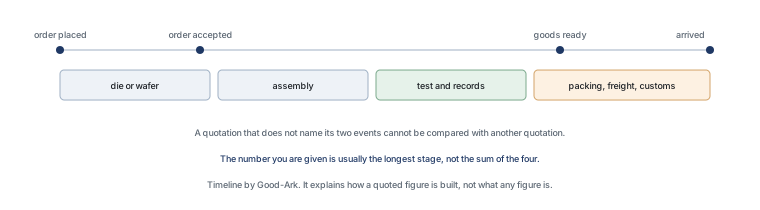
A lead time is not a property of a part; it is a current estimate produced by whichever stage of the chain is slowest. That is why two articles can quote very different numbers for the same industry in the same month and both be describing something real: one is measuring the parts in short supply and the other is measuring an average. The useful move is to find out which stage is driving the number you were given, and to treat the estimate as an indicator rather than a date.
What lead time really measures
Formally, a lead time is the interval between two events, and most disagreements about a lead time are disagreements about which two. The clock can start when an order is placed, when it is accepted, when a deposit clears or when a production slot is confirmed. It can end when the goods are ready, when they leave the factory, when they clear customs or when they arrive at your dock. A quotation that does not say which pair of events it describes cannot be compared with another quotation.
The second thing a lead time measures is capacity relative to demand, at the moment it was written. When demand is rising faster than capacity, the number extends; when new capacity arrives or demand softens, it shortens. That makes it a lagging indicator of the market and a leading indicator of your own schedule, which is the opposite of how it is usually read.
The four stages behind a quoted number
The chain has four stages and a quoted figure is usually an estimate of the longest one. Die or wafer availability comes first, and it is either satisfied from stock or from a production run. Assembly comes next, where the die is packaged. Test and documentation follows, and this is where lot records are produced. Packing, freight and customs close the chain, and this is the stage a buyer can most easily influence by choosing a faster shipping method.
Two questions settle which stage dominates. Is the part stocked as finished goods, in which case the clock starts at the last two stages? Or is it built to order, in which case the clock starts at the first? A part that is stocked can be shipped next week; the same part built to order has to be scheduled into a production line, and no amount of urgency changes the physics of a run.
Standard versus expedited parts
Many manufacturers offer more than one service level for the same device. A standard part is tested to the ordinary specification and shipped from normal production. An expedited option usually exists for customers who need samples or a first article sooner, and it can involve a separate test flow, a partial lot or a higher price. It is worth knowing that the expedited route is a different process rather than a faster queue, so it does not simply move you to the front of the same line.
The distinction matters for planning because expedited service is usually limited in quantity. It is a way to obtain samples or to bridge a gap, not a way to run production. A buyer who plans on expedited deliveries for a shipping product has moved a scheduling problem into the supplier’s hands without solving it.
Why the same family has different times
Three variables produce different lead times inside one product family. The package decides which assembly line is used, and a less common package has fewer lines and less buffer. The voltage or current rating decides which die is required, and a low-volume rating may not be in stock even when the popular ratings are. And the grade decides whether additional testing is needed, which adds a step that cannot be skipped for the order to be valid.
| Variable | Effect on the clock | What the buyer can do |
|---|---|---|
| Package | Chooses the assembly line and its queue | Check whether a compatible package is stocked |
| Voltage or current rating | Decides whether the die is on hand | Ask which ratings are stocked, not only which exist |
| Grade and screening | Adds test steps that cannot be omitted | Confirm the grade is genuinely required by the application |
| Packing | Tape and reel, tube or ammo pack have separate capacity | Ask whether the shipping pack can be substituted |
Reading a distributor stock signal
A distributor’s stock position is one of the few public indicators available to a small buyer, and it is easy to misread. A large quantity listed as available may be a single lot held in one location, which means one order can remove it entirely. A small quantity may be a cut-tape remnant rather than a production quantity. And a listing that shows a lead time alongside a stock figure is describing two different routes to the same part number.
Three signals are worth watching over time rather than in a single snapshot. Rising stock for a family while lead times extend elsewhere suggests a mix shift rather than a general shortage. Falling stock with stable lead times suggests the distributor is drawing down inventory rather than that the market is tightening. And a widening gap between quoted lead time and actual delivery is the most informative of the three, because it measures the reliability of the estimate rather than its value.
Planning buffer without hoarding
A buffer is a quantity of stock held to absorb a delay, and it has a cost: cash, space, and the risk that the parts are obsolete before use. A hoard is a buffer sized for a scenario nobody has quantified. The distinction is arithmetic rather than moral.
A workable method is to state the risk explicitly. If a delay of one delivery interval would stop a line, the buffer needed is one interval of consumption; if two suppliers exist and both would have to fail, the buffer can be smaller. Those figures come from your own production plan, and the exercise takes an afternoon. The numbers are imagined here only to show the shape of the calculation.
What to do when it slips
When a date moves, three things are worth doing in order. Ask which stage moved, because a slip in the assembly queue and a slip in customs have different remedies. Ask for the new estimate in writing, with the same start and end events as the original, so that the two numbers are comparable. And check whether the slip affects a stocked rating or a built-to-order one, because a stocked alternative may exist in a nearby grade or package.
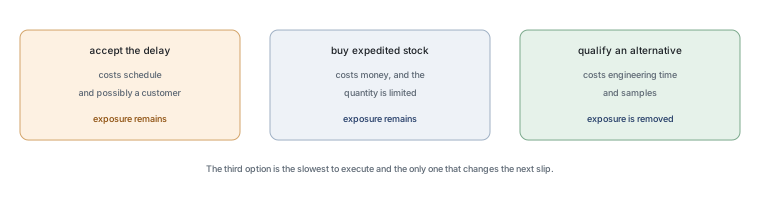
For a product already in production, the decision is usually a trade between three options: accept the delay, pay more for an expedited route that is limited in quantity, or re-qualify an alternative part. The third is the slowest to execute and the only one that permanently removes the exposure, which is exactly the argument for doing it before a slip happens.
Practical summary
Ask which events a quoted lead time describes and which stage sets it. Find out whether the part is stocked or built to order. Watch the gap between quoted and actual delivery for the parts you buy, because that is the reliability measure. Size a buffer from your own consumption and your own tolerance for a delay, and treat expedited service as a bridge rather than a plan. None of those steps requires a forecast, and all of them produce a schedule you can defend.
FAQ
Will semiconductor demand do well in 2026?
That is a market-direction question and it belongs to whoever is making the claim. What a buyer can observe directly is more useful: the lead time for the specific part, the stock position for the family, and whether your own suppliers are quoting longer or shorter intervals than they did last quarter. Those three are visible without a forecast and respond earlier than published figures.
Will there be a semiconductor shortage in 2026?
Shortages in this industry are usually device-specific rather than general, appearing as extended lead times for particular packages or ratings while other categories remain comfortable. The conditions that produce them are identifiable: capacity that lags demand, a single-sourced part in a high-volume product, and a demand surge concentrated in one process. The indicator is your own supplier’s answer about your own part number.
Is the semiconductor industry slowing down?
The industry is cyclical, and its segments move differently, so a general statement about slowing applies to some categories and not others. Analogue and power devices follow equipment production and electrification; logic and memory follow computing demand. A single quarter of weaker revenue in one segment is often a statement about inventories.
Why does a lead-time table show such high numbers?
Because aggregate tables usually take the worst case in each category, or the longest quoted figure across a group of part numbers, and then present it without the qualifier. That is useful as a signal about pressure in a segment and misleading as a planning figure, because the parts a given buyer uses may be stocked while the headline describes a different category.
Should I buy stock now to avoid a future delay?
Only against a stated risk. Buying because a headline suggests a shortage converts a scheduling problem into inventory, cash and obsolescence risk, and it can be worse than the delay it was meant to prevent. The defensible version is to quantify how long a line can run without a delivery and to hold that much and no more.
What to do next
Ask your current supplier two questions about the part you buy most: which stage sets the lead time, and what the gap has been between quoted and actual delivery over the last few orders. Both answers are free, and together they describe your real exposure. The beginner-friendly explanation of minimum order quantities and first orders is in our guide to MOQ and lead time, and the second-source argument is set out in sourcing strategy.
Standards and sector material are available from JEDEC, IPC, ISO, the Semiconductor Industry Association, NIST, and our overview of supply chains. Sector and energy background is published by the US Department of Energy.
Send Good-Ark the orderable part number and the quantity, and ask for the current estimate with the start and end events stated, plus the packing unit for that part.
Email sales@goodark.com, or start from the sourcing strategy guide.
This article is published by Good-Ark, a manufacturer of discrete semiconductor devices. It publishes no lead-time figure, shortage probability or market forecast of its own; lead times are quoted per part number and per enquiry.
Recommended
 Why Does Your Phone Charger Get Warm?Knowledge
 Energy Efficiency Rules Worldwide: How Regulations Shape Component ChoicesKnowledge
 Wide-Bandgap Semiconductors: Adoption Report 2026Knowledge
 The GaN Charger Market: Why Your Next Adapter Is SmallerKnowledge
 China’s Power Semiconductor Industry: Where It Stands in 2026KnowledgeHow to Read a Diode Datasheet: Key Parameters for BeginnersInfo