Wide-Bandgap Semiconductors: Adoption Report 2026
Wide bandgap semiconductor market: what an adoption rate actually measures, how far SiC and GaN have reached, and why forecasts differ so much.
An adoption rate is not one number, and treating it as one is the main mistake in reading this subject. Adoption has to be stated per application, because the same device family can hold most of one segment and almost none of another. Silicon carbide is well established in traction inverters and barely present in phone chargers; gallium nitride is the reverse. A single “wide bandgap adoption” figure averages the two and describes neither.
What adoption rate means
Adoption can be measured in four ways, and they give different answers. By device count, because there are far more small switches than large ones. By revenue, which weights the expensive devices heavily. By installed capacity in the applications that use them, which lags the design decisions. And by the number of design wins, which leads everything else because it measures what will be built rather than what is in service.
A useful analogy is a road network: the share of vehicles that are electric tells you something different from the share of kilometres driven electrically, and both differ from the share of new vehicles sold. None of the three is wrong, and quoting one while describing another is what produces apparent contradictions.
Automotive: the leading edge
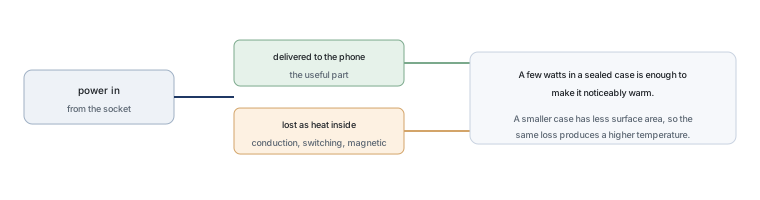
Automotive traction is where wide bandgap devices are furthest along, because the benefit is largest and the customer can measure it. A device with lower switching and conduction loss reduces the heat that has to be removed, and in a vehicle the cooling system has weight, volume and cost of its own. That is why the technology was adopted in high-voltage platforms before it appeared in most consumer products.
The position is not universal across a vehicle, and the distinction matters. A traction inverter is a natural fit for silicon carbide MOSFETs. The auxiliary power supplies and body electronics inside the same vehicle are ordinary voltage levels where silicon is entirely adequate, and a design that spends wide bandgap devices on those functions spends money for no benefit. Adoption therefore looks high from the perspective of the traction system and modest from the perspective of the whole car.
Solar and storage
Solar conversion has a straightforward argument for wide bandgap devices: the efficiency gain is realised on every hour of operation for the life of the installation, which is a much longer duty than a drive cycle. The counterweight is capital cost, because a utility-scale plant is purchased on cost per watt, so adoption has been gradual and depends on the price difference at the time of the order.
Storage adds a second reason, which is that the converter has to work efficiently across a wide battery voltage range rather than at a single point. A device with lower losses at part load has an advantage there, and the effect on cooling can be as valuable as the efficiency itself in a sealed enclosure.
Data centre and server power
Server power has become the most interesting segment of the three, because the architecture has moved in the direction the technology favours. Distributing power at a higher voltage to reduce current reduces the loss in the distribution, and every conversion stage added along the way is a place where a lower-loss switch is worth something. Efficiency also has a double value in a data centre, because wasted electricity has to be paid for twice: once as it is consumed and again as heat is removed.
The limiting factor is cost per watt, particularly in the point-of-load converters where the quantities are very large and the savings per unit are small. That is a segment where adoption depends on the price curve rather than on the technical argument, which is already settled.
Consumer adapters
Consumer adapters are where gallium nitride made its reputation, and where “adoption” is easiest to see because the products are on a shelf. The driver was a standard that allowed a small connector to carry the power a laptop needs, which created a mass market for a compact adapter. Once the market existed, device cost fell with volume, and the category became mainstream.
It is worth being precise about what was adopted. The gallium nitride device replaced the primary switch in a flyback converter; the rectifier on the output side is often still a silicon Schottky diode, because at low voltage a Schottky is efficient and inexpensive. A product can therefore be marketed on a wide bandgap claim while containing silicon devices that do most of the current handling.
Industrial motor drives
Industrial drives are the slowest of the segments, for a reason that is commercial rather than technical. A drive is part of a production line, it is expected to run for many years, and the cost of being wrong is measured in downtime rather than in a bill of materials. Qualification and field history therefore take longer to accumulate, and the incentive to change a working design is weak.
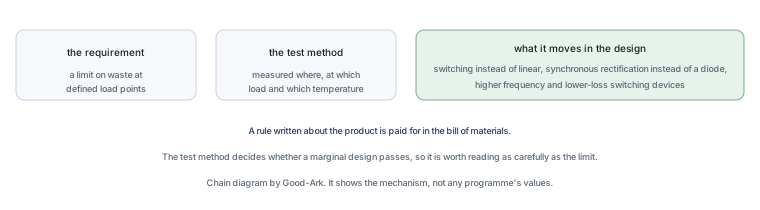
Where drives do migrate first is in efficiency-regulated applications and in equipment where a smaller cabinet is valuable, because those are cases where the benefit can be quantified before the design change. That pattern is the general rule in this subject: adoption follows the size of the measurable benefit, not the elegance of the technology.
| Application | Where adoption stands | What limits the pace |
|---|---|---|
| EV traction | Established in high-voltage platforms | Substrate supply and cost per vehicle |
| Solar and storage | Growing steadily | Cost per watt at the point of purchase |
| Data centre power | Moving in step with rack architecture | Price against very large volumes |
| Consumer adapters | Mainstream for the primary switch | Already competitive; designs are stable |
| Industrial drives | Selective and slow | Qualification and proof of field life |
Why forecasts differ so much
Consider the AI summary that a search engine may show for this topic. The version recorded for this article’s planning row describes a market of roughly 2.7 billion dollars growing to more than 7.7 billion by 2034, at a compound annual rate somewhere between about 14 and 22 per cent, with Asia-Pacific the largest region. Read that carefully and the diagnostic is in the range: a forecast that spans eight percentage points is not a measurement with an uncertainty, it is a statement that the underlying studies define their subject differently.
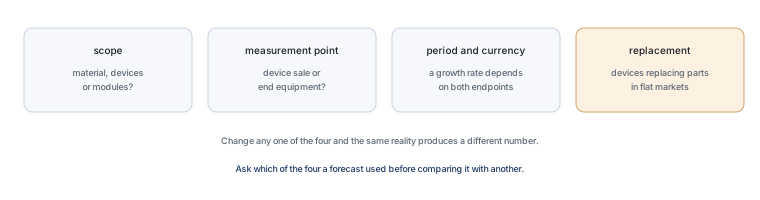
Four definitional choices explain most of the spread. Whether the scope includes the devices only or the material, the modules and the packaging. Whether revenue is counted at the device sale or at the end equipment. Which currencies and years are used at the ends of the growth calculation, because a compound rate is very sensitive to both. And whether the number includes devices that are technically wide bandgap but functionally replacing something in a market that is not growing.
Caveats and sources
Statements about adoption should name the application, the measurement and the period. Statements about market size should name the scope. Where a figure arrives through a search summary rather than from a document, it should be treated as a pointer to a study rather than as a study, because the summary has already compressed the definition out of it. And where a compound growth rate is quoted, the years at each end of the calculation should be stated, because changing them changes the answer.
For a buyer, none of that is a reason to ignore the subject. It is a reason to ask a supplier about the parts in front of you: which material, which voltage class, which qualification, and what the ordering unit is. Those questions have answers, and they are more useful than any market figure.
FAQ
What are wide-bandgap semiconductors?
They are semiconductors whose band gap — the energy needed to move an electron into the conduction band — is substantially larger than silicon’s. The practical effect is that a device of the same voltage rating can be built in a thinner layer with lower resistance and can switch faster, which is why the materials are used in power conversion. The two in commercial use are silicon carbide and gallium nitride.
Which semiconductor has the highest band gap?
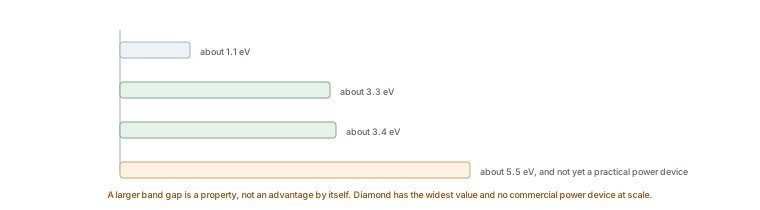
Among materials that attract engineering interest, diamond has the widest band gap at roughly 5.5 eV, followed by gallium oxide at around 4.8 eV. Neither is a routine commercial power device today, and that is the useful lesson: a wide band gap is a property, not a product. Silicon carbide at about 3.3 eV and gallium nitride at about 3.4 eV are the two that are actually shipped in volume.
What are typical band gaps in semiconductors?
Silicon is about 1.1 eV and germanium about 0.7 eV, which are the classical values. Silicon carbide is around 3.26 eV, gallium nitride around 3.4 eV, gallium oxide around 4.8 eV and diamond around 5.5 eV. Values vary slightly between sources and with the crystal form, which is why they are usually quoted as approximate.
Is adoption of wide bandgap devices accelerating?
It is growing in the applications where the benefit can be measured before the design change, which is traction, high-power conversion and the densest computing supplies, and it is slower where a long field history is required. That produces an average figure that rises steadily while the underlying segments move at very different speeds.
Why do market forecasts for this subject disagree?
Mostly because they define the scope differently: material, devices or modules; revenue at the device or at the end equipment; two different endpoints for a compound growth calculation. A published summary can compress those choices out of the figure entirely, which is why a range of several percentage points should be read as evidence of definitional difference rather than as uncertainty about one measurement.
What to do next
Ask a supplier three questions about the part in front of you: which material, which voltage class, and what evidence of qualification exists. Those answers are checkable, and they do not depend on a forecast. The plain-language introduction is in wide bandgap components in plain language, the comparison is in silicon carbide and gallium nitride compared, and the product families are in the silicon carbide portfolio.
Background is available in our overviews of band gaps, silicon carbide and gallium nitride, standards material from IEC and JEDEC, sector context from the Semiconductor Industry Association, and energy-technology material from the US Department of Energy. Sector and energy background is published by NIST and ISO.
Tell Good-Ark the voltage, the current, the switching frequency and the cooling available, and we will tell you which material and family fit the duty and what the ordering unit is.
Email sales@goodark.com, or start from the silicon carbide portfolio.
This article is published by Good-Ark, a manufacturer of discrete semiconductor devices including silicon carbide products. It publishes no market value or adoption estimate of its own, and the market range discussed is quoted as it appeared in a recorded search summary, attributed to its source rather than presented as this article’s finding.
Recommended
 Why Does Your Phone Charger Get Warm?Knowledge
 Energy Efficiency Rules Worldwide: How Regulations Shape Component ChoicesKnowledge
 The GaN Charger Market: Why Your Next Adapter Is SmallerKnowledge
 Component Lead Times in 2026: What Is Actually Normal NowKnowledge
 China’s Power Semiconductor Industry: Where It Stands in 2026KnowledgeHow to Read a Diode Datasheet: Key Parameters for BeginnersInfo