Searching by Parameter Instead of by Name: A Beginner’s Guide
Search components by parameter: beginners look for a part number, engineers look for requirements. The four parameters that narrow any catalogue, and margin.
Beginners search for a part number because a tutorial used one. Engineers search for a set of requirements because a circuit has them. Learning the second habit is what turns component selection from guesswork into a routine that produces a defensible choice even when nothing in the catalogue is familiar.
Last updated:
Why beginners get stuck on part names
A part number feels concrete, and a requirement feels vague, so the number attracts. But the number is an outcome of a selection, not an input to it: somebody decided on a voltage, a current, a package and a level of cost, and the number is the result. Starting from the number means borrowing somebody else’s requirements, which may not match yours.
The practical cost of that habit appears when the part goes out of stock or the design changes slightly. A design chosen from requirements can be re-sourced by re-running the same filter; a design chosen from a number has to be re-derived from scratch.
The four parameters that narrow everything
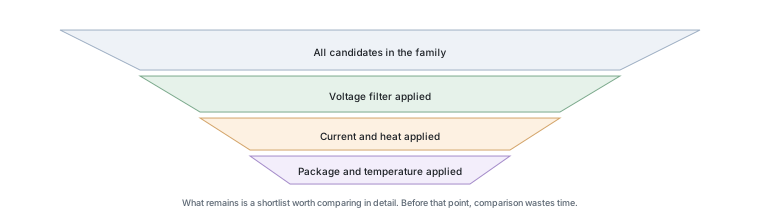
Four filters do most of the work for any component: the voltage it must withstand, the current it must carry, the package it must fit, and the temperature range it must survive. Everything else refines the choice between the survivors.
The order matters because each filter removes different candidates. Voltage eliminates parts physically incapable of the job. Current and the associated heat eliminate parts that would fail thermally. Package eliminates parts that will not fit or cannot be cooled where they are mounted. Temperature eliminates parts specified for a gentler environment than yours.
| Filter | What it removes | How to set it |
|---|---|---|
| Voltage | Parts that cannot block the worst case | Peak voltage plus margin for transients, not the nominal supply |
| Current and heat | Parts that would overheat at your current | Working current with the thermal path you actually have |
| Package | Parts you cannot mount or cool | Footprint, mounting method and available copper area |
| Temperature | Parts specified for a gentler environment | The ambient inside your enclosure, not the room you test in |
Voltage margin: how much headroom
The voltage filter is set against the worst voltage the part will ever see, not the one it sees on the bench. In a resistive circuit that is roughly the supply. In a circuit with an inductor — a relay, a motor, a transformer, a long cable — interrupting the current produces a spike that can be several multiples of the supply, and that spike lands on the component in the direction it is supposed to block.
How much margin is enough is a judgement rather than a rule. Standard practice is to allow a substantial margin above the calculated worst case, and to treat any circuit containing an inductive load or a cable that leaves the enclosure as one where the worst case is larger than it first appears. Undersizing this filter is the single most common cause of a part that works for months and then fails.
Current: rating versus reality
A current rating is quoted at a case temperature, in a mounting condition, and often for a specified waveform. Change any of those and the achievable current changes. For a device that dissipates power while conducting, the honest approach is to work from the heat rather than the headline figure: estimate the loss, estimate the thermal resistance of your actual mounting, and check the resulting temperature against the limit.
Two effects make the headline figure optimistic in a real product. A sealed enclosure raises the ambient the device sees, which adds directly to its temperature. And the loss itself rises as the device warms, because the parameter that causes it usually degrades with temperature. Both are why the same component can be comfortable on an open bench and marginal in an assembled unit.
Package and mounting
The package decides three things at once: whether the part fits your board, whether you can attach it, and how well it sheds heat. A manufacturer’s thermal rating usually assumes a stated copper area, and mounting the part with less copper than that assumption means the rating does not apply.
For a beginner the useful heuristic is to prefer packages you can see and reach. Through-hole and leaded surface-mount parts are easier to verify visually and to rework, and their thermal behaviour is easier to reason about. Leadless packages with a pad underneath are excellent once you have the process for them and frustrating before that, because the joint you cannot see is the one that decides the thermal path.
Temperature range matters more than you think
The temperature specification has two parts that beginners often conflate: the ambient range the part is rated for, and the maximum junction temperature it can tolerate. A part rated for a wide ambient range but with a modest junction limit may still be unsuitable if your circuit drives it close to its dissipation capacity.
The practical version of this is to set the filter from the ambient inside your enclosure rather than the room you test in. A box in the sun or beside a regulator can easily be thirty degrees warmer than the bench, and that difference is applied directly to every junction inside it.
Reading the filtered result list
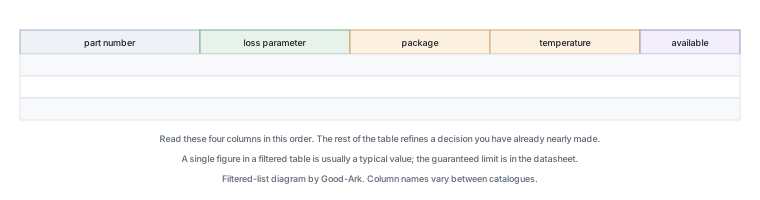
A parametric search returns a table, and the table is where beginners lose the advantage they just gained. Four columns are worth reading in order: the ratings that match your filter, the parameter that determines your loss, the package, and the availability. Everything else is refinement.
Two cautions apply to filtered lists. A parameter shown as a single number is often a typical value, and the guaranteed limit in the datasheet may be worse. And a list sorted by one column encourages choosing on that column alone, which is exactly the mistake the filtering exercise was meant to avoid.
Two details about reading a filtered list are worth stating separately, because they quietly distort comparisons. A column showing one number per part is usually a typical or headline value, not a guaranteed limit, and the datasheet may specify something worse. And a list sorted by a single column encourages choosing on that column, which is precisely the mistake the filtering exercise exists to avoid. Read the filtered list as a shortlist, not as a ranking.
Practice exercise
Take a switching job you understand and write the four filters for it before looking at any part. For a low-voltage load switch driven from a logic pin, the filters might read: block at least twice the supply to allow for transients; carry the load current with the loss your board can remove; fit a package you can solder; and operate at the temperature inside the enclosure with the gate voltage your logic provides.
Then run the filters on a catalogue and note how many candidates remain. The point of the exercise is not the answer; it is that the requirement existed before the part did, which is the habit this article is about.
Background written for beginners covers electronic components and filtering as a general concept. Component test methods come from JEDEC, thermal and assembly expectations from IPC, the substance restrictions that appear on component declarations from the EU RoHS Directive, and sector-level context from the Semiconductor Industry Association. Document and standards background is published by ISO and NIST.
FAQ
Why can I not just search for the part a tutorial used?
You can, and for a first experiment it is the fastest route. The problem appears when something changes: the part goes out of stock, the supply voltage differs, or the load is heavier. A design chosen from requirements can be re-sourced by re-running the same filter, while a design chosen from a number has to be re-derived. Learning the second habit early costs a little time and saves a lot later.
How much voltage margin should I allow?
Enough to cover the worst case the circuit can produce, which is usually larger than the supply. For circuits with an inductor — motors, relays, transformers — or with a cable that leaves the enclosure, the transient can be several multiples of the nominal voltage. Standard practice allows substantial headroom above the calculated worst case, and it is better to over-specify this filter than to discover the transient after the first failure.
Is a bigger current rating always safer?
Safer in the sense of running cooler, but not free. A device rated for much more current usually has a larger die, a bigger package and a higher price, and the extra capability may be wasted. More importantly, the headline rating is quoted at a case temperature you may not achieve, so a genuinely adequate part with a good thermal path can outperform a larger part mounted badly.
What does a parametric search not tell me?
It does not tell you the guaranteed limits, because filtered tables usually show typical or headline values. It does not tell you how the parameters behave at your temperature, which is in the datasheet curves. And it does not tell you whether the part suits your circuit, because that depends on conditions the catalogue does not know. The search narrows; the datasheet decides.
How do I know when to stop filtering?
When the list is short enough to read each datasheet properly. That is usually a handful of candidates, and the comparison at that point is worth doing carefully rather than by sorting the list on one column. If the list is still long, one of the filters is set too loosely; if it is empty, one is set too tightly.
What to do next
Write the four filters for your current project and keep them. They become the specification you check a substitute against in two years, and they let somebody else repeat the selection without re-deriving it. The verification steps that follow a selection are in our article on finding a replacement part.
Give Good-Ark the voltage, the current, the package and the temperature range, and we can point to the family and rating class that meet them with margin.
Email sales@goodark.com, or start from the product family learning centre.
This article is published by Good-Ark, a manufacturer of discrete semiconductor devices. It describes a selection method rather than any specific part; ratings, thermal data and package options belong to the current official datasheet.
Continue through this engineering topic
For the complete selection, design, verification, and troubleshooting path, explore the Good-Ark Product and Sourcing Hub.
- Practical guide: How to Search for a Part Number and Confirm It Is Real
- Practical guide: Authorized Distributor vs Online Marketplace: What Is the Real Difference?
- Practical guide: Good-Ark Company History: Riding a Century of Electronics, From Radio Valves to Electric Cars
- Ask Good-Ark technical support about this application
Recommended
 Why Do Diodes Get Hot? Conduction and Switching Losses ExplainedInfoStandard, Fast Recovery, and Schottky Diodes: What’s the Difference?Info
 What Is a Fast Recovery Diode? Understanding “Fast Recovery”Info
 What Is a Diode? A Beginner’s Guide to How It WorksInfo
 Automotive Semiconductor Report 2026: Chips Per Car Keep RisingKnowledge