Where to Buy Good-Ark Parts: Authorized Channels, Samples and Quotes
The difference between a smooth prototype and a two-week delay is often not the part — it is the buying path. A…

The difference between a smooth prototype and a two-week delay is often not the part — it is the buying path. A sample request without the application details, a quote without the volume tier, or a distributor claim without verification can each stall a design that the component itself would have supported. This guide explains how to buy Good-Ark semiconductors at each stage of the design cycle: samples for prototypes, quotes for pilot builds, and supply agreements for production — and how to verify that the parts you receive are the parts you specified.
Last updated:
Every Good-Ark purchase starts with the part number and its current datasheet
Every purchase should start with the exact part number and its current datasheet from the product page — the ordering information references that document revision, and any distributor listing that disagrees with it is unverified until proven otherwise.
The part number and datasheet are the contract. Good-Ark product pages list the part number, package, rating table and datasheet link, and the purchasing conversation should reference that exact revision. A distributor listing with different parameters or an older revision is a red flag, not a substitute. The product grouping pages organize the catalog by family — rectifiers, bridges, protection, small signal, MOSFETs, SiC and IGBTs — so an engineer who knows the function can navigate to the family and then to the part. Starting anywhere else risks buying a part that only looks like the one in the BOM.
What should a sample request include?
A sample request should include the exact part number and quantity, the datasheet revision, the application and operating conditions, any compliance documentation needs, and the shipping address and timeline.
Sample requests go faster when the supplier can confirm the part fits before you spend a prototype cycle. Include the application — output voltage, current, frequency, ambient — so the engineering team can catch a specification mismatch early. State any compliance needs such as automotive qualification or RoHS/REACH statements, because those documents follow the part number and the request. Provide the shipping address and the timeline, since sample availability and logistics vary by region. A complete first request turns a sample order into a design review; an incomplete one turns it into an email exchange.
A comparable quotation defines price tier, lead time, MOQ and freight
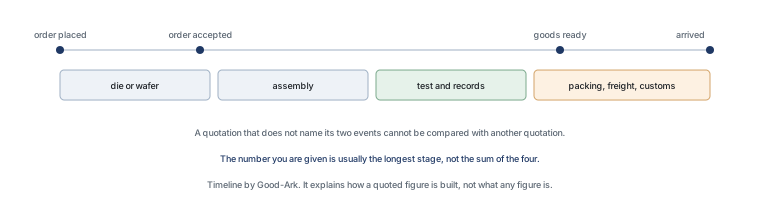
A quotation is comparable when the variables are defined: price at your volume tier, lead time, minimum order quantity, and whether the quote covers freight and customs for your destination.
The component price is only one line of the comparison. Ask for the price at the volume you actually plan to order, the lead time from order to delivery, the minimum order quantity, and the freight terms. For production forecasts, ask how the supplier wants the forecast communicated — discrete semiconductor capacity is planned in advance, and a rolling forecast protects both sides. If the part is a cross-reference candidate, provide the original part’s datasheet and application conditions so the equivalent can be checked against the parameter window, not just the pinout. A quote without those variables is a starting point, not a decision document. ECIA’s lead-time explainer shows why the planning variables matter for any semiconductor purchase.
.png)
How do you verify an authorized distributor?
Check the supplier against the manufacturer’s official channel information before buying outside the direct route; a supplier not on the list may still be legitimate, but the buyer takes on the verification burden.
The authorized model is documented in real partnerships — Astute Group’s Good-Ark announcement and Computer Controls’ partnership press release are examples of the distributor model in EMEA. For any supplier, request chain-of-custody documents, confirm the date and lot codes against the manufacturer’s format, and inspect the parts before they enter production. For critical power components, the authorized channel is the default and anything else is a documented risk decision. The verification steps are the same whether the supplier claims authorization or not; the difference is who carries the burden of proof.
Every production shipment needs the documents that prove lot traceability
A production shipment should include the packing list with the manufacturer’s part number, quantity and date codes; the invoice with commercial terms; compliance statements where required; and the certificate of conformance for the lot.
File the documentation with the lot information so a future issue can be traced to a defined population. The packing list and invoice establish what was ordered and shipped; the RoHS/REACH statements and certificate of conformance establish what the lot claims; and automotive programs add the quality documentation their PPAP and qualification requirements specify. If the supplier cannot produce the certificate of conformance or the date codes match nothing the manufacturer publishes, the shipment is suspect regardless of the markings. Traceability is not paperwork — it is the difference between a contained field issue and an entire-lot recall.
How do you get technical support after the order?
Contact technical support with the schematic, the waveforms and the operating conditions documented — application engineering helps with datasheet interpretation, circuit questions and cross-references before and during design-in.
The buying relationship does not end at the purchase order. If a part does not behave as expected on the bench, the fastest path is the supplier’s technical support with the schematic, the waveforms and the operating conditions attached. A component supplier that answers design questions is also the one that catches a specification mismatch before it becomes a field failure. Use the support channel early — during selection, not after the BOM is locked — because a datasheet question answered in an afternoon is cheaper than a prototype revision answered in a week.
Lead times shape the buying decision from sample to production forecast
Lead time shapes the decision because discrete semiconductor capacity is planned in advance: a prototype can be covered from sample stock, but a production forecast with a realistic horizon is what protects the line when demand moves.
The buying path should therefore ask the lead-time question at every stage, not only at the production order. For a prototype, sample availability and small-quantity stock usually cover the need within days. For a pilot build, confirm the lead time before committing the schedule. For production, provide a rolling forecast and update it as the demand picture changes, because the supplier plans capacity from those numbers. If the part is a second source or a cross-reference, the lead-time comparison belongs in the decision alongside the price and the parameter window — the cheapest source is not the cheapest if it cannot deliver when the line needs the parts.
| Stage | What to send | What to expect back |
|---|---|---|
| Sample request | Part number, application, compliance needs | Availability, fit confirmation, timeline |
| Quotation | Volume tier, destination, forecast | Price, lead time, MOQ, freight terms |
| Production order | Forecast, documentation requirements | Shipment with packing list and certificates |
| Design support | Schematic, waveforms, operating conditions | Application engineering review |
Frequently asked questions
Can I buy small quantities for a prototype?
Yes. Samples and small-quantity orders are the normal entry point for design work; use the sample and quote process with the application details included. Prototype quantities rarely need a full forecast, but the request goes faster when the part number, datasheet revision and operating conditions are complete.
How do I know a distributor is authorized?
Check the manufacturer’s official channel information; do not rely on a distributor’s own claims. If the supplier is not listed, treat the purchase as unverified until you have chain-of-custody documents, matching date codes and a certificate of conformance. For critical parts, the authorized list is the source of truth.
What if the part I need is a cross-reference?
Provide the original part’s datasheet and application conditions. The Good-Ark equivalent must match the parameter window — voltage class, current at the case temperature, surge, package and thermal resistance — not just the footprint or the prefix. The engineering team confirms the equivalent before you commit the BOM.
Do I need a forecast for production?
For volume production, yes. Discrete semiconductor capacity is planned from forecasts, and a rolling forecast lets the supplier reserve capacity and protect your lead time. The forecast does not need to be perfect — it needs to be communicated and revised as the demand picture changes.
What the buying path comes down to
The buying path comes down to the part number, the application details and the documentation: start from the current datasheet, send the operating conditions with every request, and verify the supplier and the shipment before production.
The sample request, the quotation and the production order each go faster when the technical information is complete on the first contact. Verify the channel, file the lot documentation, and keep the support channel open through design-in. The part that ships is only as good as the paper trail that proves it is the part you designed in.
The sample and quote guide walks through the request workflow, and the contact page connects you with the sales and engineering teams. Start the conversation with the part number, the application and the volume, and the buying path follows from there.
Continue through this engineering topic
For the complete selection, design, verification, and troubleshooting path, explore the Good-Ark Product and Sourcing Hub.
- Practical guide: Good-Ark Compliance Documentation: RoHS, REACH and Quality Certificates
- Practical guide: RoHS and Halogen-Free Compliance for Power Components: A Practical Guide
- Practical guide: Avoiding Counterfeit Power Semiconductors: Sourcing and Verification
- Ask Good-Ark technical support about this application
Recommended
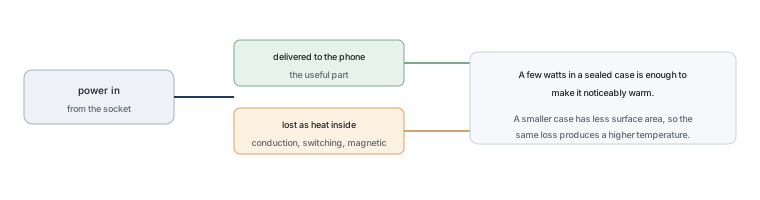 Why Does Your Phone Charger Get Warm?Knowledge
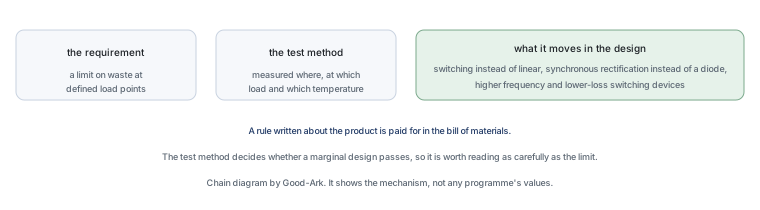 Energy Efficiency Rules Worldwide: How Regulations Shape Component ChoicesKnowledge
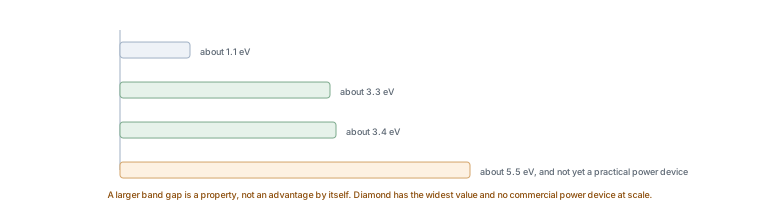 Wide-Bandgap Semiconductors: Adoption Report 2026Knowledge
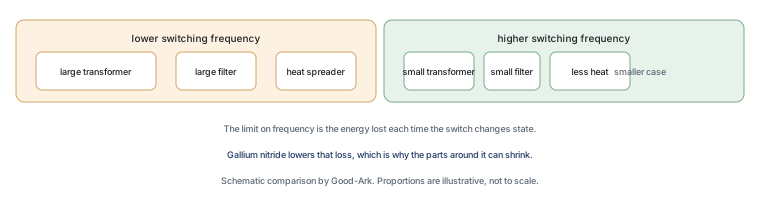 The GaN Charger Market: Why Your Next Adapter Is SmallerKnowledge
 Component Lead Times in 2026: What Is Actually Normal NowKnowledge
 China’s Power Semiconductor Industry: Where It Stands in 2026Knowledge