Good-Ark Cross Reference: Finding Equivalents for Legacy Part Numbers
Replacing a discontinued diode is a specification exercise rather than a search exercise, and the difference matters because the obvious approach —…
Replacing a discontinued diode is a specification exercise rather than a search exercise, and the difference matters because the obvious approach — finding something with a similar number — produces false confidence. The method below takes about twenty minutes per part and produces a substitution you can defend.
When replacement is the right move
Replacement is appropriate when the original is obsolete and no equivalent remains available, when a second source is needed to protect supply, or when the circuit is being revised anyway and the original is inconvenient. It is not appropriate when the original is merely hard to find, because a substitute introduces verification work that a stocked original does not.
It is also worth distinguishing two situations that look similar. Replacing a part in an existing product is constrained by everything already fixed: the footprint, the thermal path, the enclosure and the qualification already completed. Choosing a part for a new design has none of those constraints. The method below assumes the harder case, which is replacement, because it is stricter and covers both.
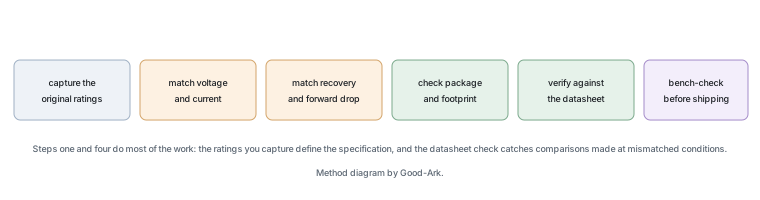
Step 1: capture the original ratings
Write down six things from the original datasheet rather than from the schematic or the purchase record. The reverse voltage rating. The average forward current and the case temperature it was specified at. The forward voltage at your operating current. The surge current rating with its waveform. The reverse recovery behaviour or the family that implies it. And the package with its thermal characteristics.
Two of those are frequently omitted and both matter. The case temperature attached to the current rating tells you whether the figure was optimistic for your mounting. And the recovery behaviour decides whether a substitute will work in a switching circuit even if its voltage and current match, because a slow part in a fast circuit becomes a heat source and a noise source rather than a functional equivalent.
Step 2: match the critical parameters
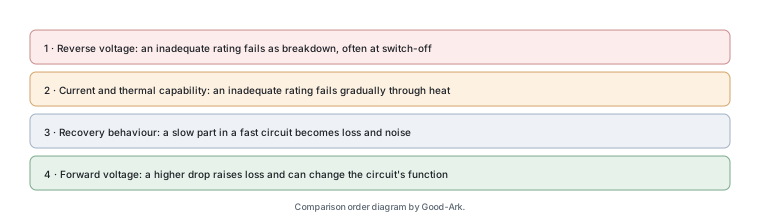
Match voltage first, then current, then speed, then forward voltage. The order reflects how badly each mismatch behaves. An inadequate voltage rating fails in avalanche, usually at the moment of switch-off. An inadequate current or thermal capability fails gradually through heat. An inadequate speed degrades efficiency and creates noise. And a forward voltage that differs changes the loss and, in low-voltage circuits, whether the circuit works at all.
Two rules make this step reliable. Compare like with like: a current rating quoted at a different case temperature is not comparable, and a forward voltage quoted at a different current is not either. And require the substitute to be equal or better on every parameter you cannot easily measure, rather than assuming a small deficit is acceptable.
| Parameter | Match requirement | Consequence of a mismatch |
|---|---|---|
| Reverse voltage | Equal or higher, with transient margin | Breakdown or avalanche, often at switch-off |
| Average current and thermal | Equal or better at your case temperature | Overheating and a shortened service life |
| Recovery behaviour | Equal or faster for the circuit’s frequency | Switching loss, noise and stress on adjacent parts |
| Forward voltage | Evaluated at your operating current | Higher loss, and in low-voltage circuits a functional failure |
Step 3: check the package and footprint
A substitute has to fit the place the original occupied, which means the footprint, the lead form and the thermal mounting all have to match or be accommodated. Two packages with the same name from different manufacturers can differ slightly in dimensions, and a slightly larger body can conflict with a neighbouring component.
Check three things against the datasheet drawing rather than against the old part. The land pattern or pin spacing. The height and clearance around the body. And the thermal path, because a substitute in a package with a worse path may meet its ratings on paper and not in your board.
Step 4: verify with the datasheet
Before ordering, confirm that the document you used is current, that it names its issuing manufacturer, and that the parameters you compared were quoted under conditions you can match. This step catches the two most common errors in substitution: comparing a guaranteed limit against a typical value, and comparing figures quoted at different temperatures.
It is also where you check anything the circuit exercises that the four main parameters do not cover. Leakage in a high-impedance path, capacitance in a signal path, and the body diode behaviour in a circuit that relies on it are three that regularly decide a substitution and rarely appear in a comparison table.
Step 5: bench-check before shipping
A bench check is not a substitute for the specification comparison, and it catches things the comparison cannot: a footprint that fits but solders badly, a circuit that misbehaves because of leakage or capacitance, and a temperature that rises faster than expected. The useful measurements are the forward voltage at your operating current, the temperature after a period at full load, and the behaviour at the circuit’s switching frequency if it has one.
For a one-off repair, the bench check is often the only verification available and it is usually sufficient. For anything that ships, it is a preliminary to a documented comparison and, in a regulated context, to a re-qualification.
Parameters you must never trade away
Four categories are not negotiable. Reverse voltage, because the failure is immediate and can destroy neighbouring components. The thermal capability at your actual mounting, because the failure is slower and harder to attribute. Recovery behaviour where the circuit switches, because the consequence is a loss of efficiency and additional stress elsewhere. And in safety-related circuits, any parameter that appears in the qualification evidence, because a substitution invalidates that evidence entirely.
Where a deficit is unavoidable, the honest approach is to change the circuit rather than to accept the deficit. A lower voltage rating can sometimes be offset by clamping the transient upstream; a higher forward voltage can sometimes be accommodated by accepting the extra loss explicitly. Both are design changes, and treating them as such is what keeps a substitution defensible.
Matching legacy part families to Good-Ark series
Legacy part families map to Good-Ark series by function and class: general-purpose axial rectifiers map to the general rectifier series, fast-recovery parts to the FRD series, Schottky parts to the Schottky families, and TVS, MOSFET, SiC and IGBT parts to their corresponding categories — with the exact match confirmed on the datasheet.
Last updated:
The mapping is a navigation aid, not a substitute for the datasheet comparison. A legacy 1N400x-style rectifier points to the general rectifier category; a legacy fast-recovery or Schottky part points to those families; and a TVS, MOSFET or wide-bandgap legacy part points to its category. Within the category, the voltage class and the package narrow the search. The mapping saves time by sending the buyer to the right families, and the datasheet comparison finishes the job. For parts whose function is unclear, the starting questions are the same as the selection ones: what does the circuit do with the part, and what does the application require?
The cross-reference mistakes that send the wrong part to the bench
The common mistakes are matching by prefix or package alone, ignoring the temperature condition on the current rating, comparing different test conditions, and skipping the application’s surge or switching requirement — each is avoided by comparing full windows with their conditions.
A prefix or package match proves nothing about the electrical window. The current rating must be compared at the same case temperature, and the voltage and surge values at the same conditions, or the comparison is meaningless. An application that switches at frequency needs the recovery or gate-charge comparison even when the DC window matches. The final mistake is treating the cross reference as the end of the process: the equivalent should be validated on the bench for the application’s real events, because the datasheet window and the circuit behavior can differ. The cross reference narrows the choice; the bench test confirms it.
A worked replacement example
The designations and numbers below are invented to show the arithmetic. They do not describe any real part, and they are not a recommendation.
Suppose the original is a general-purpose rectifier in an axial package in a low-frequency supply, with a reverse rating of 600 volts, an average forward current quoted at 1 amp at a case temperature of 75 degrees, a forward voltage of about 1.1 volts at 1 amp, and a package with a thermal resistance that suits leads into a moderately sized copper area. The circuit runs at 50 Hz with no switching stress, and the ambient inside the enclosure reaches 45 degrees.
The substitution filters read: reverse voltage at least 600 volts with margin for the mains transient; average current at least 1 amp at a case temperature of at least 75 degrees; recovery behaviour irrelevant because the frequency is 50 Hz; forward voltage comparable at 1 amp, since a materially higher drop would add about a watt of heat; and a package whose thermal path is at least as good as the original’s in the same copper area.
What that example shows is that one of the four parameters dropped out entirely, because the circuit’s frequency made recovery behaviour irrelevant. The method is the same every time; which parameters carry weight depends on the circuit, and knowing which ones do is most of the skill.
The related reading on this site covers diodes and part numbers. Component test methods come from JEDEC, assembly and footprint expectations from IPC, quality management requirements that govern change control from ISO, and sector-level context from the Semiconductor Industry Association. Document and standards background is published by NIST and IEC.
FAQ
Can I replace a diode with one that has a higher voltage rating?
Usually yes, and it is the safe direction for this parameter. Two consequences are worth checking. A higher voltage rating often comes with a higher forward voltage for the same die area, which increases the loss. And in switching circuits the recovery behaviour may differ, so a higher-rated part is not automatically interchangeable. Voltage is the parameter where going up is safe; the others are not symmetrical in the same way.
Is a part with the same part number from a different manufacturer a safe substitute?
A registered part number identifies a type rather than a single specification, and manufacturers publish their own guaranteed limits for it, so two parts sharing a number can differ in detail. Comparing the guaranteed limits rather than the typical values is what makes the substitution safe, and the comparison has to be done at matching conditions.
What if the substitute is faster than the original?
Generally safe and often beneficial, because a faster part produces less recovery loss and less noise than a slower one. Two things are worth checking: a much faster part can produce sharper edges, which interact with layout inductance and can create ringing, and it may have a different capacitance that affects a signal path. In a power circuit the faster part is usually the better choice.
How do I handle a substitution in a safety-related circuit?
Treat it as a change that invalidates the existing qualification, because in most regulated contexts that is exactly what it is. The substitution then requires its own evidence rather than a bench check, and the decision belongs to whoever owns the qualification rather than to whoever is doing the repair. If that evidence is not available, the correct action is not to make the substitution.
What is the most common mistake in substitution?
Comparing specifications quoted at different conditions. A current rating at a different case temperature, a forward voltage at a different current, or a leakage figure at a different voltage are not comparable, and treating them as comparable is how a substitute appears to meet a specification while failing in the circuit. Check the conditions before comparing the numbers.
What to do next
Write the six original ratings down before you look at any candidate. That list is the specification the substitute has to meet, and it is also the record that will explain the choice to whoever revisits the design in three years. The selection method that produced the original part from requirements is in our article on searching by parameter.
Send Good-Ark the original ratings and the circuit conditions, and we can suggest which families meet them and confirm the documentation that applies to each candidate.
Email sales@goodark.com, or start from the cross-reference and replacement guide.
This article is published by Good-Ark, a manufacturer of discrete semiconductor devices. The worked example uses invented designations and round numbers to demonstrate the method; it is not a recommendation of any specific substitute.
Continue through this engineering topic
For the complete selection, design, verification, and troubleshooting path, explore the Good-Ark Product and Sourcing Hub.
- Practical guide: Good-Ark Datasheets: Finding Official Documents and Verifying What You Read
- Practical guide: Where to Buy Good-Ark Parts: Authorized Channels, Samples and Quotes
- Practical guide: Good-Ark Compliance Documentation: RoHS, REACH and Quality Certificates
- Ask Good-Ark technical support about this application
Recommended
 Why Does Your Phone Charger Get Warm?Knowledge
 Energy Efficiency Rules Worldwide: How Regulations Shape Component ChoicesKnowledge
 Wide-Bandgap Semiconductors: Adoption Report 2026Knowledge
 The GaN Charger Market: Why Your Next Adapter Is SmallerKnowledge
 Component Lead Times in 2026: What Is Actually Normal NowKnowledge
 China’s Power Semiconductor Industry: Where It Stands in 2026Knowledge