Is Good-Ark Legit? How to Judge Any Component Brand in Ten Minutes
Is Good-Ark legit? Five checks in about ten minutes settle whether a brand is real, whether a part number decodes, and whether a seller may sell it.
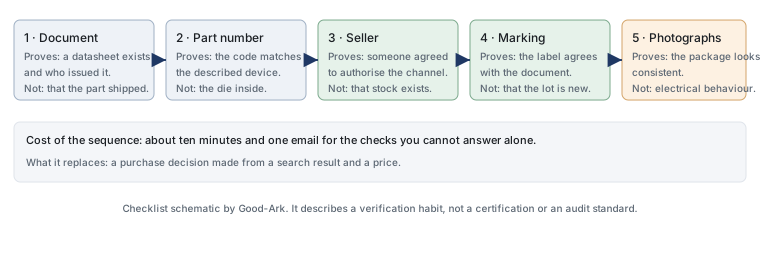
The question is reasonable, and the honest answer is that “is this brand legit?” cannot be settled by reading opinions. Forum threads collect the loudest experiences rather than the typical ones, and review sites collect complaints about delivery rather than evidence about devices. What settles it is a short sequence of checks that produce documents, and those checks work identically for every component manufacturer you will ever evaluate.
Last updated:
What “legit” means for a component brand
The word hides three separate questions, and they fail independently. The first is whether the company exists as a legal entity you can contract with. The second is whether the part you are holding is what its label says it is. The third is whether the seller is entitled to sell it. A brand can pass the first and fail the third, or pass all three for one part number and fail the second for the next one.
That is why blanket verdicts are useless. “Trustworthy brand” is not a property you can look up; it is a conclusion you reach per part, per lot and per supplier, using evidence you can file. The rest of this article is that evidence, in the order that eliminates problems fastest.
Check 1: can you find an official document
Start with the datasheet, because it is the only artefact that describes the device rather than advertising it. A real document names its issuing manufacturer, carries a revision identifier or date, and lists the parameter table with test conditions. A page that shows a part number, a few headline ratings and a download button from an unknown host is a lead, not a document.
The practical test is one question: who issued this file? If the answer is a manufacturer whose name you can tie to the company you are checking, you have a starting point. If the answer is nobody, no amount of positive reviews compensates — you cannot verify a part against nothing.
Check 2: does the part number decode
A genuine orderable part number usually carries more information than the family name: a voltage class, a current class, a package, sometimes a grade or packing suffix. The point of the check is not to decode it perfectly but to see whether the code is internally consistent with the device described. If the description claims a 600 V part and the number belongs to a 100 V family, something is wrong with the listing, the copy, or the photograph.
Be careful about a related trap: families and prefixes are shared across manufacturers. A prefix that looks like a brand tells you which family of parts you are looking at, not who made the one in your hand. Our article on sorting out names and part-number conventions shows how to separate those two questions.
Check 3: who is allowed to sell it
Authorisation is a commercial agreement, not a property of a website. The reliable version of this check is a written confirmation from the manufacturer or its representative that a named company is an authorised channel for a named manufacturer’s parts. Distributors often state their authorisation on their own pages, and that statement is useful, but the confirmation that survives a dispute is the one from the manufacturer.
Why this matters more than price: an unauthorised seller can be entirely honest and still be unable to tell you which production lot you received, whether the parts were stored correctly, or whether they were bought as surplus. Those are the questions that matter when a batch misbehaves in production.
Check 4: does the marking match the datasheet
Component marking follows a marking specification that the manufacturer publishes. The package photograph in the datasheet, the marking diagram and the ordering-information table together define what the top of the part should look like. Compare them to the part in your hand: the same code, in the same arrangement, with a lot or date code in the expected position.
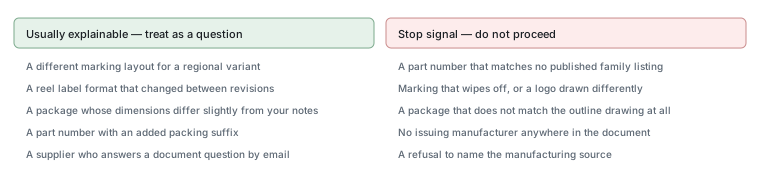
Mismatches come in two grades. A missing or shifted code is often a packaging variant or a regional marking difference, which is a question. A part that carries a plausible-looking code but does not match any published marking scheme is a stop signal, because there is no explanation that ends well.
Check 5: what a few real photographs show
Ask for photographs of the actual goods before shipment if you are buying without inspection: the reel or tube label, the top marking at magnification, and the packaging. Three things are worth looking at closely. Is the marking laser-etched or printed in a way that would wipe off? Do the labels on the reel and the box agree on part number, quantity and lot? And does the packaging look like a manufacturer’s standard, or like repackaged loose stock?
None of it proves electrical performance, which is exactly why it is the last check rather than the first. It is a cheap filter that removes obvious mismatches before you spend money on testing.
It is worth being clear about what a purchase order is for. Its job is not to record the brand you trust; it is to pin down the exact thing you are buying. The orderable part number, the package, the grade and the packing option are the details that can be substituted silently if they are left out — and a supplier who was given an incomplete specification has not done anything wrong when the delivery does not match your expectation.
Red flags that appear across brands
Some patterns recur regardless of who made the part, and they are worth memorising because they are the same in every industry.
| Pattern | What it usually means | What to do |
|---|---|---|
| A price far below the market for a current part | The goods are surplus, refurbished, or not what the label says | Ask for the lot code and the manufacturer’s channel confirmation before ordering |
| No datasheet, or a datasheet with no issuing manufacturer | Nobody is accountable for the specification | Stop. There is nothing to verify against |
| Photographs reused across several sellers | Stock images rather than the actual goods | Request a photo of the lot you will receive |
| The seller cannot say who manufactured the part | The chain of custody is unknown | Buy elsewhere, or treat the parts as untraceable and unsuitable for production |
| Marking that rubs off, or a package that does not match the outline drawing | The device may not be the package it claims | Reject the lot and document the photographs |
| Delivery quoted as “always in stock” with no lot information | Stock position is being guessed | Ask for a written lead-time statement and a lot code |
It helps to know which standards the documents come from, because that tells you what a supplier ought to be able to produce on request. Discrete device test methods are published by JEDEC; quality management systems, which is what most factory audit reports refer to, are described by ISO; and the assembly side, including what happens to a part once it is soldered, is covered by IPC. On the compliance side, the two documents most often requested are the substance restrictions described under the EU RoHS Directive and the chemical obligations explained by ECHA under REACH. Sector-level context is published by the Semiconductor Industry Association.
One more habit is worth building early: keep the evidence, not just the conclusion. A folder per part number, holding the datasheet revision you qualified, the channel confirmation, the lot codes received and the photographs taken on arrival, turns a future dispute from an argument into a comparison. It also makes incoming inspection faster the second time, because you already know what the marking and the packaging are supposed to look like.
A printable ten-minute checklist
Written down, the whole sequence fits on one page and takes about ten minutes for parts you already have in hand, plus however long one email takes for the channel confirmation.
- Find the datasheet and name its issuing manufacturer.
- Check the revision date, and check that the revision covers your part number.
- Decode the orderable part number against the ordering-information table.
- Ask the manufacturer, in writing, to confirm your supplier is an authorised channel.
- Compare marking and package against the datasheet drawing and marking specification.
- Request photographs of the actual reel, box and marking before shipment.
- File all of it — date, source, file names — with the purchase order.
FAQ
Can I decide this from reviews and forum threads?
No, and the reason is statistical rather than personal. Reviews and posts are written by people with something to say: a delivery problem, a single failure, a good experience with one order. None of that describes the consistency of a manufacturing process or the traceability of a lot. Use them to find questions worth asking, then answer those questions with documents.
What if the manufacturer does not reply to my verification request?
That is itself an answer about the channel, not necessarily about the brand. Ask the distributor to provide the confirmation, since an authorised distributor has a commercial relationship to draw on. If nobody in the chain can confirm the channel in writing, treat the parts as untraceable and keep them out of production.
Is a low price always a warning sign?
Not always. Large distributors discount at volume, end-of-life stock is genuinely cheaper, and older revisions can be sold off legitimately. What is a warning sign is a price that is far below the market for a part with no explanation, no lot code and no channel confirmation. Cheap is a question; cheap and undocumented is a stop signal.
How does this apply to a company with a long history?
Exactly the same way. Longevity is a useful signal about survival, and a stock exchange listing creates a public paper trail, but neither verifies the part in your hand. Treat company-level evidence and device-level evidence as two separate files; both are needed, and neither substitutes for the other.
Where can I find the parts of this process that are already documented?
The data side is covered in our guide to finding official datasheets and verifying what you read, the sourcing side in authorised channels, samples and quotes, and the wider risk picture in the counterfeiting and verification guide.
What to do next
Run the sequence once on a part you already buy. The value is not in the verdict you reach on the first attempt; it is in having a repeatable answer to a question that otherwise consumes an afternoon of forum reading each time it comes up.
Good-Ark can confirm a datasheet revision, an orderable part number or the status of a supply channel, and put the answer in writing for your records. Send the details to sales@goodark.com.
This article is published by Good-Ark, one of the brands the method can be applied to. It makes no claim about third-party reviews or ratings, and deliberately does not name or characterise any reseller.
Continue through this engineering topic
For the complete selection, design, verification, and troubleshooting path, explore the Good-Ark Product and Sourcing Hub.
Recommended
 Why Do Diodes Get Hot? Conduction and Switching Losses ExplainedInfoStandard, Fast Recovery, and Schottky Diodes: What’s the Difference?Info
 What Is a Fast Recovery Diode? Understanding “Fast Recovery”Info
 What Is a Diode? A Beginner’s Guide to How It WorksInfo
 Automotive Semiconductor Report 2026: Chips Per Car Keep RisingKnowledge