Good-Ark Company History: Riding a Century of Electronics, From Radio Valves to Electric Cars
From radio valves to electric cars: how the diode business evolved, where Good-Ark company history began in 1990, and why old part numbers persist.
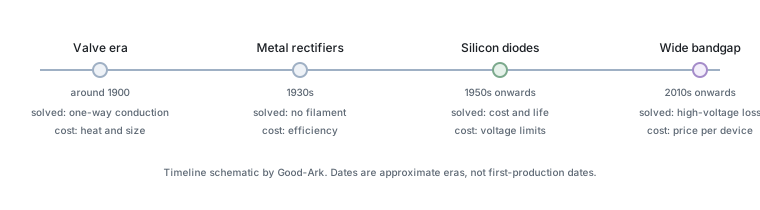
Every generation of electronics leaves a layer behind, and those layers are still on the board. The adapter on your desk contains the descendants of parts invented to make radio work, and the fuse-box logic of a modern car traces back to the same idea: change the voltage, protect what comes after. Understanding that lineage is the quickest way to understand why a particular device family exists at all.
Last updated:
Why electronics history is really a component history
Ask why a power supply uses four diodes rather than one, why a car needs a part qualified to a different standard than a laptop, or why a switching converter replaced a heavy transformer, and the answer is usually historical rather than theoretical. Each answer is a solution to a constraint somebody hit decades ago, and the constraint is often still with us in a different form.
The analogy that works best is archaeology. Dig into any modern product and you find strata: a layer from the era of glass valves and heat, a layer from the era when silicon became cheap, and a thin new layer of wide-bandgap materials at the top where the hard problems are being solved. Old layers do not disappear, because the jobs they do have not disappeared either.
The valve era and the first rectifiers
Converting alternating current into direct current was one of the first electronic problems, because early radio sets needed direct current and the wall supplied something else. The first practical answer was a glass valve — a vacuum tube that conducted in one direction and glowed while doing it. It worked, and it was hot, fragile and expensive, which is the pattern that drives every later replacement.
By the 1930s, metal rectifiers based on selenium and copper oxide had arrived for lower-power duties. They were solid, quiet and compact compared with a valve, and they were still inefficient by modern standards. This is the point worth remembering for a beginner: the direction of travel was never “more clever”, it was always “less loss, less heat, less volume, longer life”.
Silicon changes everything
Silicon reshaped the whole field in two steps. The transistor in 1947 showed that a solid piece of material could switch current without a vacuum, and the integrated circuit in the late 1950s showed that many devices could be built side by side on one piece of silicon. The second step is the one people remember, because it produced computing. The first step is the one that matters here, because it made single-function devices cheap enough to use by the billion.
Once a rectifier cost almost nothing, designs changed. Engineers stopped protecting rectifiers and started assuming them, the same way modern designs assume a microcontroller is available. That shift is why the diode became the most-produced electronic component in history and why it is still manufactured in volumes that dwarf the chips in the news.
The rise of consumer power supplies
The next turning point was the switching power supply. Instead of dropping voltage in a heavy transformer and burning the surplus as heat, a switching supply chops the input at high frequency and passes energy through a small transformer. That change made adapters light enough to carry and efficient enough to leave plugged in.
It also created a new set of component requirements: fast recovery behaviour in the diodes, low forward drop at the output, and protection at the input so that a lightning-induced spike does not reach the switch. Almost every device family in a modern catalogue exists because one of those requirements had to be met at a price the market would pay.

Cars become electronics platforms
The next shift did not come from a new component but from a new customer. A car contains electronics that must work from a cold winter morning to a hot engine bay, and it must survive electrical events that a phone charger never sees, including the spike that occurs when a heavy load is disconnected while the alternator is charging. Every part family had to be re-qualified for that environment.
This is where a component company’s history starts to matter commercially rather than nostalgically. Suzhou Good-Ark Electronics was founded in 1990, listed on the Shenzhen Stock Exchange in 2006 under code 002079, and dates its automotive-grade product line to 2010 — a decade in which the electronics content of a vehicle began rising sharply. The company’s own account of that progression is on its company overview page, and the functional view of the automotive range is in the automotive portfolio article.
| Era | Constraint it solved | New cost it created |
|---|---|---|
| Valve rectifiers | Made one-way conduction practical for radio and early power supplies | Heat, fragile glass, short life |
| Metal and selenium rectifiers | Removed the filament; solid and compact for low power | Poor efficiency, limited current |
| Silicon diodes | Made rectification cheap, reliable and mass-producible | Voltage and switching-speed limits |
| Fast recovery and Schottky types | Reduced switching loss in high-frequency supplies | Trade-offs in leakage and usable voltage |
| Wide-bandgap devices | Reduced loss at high voltage and high frequency | Higher device cost and new layout stress |
The wide-bandgap turn
The current era is about materials rather than circuits. Silicon has a practical limit: push it to higher voltages and faster switching, and losses and heat climb faster than performance. Silicon carbide tolerates higher voltage and temperature, and switches quickly enough that converters become smaller, which is why it appeared first where size and efficiency are worth paying for — electric vehicle charging, solar inverters and dense data-centre power.
The honest caveat is that this era is younger and more expensive. You can read the background in the silicon carbide portfolio article, but for a beginner the useful takeaway is simply that the newest layer on the board is solving the oldest problem — loss — with a different material.
What the next decade looks like
Three forces are visible now without needing a forecast. Efficiency rules keep tightening, which pushes designers toward lower-loss parts and away from cheap and cheerful ones. Operating voltages in vehicles and data centres keep rising, which pushes the wide-bandgap layer further down the power range. And the cost of heat keeps rising relative to the cost of silicon, because a smaller box with the same losses runs hotter and lives shorter.
None of that tells you which part to buy next year. It does tell you what to learn: loss, thermal path and switching behaviour are the three subjects that survive every generational change. The product family learning centre is organised around those subjects rather than around the calendar.
The regulatory layer has become part of the technology story too. Efficiency rules now decide which converter architectures are worth building, and the bodies that publish the surrounding expectations are public: sector data and policy positions from the Semiconductor Industry Association, energy-efficiency programmes from the US Department of Energy, and the international electrotechnical standards that power designers refer to at the International Electrotechnical Commission. Sector and quality background is published by JEDEC.
Two further reference points help if you want to follow the material side of the story. The behaviour of the device class itself is summarised in the entry on diodes, and the material that made the newest era possible is described in our guide to silicon carbide. For what happens to a device after it is soldered down, the workmanship expectations come from IPC, and the quality management systems behind factory audits from ISO.
Why beginners should care about this history
Part numbers are fossils. The 1N400x family still uses a numbering convention from an era when the “1N” prefix meant one semiconductor junction and the digits encoded a registration sequence rather than a specification. Knowing that saves you from assuming a number means something it does not — and it explains why two parts with similar numbers can behave very differently.
History is also a debugging tool. When a design behaves oddly, the reason is often that an old solution was carried forward past the constraint that justified it: a capacitor chosen for a 50 Hz transformer that now sits after a switching stage, or a protection part placed where it worked in a lighter product. Recognising the layer a decision came from is often faster than re-deriving it.
FAQ
How old is the diode?
The one-way valve idea goes back to the earliest radio work, with the vacuum tube diode demonstrated in 1904. Solid-state versions arrived with selenium and copper-oxide rectifiers in the 1930s, and silicon diodes became dominant after the 1950s. The concept is older than the transistor, which is a useful reminder that rectification is a fundamental problem rather than a modern one.
Why is a common rectifier called a 1N4007?
The “1N” prefix is a registration convention for a single semiconductor junction, and the digits are a sequence number from a registry rather than a code for voltage or current. The ratings live in the datasheet, not in the name. That is why substituting a part with a similar-looking number is a specification decision, not a naming decision.
Does Good-Ark make vacuum tubes?
No. The company was founded in 1990, long after solid-state devices took over, and its portfolio is built on silicon and silicon carbide devices: rectifiers, bridges, protection parts, transistors, MOSFETs, wide-bandgap devices, photovoltaic bypass diodes and a small set of analog products. The valve era is background, not product.
Is the ordinary rectifier obsolete?
No, and the volume figures make the opposite point. Circuits that run from the mains at 50 or 60 Hz are still everywhere — adapters, appliances, industrial supplies — and they are exactly where plain rectifiers remain the cheapest sensible answer. Newer device classes win on loss and speed, not on price, so the old part survives wherever the old constraint still applies.
Where should I start if I want to understand one layer properly?
Start with the layer that matches the equipment you own and can measure safely. A low-voltage DC circuit teaches loss and thermal behaviour without mains risk, and the introduction to discrete power devices gives the vocabulary for the rest.
What to do next
The useful conclusion is not a timeline to memorise but a habit: when you meet a part, ask which constraint it was designed to solve, and whether that constraint still applies in your circuit. That question cuts through most of the confusion that part numbers create.
Good-Ark publishes product families, package options and quality documentation, and can confirm what is in production today rather than what a decade-old page says. Write to sales@goodark.com or begin with the product family learning centre.
This article is published by Good-Ark, the company whose founding year and listing are mentioned. Historical industry milestones are limited to widely documented dates; company facts are limited to what the company publishes, and financial figures are left to its formal disclosures.
Continue through this engineering topic
For the complete selection, design, verification, and troubleshooting path, explore the Good-Ark Product and Sourcing Hub.
- Practical guide: What Does Good-Ark Electronics Actually Make? A Beginner’s Look at the Product Line
- Practical guide: Good-Ark, Good-Ark Semi, or Good-Ark Semiconductor? Sorting Out the Names
- Practical guide: Good-Ark Semiconductor Explained for People Who Do Not Work in Electronics
- Ask Good-Ark technical support about this application
Recommended
 Why Do Diodes Get Hot? Conduction and Switching Losses ExplainedInfoStandard, Fast Recovery, and Schottky Diodes: What’s the Difference?Info
 What Is a Fast Recovery Diode? Understanding “Fast Recovery”Info
 What Is a Diode? A Beginner’s Guide to How It WorksInfo
 Automotive Semiconductor Report 2026: Chips Per Car Keep RisingKnowledge