Good-Ark — discrete power semiconductors: rectifiers, Schottky, TVS, MOSFETs, SiC and IGBT
Request a Quote

Diode Markings Decoded: Reading the Numbers on a Component You Found in a Drawer

Diode Markings Decoded: Reading the Numbers on a Component You Found in a Drawer

Sooner or later everybody ends up with a handful of loose diodes and no idea what they are. The codes on the body look like they should be enough, and sometimes they are — but the same short code can mean different parts from different manufacturers, which is the trap worth understanding before you trust … Read more

How Does a Diode Work? The PN Junction in Plain Language

How Does a Diode Work? The PN Junction in Plain Language

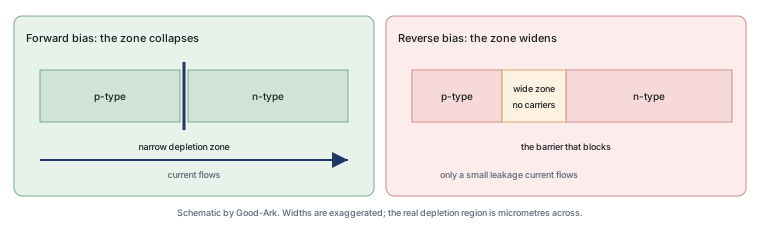
Everything a diode does comes from one thin boundary inside it. The package, the leads and the markings are just delivery; the behaviour lives in a zone a few micrometres wide where two differently treated regions of silicon meet, and understanding that zone makes the rest of the device class predictable rather than mysterious. Two … Read more

Diode Anode and Cathode: How to Tell Which End Is Which Every Time

Diode Anode and Cathode: How to Tell Which End Is Which Every Time

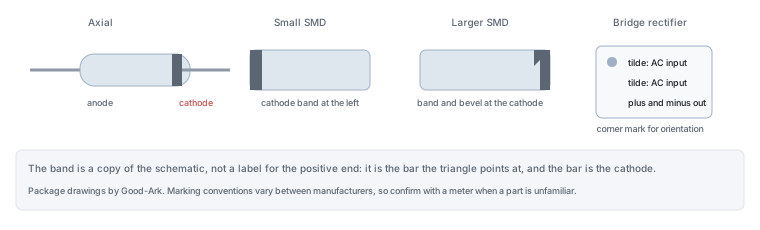
Almost every beginner destroys something by fitting a diode the wrong way round, and the reason is nearly always the same: the band on the package marks the cathode, and most people assume the banded end is the positive one. Getting this single convention straight prevents the majority of early failures in this device class. … Read more

What Is a Diode? The One-Way Valve of Electronics, Explained With Everyday Pictures

What Is a Diode? The One-Way Valve of Electronics, Explained With Everyday Pictures

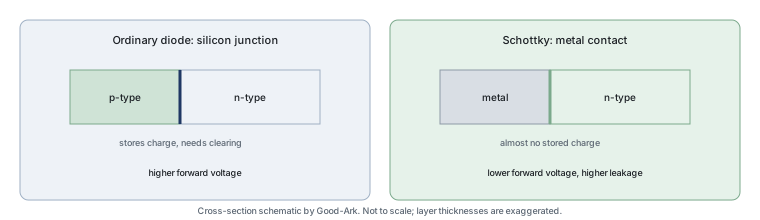
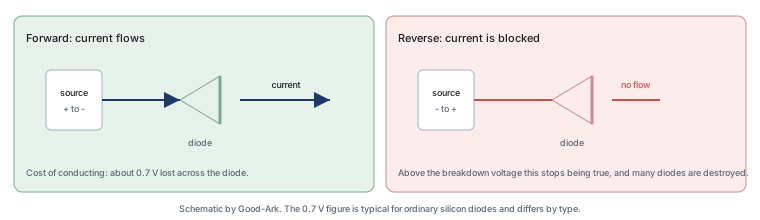
A diode is the simplest interesting component in electronics: it conducts in one direction and blocks in the other. What makes it worth learning first is that almost every power supply, every battery circuit and every electronic device you own depends on that single behaviour, and the rest of the device catalogue is variations on … Read more

Wide-Bandgap Semiconductors Explained in One Sitting

Wide-Bandgap Semiconductors Explained in One Sitting

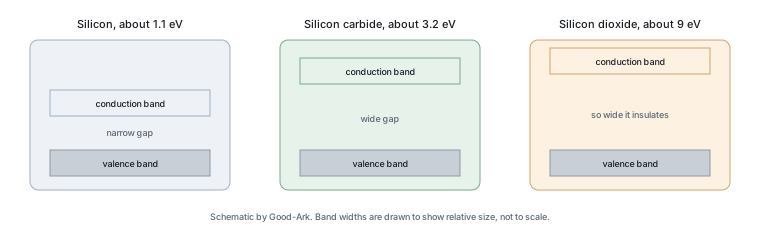
Every material used to make a semiconductor device can be described by one number: the energy an electron must gain to break free of the atomic lattice and start conducting. That number, the band gap, predicts how much voltage the material can hold, how much current it leaks when hot, and even what colour light … Read more

SiC in Solar Inverters: Why a Few Percent of Efficiency Matters

SiC in Solar Inverters: Why a Few Percent of Efficiency Matters

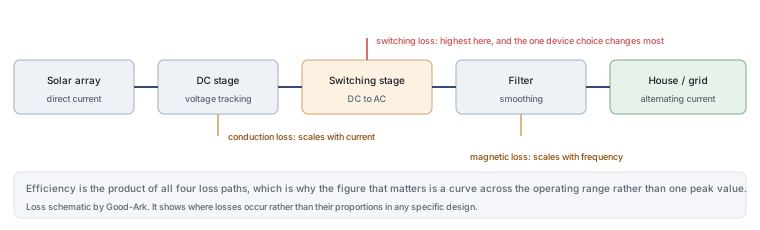
An inverter is the only part of a home solar system that works every day the sun rises, and it is usually the first major component to be replaced. Its efficiency is therefore not a laboratory number: every per cent is energy that either reaches your house or becomes heat inside a box mounted on … Read more

Why Are SiC Devices Expensive, and When Are They Worth It?

Why Are SiC Devices Expensive, and When Are They Worth It?

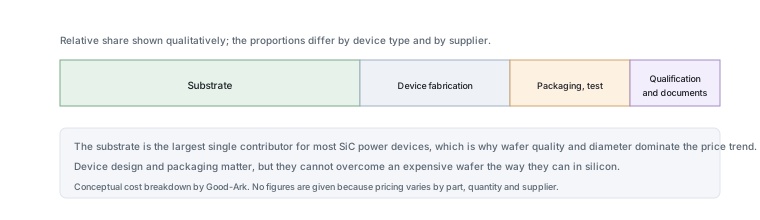
The reason a silicon carbide device costs several times what an electrically comparable silicon part costs is not difficult to understand, and it is almost entirely upstream of the device. The expensive part is the wafer, and the wafer is expensive because growing this crystal is slow, hot and difficult. Last updated: October 16, 2026 … Read more

SiC vs GaN: Two Wide-Bandgap Materials Compared Simply

SiC vs GaN: Two Wide-Bandgap Materials Compared Simply

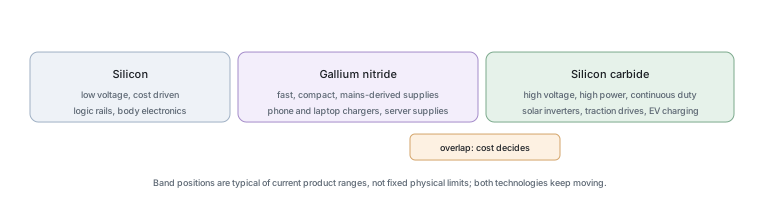
Both materials are described as wide bandgap, both switch faster than silicon, and both appear in products you can buy today. The reason they are not competitors in most designs is simple: they occupy different voltage territory, and the boundary between them is where most of the engineering decisions live. Last updated: October 16, 2026 … Read more

SiC vs Silicon: Why Some Electric Cars Charge Faster

SiC vs Silicon: Why Some Electric Cars Charge Faster

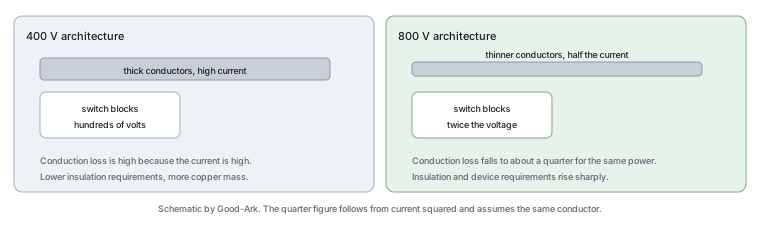
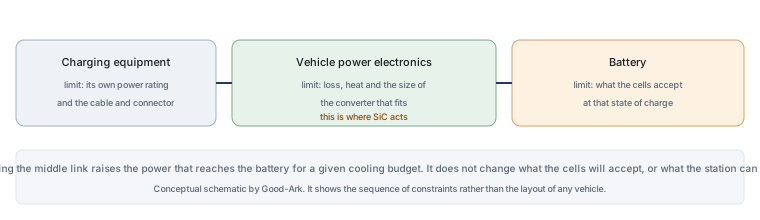
Two cars with similar batteries can charge at noticeably different rates, and part of the difference sits in the power electronics rather than in the cells. Silicon carbide is one reason a converter can handle more power in a smaller, cooler box — but it is an enabler rather than the cause, and understanding where … Read more

Need a part number checked against your design?

Send the topology, current and voltage class. Good-Ark sales and application engineering will confirm the closest device, package and qualification status.

Copyright Suzhou Good-Ark Electronics Co., Ltd. All Rights Reserved