Why 800 V Electric Cars Use Silicon Carbide
Learn why 800 V EVs use SiC, calculate the conditional conductor-loss benefit, and separate charging performance from semiconductor material choice.

An 800 V-class battery can transfer a given DC power at less current than a 400 V-class battery, which can reduce conductor loss. Silicon carbide is attractive in the power-conversion stages because it can offer useful high-voltage switching performance. It is a design choice, not a material required by the battery voltage alone.
Last updated:
Two ways to deliver more power
At a defined DC comparison point, power is voltage times current. Raising voltage can transfer the same power at less current, or more power at the same current, subject to the rest of the system.
A vehicle’s nominal architecture is not its constant operating voltage. State of charge, battery configuration and limits change the real voltage range. The semiconductor blocking requirement must cover that range and the switching transients, not only the architecture label.
Why higher voltage can reduce conductor loss
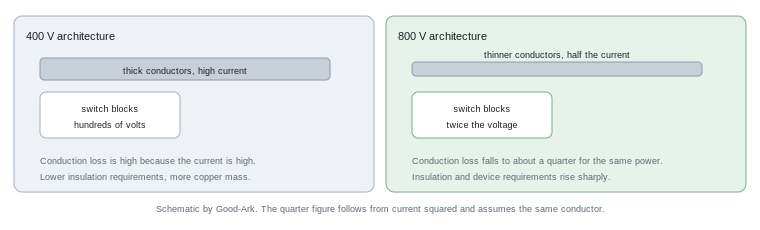
At an assumed 100 kW DC transfer, 400 V gives 250 A and 800 V gives 125 A. If the same conductor path has an assumed resistance of 10 mΩ, its I²R loss is 625 W and 156.25 W respectively.
The quarter-loss result assumes unchanged resistance and the same transferred power. If a designer instead reduces copper to save mass, the resistance changes and the saving must be recalculated. Motor phase current, inverter switching loss and vehicle range cannot be obtained directly from this conductor example.
The problem silicon faces at high blocking voltage
High-voltage silicon MOSFETs face a resistance trade-off, while silicon IGBTs use a different conduction mechanism and can serve high-voltage duties. It is therefore inaccurate to describe all silicon switches as one resistance model or to say an 800 V inverter is impossible without SiC.
Compare actual candidate technologies and topologies at the required current, temperature and switching conditions. Silicon IGBT, silicon MOSFET and SiC MOSFET are distinct alternatives, with the appropriate voltage class and architecture determining which can be considered.
How SiC helps, and what it still costs
SiC’s material properties support high-voltage devices with useful conduction and switching characteristics. ROHM’s SiC–IGBT explanation illustrates the absence of IGBT-style turn-off tail current in its MOSFET comparison; its specific measured saving is tied to its devices and setup.
That benefit does not eliminate gate-drive, insulation, thermal, short-circuit-protection or EMI work. Faster edges can expose layout inductance and increase noise. Evaluate the complete converter rather than predicting its efficiency from the material name.
What drivers actually notice
A higher-voltage platform can support high charging power when the station, vehicle hardware and battery permit it. It does not automatically halve a charging stop or guarantee a particular range increase.
For example, an assumed 800 V at 250 A corresponds to 200 kW, while 400 V at 250 A corresponds to 100 kW. These instantaneous DC values are not complete charging curves. Battery temperature, state of charge, station capability and thermal limits can change power throughout the session.
Charging infrastructure implications
Check a charging station’s output voltage range as well as its current and power limit. A voltage-range mismatch can limit charging or require an architecture-specific conversion path. The connector label alone is not enough to establish the available power.
For a vehicle comparison, use the actual model’s charging curve under stated conditions. For engineering, separate insulation, switching-device and power-path requirements. The EV power-stage map explains which stage a technology decision belongs to.
Two external references are useful when checking a claim about a high-voltage vehicle. The device class that does the switching is described under
Where the technology choice belongs
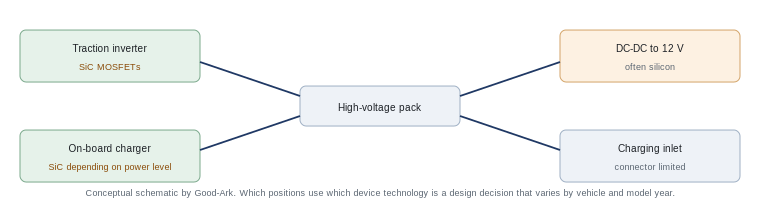
SiC can be used in traction inverters, chargers and high-voltage DC-DC stages, while low-voltage circuits may continue to use silicon. The exact distribution varies by architecture and does not follow one vehicle-wide rule.
Compare usable efficiency over the mission profile, cooling, packaging, driver and protection cost, supply and qualification evidence. A higher-voltage battery creates new requirements; it does not remove the need to compare alternatives.
Frequently Asked Questions
Is SiC mandatory in every 800 V electric vehicle?
No. The battery voltage alone does not mandate a semiconductor material. Evaluate actual device ratings, topology, losses and system requirements.
Does 800 V always mean one-quarter of all losses?
No. The quarter result applies to I²R conductor loss at fixed power and unchanged conductor resistance when voltage doubles.
Will an 800 V car always charge twice as fast?
No. Charging depends on the station, vehicle power path and battery acceptance across state of charge and temperature.
Are SiC MOSFETs only for traction inverters?
No. They can be considered in other high-voltage conversion stages. The application and operating point determine suitability.
Continue through this engineering topic
For the complete selection, design, verification, and troubleshooting path, explore the Silicon Carbide and Wide Bandgap Hub.