SiC vs GaN: Two Wide-Bandgap Materials Compared Simply
SiC vs GaN: both are wide bandgap, both are faster than silicon, and they are used in almost opposite places. A plain comparison of voltages and costs.
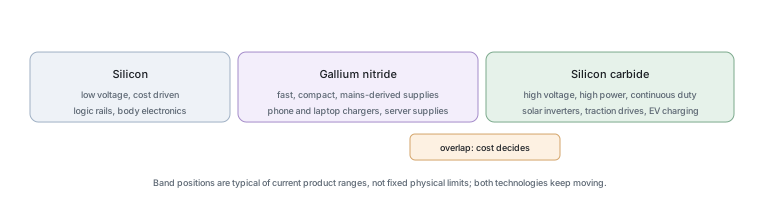
Both materials are described as wide bandgap, both switch faster than silicon, and both appear in products you can buy today. The reason they are not competitors in most designs is simple: they occupy different voltage territory, and the boundary between them is where most of the engineering decisions live.
Last updated:
Why both exist
Silicon has practical limits, and different applications hit them differently. In a small charger, the limit is switching frequency and the size of the magnetic components. In a solar inverter or a traction drive, the limit is voltage and the amount of heat generated. One material family cannot be optimal for both, so the industry developed two.
Gallium nitride is fast and efficient at moderate voltages, which makes it ideal for compact power supplies where the frequency is high and the voltages are a few hundred volts at most. Silicon carbide is efficient at higher voltages and higher power, which makes it ideal where the switching is still fast but the blocking voltage is measured in kilovolts. The two overlap only in a narrow band, and even there the choice usually follows cost rather than physics.
Voltage ranges in everyday terms
The simplest way to keep them apart is to think about what the device is blocking. A gallium nitride power device typically works in the range up to a few hundred volts, which covers mains-derived supplies, fast chargers and low-voltage conversion. A silicon carbide device typically works from several hundred volts up into the kilovolt range, which covers solar inverters, vehicle traction systems and industrial drives.
There is a reason for the split rather than a convention. Gallium nitride is often built as a lateral device, with current flowing along the surface of the die, and lateral layouts become awkward as the voltage rises and the required spacing grows. Silicon carbide is built as a vertical device, with current flowing through the thickness of the die, which scales naturally to higher voltages. That structural difference, more than chemistry, sets the boundary.
Where you find GaN chargers
The clearest consumer example is the compact wall charger. Gallium nitride switches fast enough that the conversion can run at high frequency, which shrinks the transformer and the capacitors enough that a 65-watt charger fits in something the size of a matchbox. That is not marketing: it is the direct consequence of higher switching frequency, and it is why the same power level in a gallium nitride design occupies much less volume than the older silicon equivalent.
Beyond chargers, gallium nitride appears in server power supplies, in some lighting drivers and in radio-frequency applications where its speed is valuable for a different reason. The common thread is a moderate voltage, a high frequency and a premium on size.
Where SiC dominates
Silicon carbide appears where the voltage is high enough that a silicon device would need a large, lossy blocking region. Solar inverters, vehicle traction inverters, high-power charging equipment and industrial motor drives are the established applications. The pattern that repeats is voltage above a few hundred volts combined with continuous operation, so that a small efficiency difference accumulates into a real energy difference.
One widely reported example of that logic in practice is the use of silicon carbide MOSFETs in electric vehicle traction inverters by a number of manufacturers, including Tesla, together with public discussion by that company of reducing the quantity used in later designs. Both halves of that story are instructive: the material won on system efficiency, and the quantity is still a commercial decision that can change with each generation. Specifications vary by model year, so treat any specific claim as something to verify against current sources.
Cost and maturity
Gallium nitride is generally cheaper per device for the power levels it serves, partly because it can be built on silicon substrates using processes closer to established wafer fabrication. Silicon carbide remains more expensive because its substrates are grown slowly at high temperature and are available in smaller diameters, which raises the cost per usable area.
Maturity differs in a subtler way. Silicon carbide has been in volume automotive production for years, so its qualification paths and reliability expectations are well established for those applications. Gallium nitride has moved quickly in consumer power and is still building the same depth of field experience in some industrial categories. Neither is experimental, but they are at different points on the same curve.
| Dimension | Gallium nitride | Silicon carbide |
|---|---|---|
| Typical blocking voltage | Up to a few hundred volts | Several hundred volts into the kilovolt range |
| Device structure | Often lateral | Usually vertical |
| Where it wins | Compact, high-frequency supplies | High-power, high-voltage conversion |
| Consumer example | The small charger in your bag | The inverter or charging hardware in a vehicle or solar system |
| Relative cost | Lower at its power levels | Higher, driven by substrate cost |
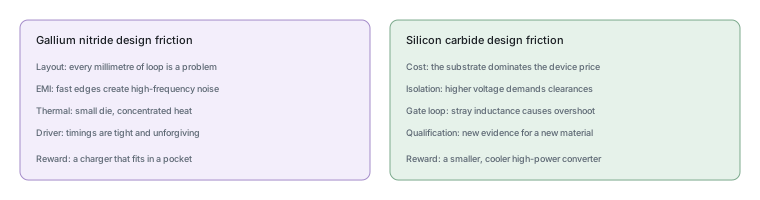
| Gate drive sensitivity | High; fast edges are less forgiving | High; loop inductance matters |
| Main design friction | Layout and EMI at high frequency | Cost, plus layout and isolation at high voltage |
Reliability questions people ask
Two concerns come up repeatedly. The first is whether these materials are as reliable as silicon. The honest answer is that reliability is a property of a qualified device rather than of an element: a well-qualified gallium nitride or silicon carbide part in an automotive application has passed the same kind of testing as a silicon part, and an unqualified part in any material is a risk. Qualification evidence is what you compare, not the periodic table.
The second is whether they degrade in ways silicon does not. Dynamic on-resistance in some gallium nitride devices and threshold instability in some silicon carbide devices are real phenomena that designers and suppliers work with, and they are precisely why the datasheet includes the parameters it does. Again, the practical defence is documented qualification and known behaviour in the intended operating range. External background is useful here: the materials are described under gallium nitride and silicon carbide, device measurement methods come from JEDEC, system-level expectations from the International Electrotechnical Commission, and sector reporting from the Semiconductor Industry Association. Wide bandgap and sector background is published by the US Department of Energy, NIST and ISO.
Choosing between them, simply
Three questions settle most cases. What voltage must the device block? If it is several hundred volts or less, gallium nitride is likely to be cheaper and smaller. If it is higher, silicon carbide is the practical option. How many hours a year does the equipment run? The more it runs, the more a small efficiency difference is worth. And how much does the size of the converter matter? A product where size is the whole point, such as a travel charger, pulls toward gallium nitride; a cabinet where the heatsink dominates pulls toward silicon carbide.
If those answers point in conflicting directions, the decision is genuinely close, and prototyping both is cheaper than arguing. That happens most often in the overlap band, where both materials are technically adequate.
One practical consequence of all this is worth stating, because it affects how you read a specification sheet. The position of a device in the circuit often matters more than its headline rating, and two designs with the same nominal voltage class can behave very differently depending on where the wide-bandgap part sits and where silicon was judged adequate. That is why a comparison of two competing products on the basis of “uses silicon carbide” tells you almost nothing on its own.
Comparison card
Keep the two in mind as different tools rather than successive generations: gallium nitride is the fast, light option at moderate voltage, and silicon carbide is the high-voltage, high-power option that tolerates a hard working life. Neither is replacing the other, and neither is close to replacing silicon across the whole range of electronics.
FAQ
What are the disadvantages of GaN chargers?
Three practical ones. They cost more than an equivalent silicon charger, because the devices and their drivers are more expensive. They are less forgiving of a careless layout, so a poorly designed one can be noisier than the silicon part it replaced. And they are typically limited to lower blocking voltages than silicon carbide, which is not a problem for a charger but rules them out for high-voltage conversion. For most buyers, none of that outweighs the size benefit.
Does Tesla use silicon carbide?
It has been widely reported that Tesla uses silicon carbide MOSFETs in its traction inverters, and the company has also publicly discussed reducing the amount of the material used in newer designs. Both parts of that are worth noting: the material won on system efficiency, and the quantity remains a commercial decision that can change between generations. Because this varies by model and year, verify against current technical sources rather than assuming any single statement applies to the whole range.
Why is silicon preferred over germanium?
This question usually refers to germanium rather than gallium nitride. Silicon replaced germanium in most electronics from the 1950s onward because it forms a stable, easily grown native oxide that made manufacturing and passivation practical, it leaks far less current at elevated temperature, it can be grown into larger and purer crystals, and its raw material is abundant. Germanium still appears in specialised applications, but silicon became the default for structural reasons rather than because it is intrinsically faster.
Will GaN replace silicon?
No, and it is not trying to. Gallium nitride is winning in a specific band: moderate voltage, high frequency, compact supplies. Silicon remains cheaper and entirely adequate across most of the electronics industry, from logic to low-voltage switching, and it continues to improve. The realistic picture is a division of labour rather than a replacement, with silicon carbide taking the high-voltage band and gallium nitride the compact high-frequency band.
Where should I start if I need to choose?
Start with the blocking voltage, then the duty cycle, then the size constraint. If the voltage is the deciding factor, the answer usually follows immediately; if not, the design is in the overlap band and prototyping both is the honest way to decide. The material background for the high-voltage side is in our introduction to silicon carbide.
What to do next
Write down the blocking voltage and the annual operating hours for your application. Those two numbers separate the materials more reliably than any general comparison, and they are also the two questions a supplier will ask first. If your answer lands on the high-voltage side, the design-side material is in the guide to SiC power device design.
Tell Good-Ark the blocking voltage, the switching frequency and the duty cycle, and we can point to the SiC families that fit and explain where a different technology would serve you better.
Email sales@goodark.com, or start from the SiC portfolio page.
This article is published by Good-Ark, a manufacturer of silicon carbide devices and therefore not a neutral party in the high-voltage comparison. The reference to one vehicle manufacturer’s reported use of the technology is public information that changes by model year, not a customer relationship.
Continue through this engineering topic
For the complete selection, design, verification, and troubleshooting path, explore the Silicon Carbide and Wide Bandgap Hub.
- Practical guide: SiC vs Silicon: Why Some Electric Cars Charge Faster
- Practical guide: What Is Silicon Carbide (SiC)? A Beginner’s Introduction
- Practical guide: Good-Ark SiC Devices in Plain Language: Silicon Carbide for People Outside the Industry
- Ask Good-Ark technical support about this application
Recommended
 Why Do Diodes Get Hot? Conduction and Switching Losses ExplainedInfoStandard, Fast Recovery, and Schottky Diodes: What’s the Difference?Info
 What Is a Fast Recovery Diode? Understanding “Fast Recovery”Info
 What Is a Diode? A Beginner’s Guide to How It WorksInfo
 Automotive Semiconductor Report 2026: Chips Per Car Keep RisingKnowledge