Good-Ark — discrete power semiconductors: rectifiers, Schottky, TVS, MOSFETs, SiC and IGBT
Request a Quote

Why Does a Bridge Rectifier Need Four Diodes?
Why Does a Bridge Rectifier Need Four Diodes?

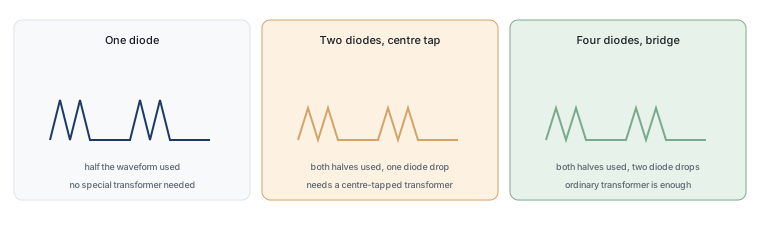
The answer is one sentence long, and the reasoning behind it is the part worth knowing: two diodes give full-wave rectification but only if the transformer has a centre tap, and four diodes achieve the same result with an ordinary transformer. The fourth pair exists to remove a requirement rather than to add a function. … Read more
What Is a Bridge Rectifier? Turning AC Into DC, Explained With Pictures

What Is a Bridge Rectifier? Turning AC Into DC, Explained With Pictures

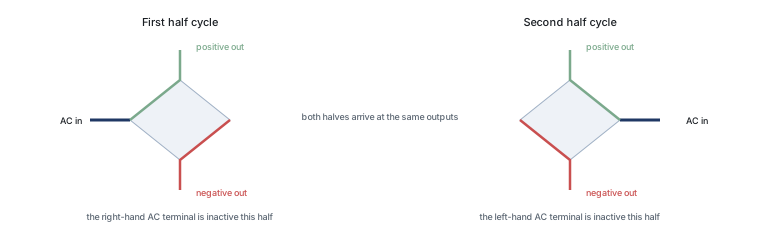
The useful way to understand a bridge rectifier is to follow the current through it twice, once for each half of the incoming cycle. When you have done that, the four diodes stop looking arbitrary and start looking inevitable, and the shape of the output makes sense without any theory. Last updated: October 16, 2026 … Read more

Schottky vs Normal Diode: Which One Should You Pick?

Schottky vs Normal Diode: Which One Should You Pick?

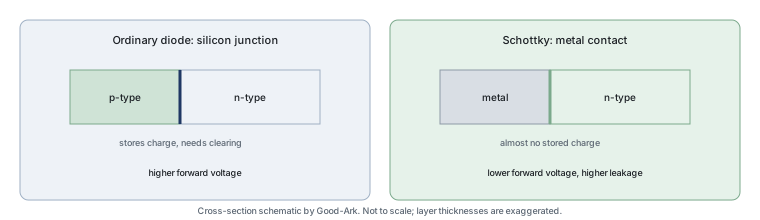
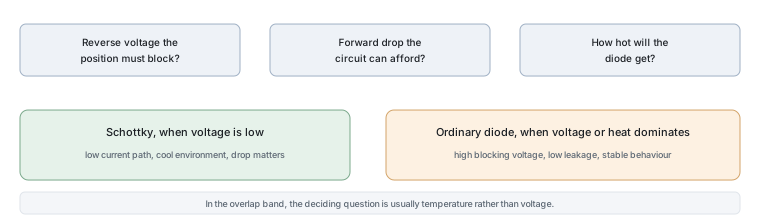
For most hobby circuits the choice resolves in about fifteen seconds once you know two numbers: the highest reverse voltage the position will see, and how much forward drop you can afford. The rest of this article explains why those two numbers decide it, and where the answer stops being obvious. The short answer for … Read more

Diode Markings Decoded: Reading the Numbers on a Component You Found in a Drawer

Diode Markings Decoded: Reading the Numbers on a Component You Found in a Drawer

Sooner or later everybody ends up with a handful of loose diodes and no idea what they are. The codes on the body look like they should be enough, and sometimes they are — but the same short code can mean different parts from different manufacturers, which is the trap worth understanding before you trust … Read more

Why Do Diodes Get Hot? Forward Voltage, Current, and Heat for Beginners

Why Do Diodes Get Hot? Forward Voltage, Current, and Heat for Beginners

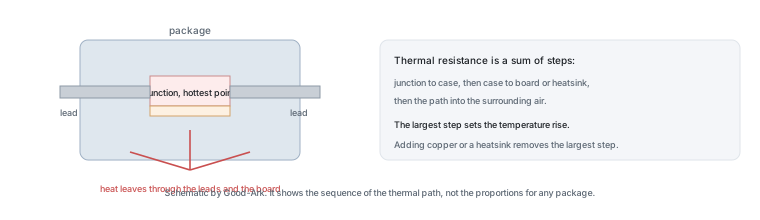
One multiplication explains most of it: the voltage across the diode multiplied by the current through it gives the power it turns into heat. Everything else — why some diodes run cooler, why a heatsink helps, why the same part survives in one product and fails in another — follows from that number and from … Read more

How Does a Diode Work? The PN Junction in Plain Language

How Does a Diode Work? The PN Junction in Plain Language

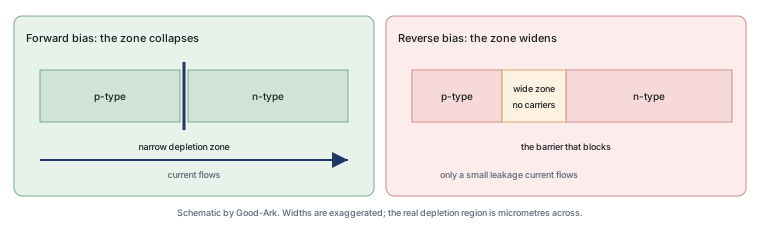
Everything a diode does comes from one thin boundary inside it. The package, the leads and the markings are just delivery; the behaviour lives in a zone a few micrometres wide where two differently treated regions of silicon meet, and understanding that zone makes the rest of the device class predictable rather than mysterious. Two … Read more

Diode Anode and Cathode: How to Tell Which End Is Which Every Time

Diode Anode and Cathode: How to Tell Which End Is Which Every Time

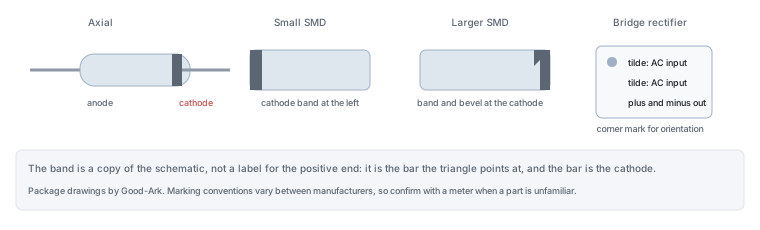
Almost every beginner destroys something by fitting a diode the wrong way round, and the reason is nearly always the same: the band on the package marks the cathode, and most people assume the banded end is the positive one. Getting this single convention straight prevents the majority of early failures in this device class. … Read more

What Is a Diode? The One-Way Valve of Electronics, Explained With Everyday Pictures

What Is a Diode? The One-Way Valve of Electronics, Explained With Everyday Pictures

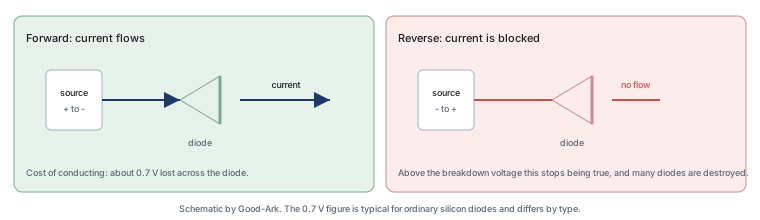
A diode is the simplest interesting component in electronics: it conducts in one direction and blocks in the other. What makes it worth learning first is that almost every power supply, every battery circuit and every electronic device you own depends on that single behaviour, and the rest of the device catalogue is variations on … Read more

Why 800 V Electric Cars Need Silicon Carbide

Why 800 V Electric Cars Need Silicon Carbide

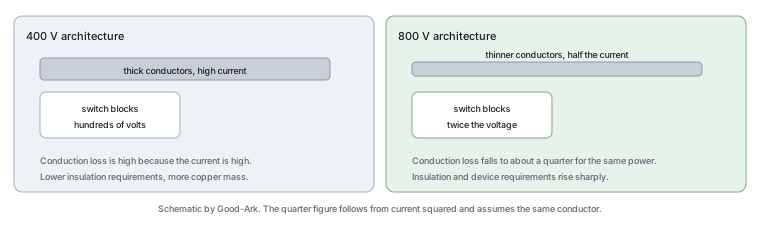
Doubling the battery voltage looks like a simple change and behaves like a redesign. It halves the current needed for the same power, which is why it is attractive; it also changes what the semiconductors have to block, which is why silicon carbide ends up in the design rather than silicon. Last updated: October 11, … Read more

Wide-Bandgap Semiconductors Explained in One Sitting

Wide-Bandgap Semiconductors Explained in One Sitting

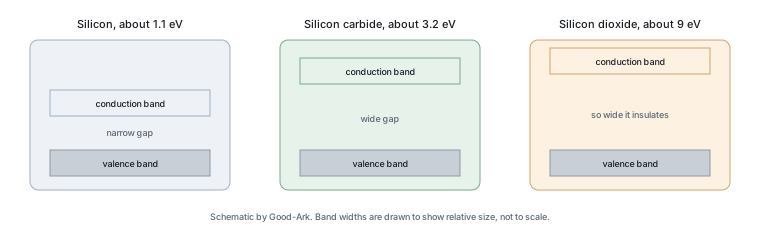
Every material used to make a semiconductor device can be described by one number: the energy an electron must gain to break free of the atomic lattice and start conducting. That number, the band gap, predicts how much voltage the material can hold, how much current it leaks when hot, and even what colour light … Read more

SiC in Solar Inverters: Why a Few Percent of Efficiency Matters

SiC in Solar Inverters: Why a Few Percent of Efficiency Matters

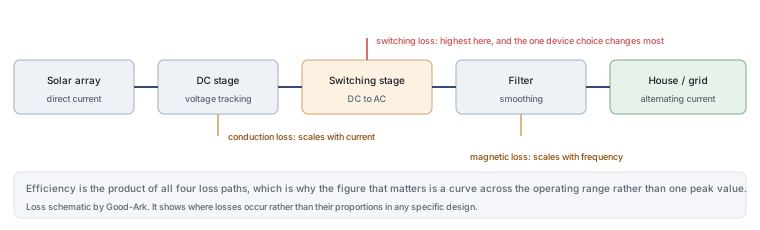
An inverter is the only part of a home solar system that works every day the sun rises, and it is usually the first major component to be replaced. Its efficiency is therefore not a laboratory number: every per cent is energy that either reaches your house or becomes heat inside a box mounted on … Read more

Need a part number checked against your design?

Send the topology, current and voltage class. Good-Ark sales and application engineering will confirm the closest device, package and qualification status.

Copyright Suzhou Good-Ark Electronics Co., Ltd. All Rights Reserved