Good-Ark — discrete power semiconductors: rectifiers, Schottky, TVS, MOSFETs, SiC and IGBT
Request a Quote

Why Are SiC Devices Expensive, and When Are They Worth It?

Why Are SiC Devices Expensive, and When Are They Worth It?

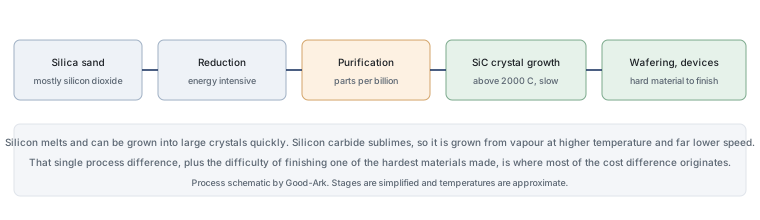
The reason a silicon carbide device costs several times what an electrically comparable silicon part costs is not difficult to understand, and it is almost entirely upstream of the device. The expensive part is the wafer, and the wafer is expensive because growing this crystal is slow, hot and difficult. Last updated: October 16, 2026 … Read more
SiC vs GaN: Two Wide-Bandgap Materials Compared Simply

SiC vs GaN: Two Wide-Bandgap Materials Compared Simply

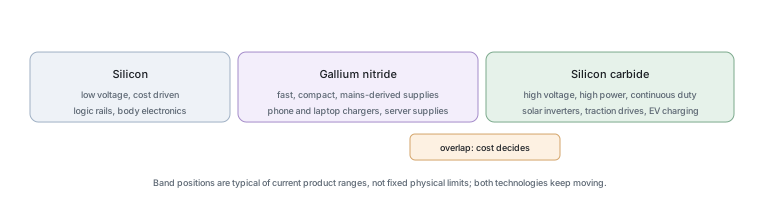
Both materials are described as wide bandgap, both switch faster than silicon, and both appear in products you can buy today. The reason they are not competitors in most designs is simple: they occupy different voltage territory, and the boundary between them is where most of the engineering decisions live. Last updated: October 16, 2026 … Read more
SiC vs Silicon: Why Some Electric Cars Charge Faster

SiC vs Silicon: Why Some Electric Cars Charge Faster

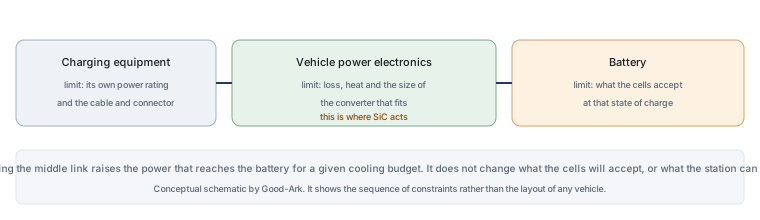
Two cars with similar batteries can charge at noticeably different rates, and part of the difference sits in the power electronics rather than in the cells. Silicon carbide is one reason a converter can handle more power in a smaller, cooler box — but it is an enabler rather than the cause, and understanding where … Read more

What Is Silicon Carbide (SiC)? A Beginner’s Introduction

What Is Silicon Carbide (SiC)? A Beginner’s Introduction

There is a reasonable chance you have held silicon carbide in your hand without knowing it, because the same material that makes an abrasive disc also makes a power transistor. The difference between the two is not chemistry but crystal quality: a bonded mass of hard grains and a single crystal grown for electronics are … Read more

Protecting USB Ports From Static: A Beginner’s Guide

Protecting USB Ports From Static: A Beginner’s Guide

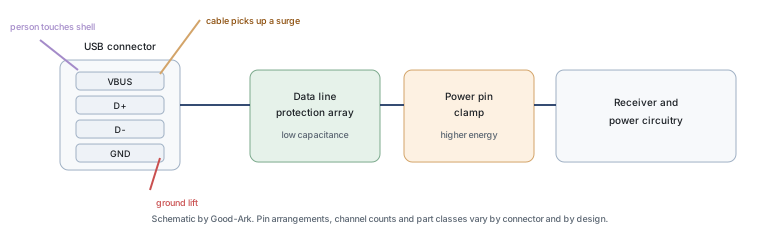
A USB port is a hole in the enclosure with four conductors behind it, one of which is a direct connection to a power rail and two of which go straight into a high-speed receiver. That combination makes the connector the single most exposed point on most consumer devices, and it is why the protection … Read more

Clamping Voltage Explained: The Datasheet Number That Decides Protection

Clamping Voltage Explained: The Datasheet Number That Decides Protection

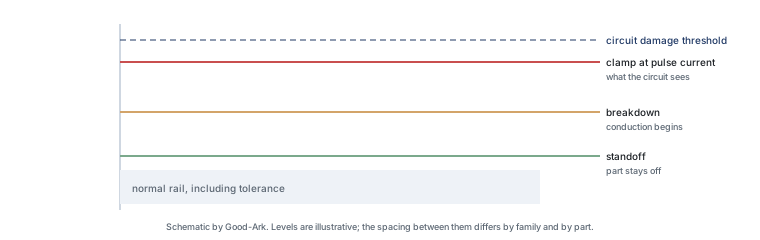
Three voltages are printed next to each other on a protection datasheet, they are all measured in volts, and only one of them tells you whether your circuit survives. Reading them in the wrong order is the single most common reason a correctly specified part fails to protect anything. Last updated: October 11, 2026 Three … Read more

How Does a Surge Protector Work? (And When It Quietly Stops Working)

How Does a Surge Protector Work? (And When It Quietly Stops Working)

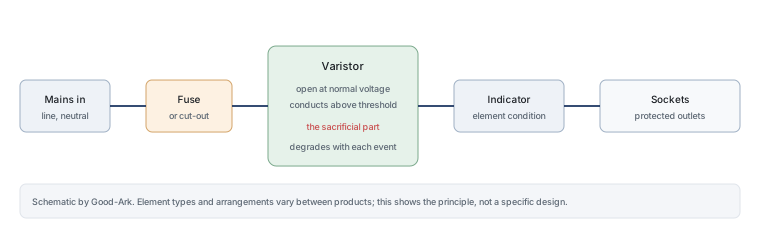
The component inside a surge protector is a sacrificial one. It conducts almost nothing for years, absorbs the energy of an event when one arrives, and comes back slightly worse than before. That is the whole design, and it explains both why the device works and why it eventually has to be thrown away. Last … Read more

Lightning, Surges and Home Electronics: Where Protection Actually Sits

Lightning, Surges and Home Electronics: Where Protection Actually Sits

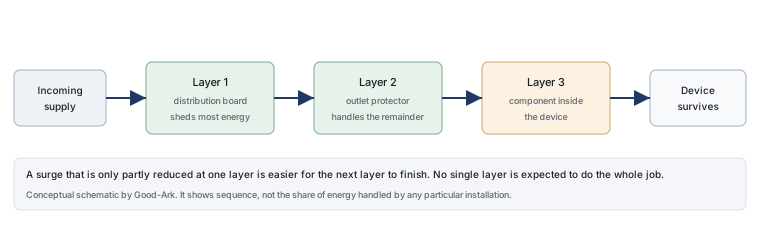
A direct lightning strike is rare and usually destroys things whatever you do. The far more common case is a surge induced on the wiring by a nearby strike, and that one arrives in stages — which is exactly what makes it defensible. Protection is not a single device; it is a sequence of places … Read more

ESD Protection for Beginners: Why a Tiny Diode Saves Your Phone

ESD Protection for Beginners: Why a Tiny Diode Saves Your Phone

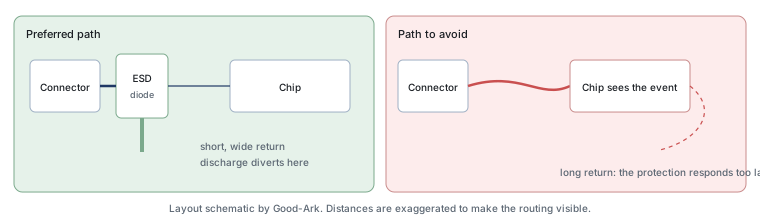
The smallest part on a phone circuit board is often a protection diode, a few tenths of a millimetre across, and it exists because the connector next to it is a doorway. Anything a user touches is a place where a static discharge can enter, and the protection part decides whether that discharge ends as … Read more

Protection Diodes: TVS, Reverse Polarity, Flyback and Input Clamps

Protection Diodes: TVS, Reverse Polarity, Flyback and Input Clamps

Protection diodes can clamp a transient, block unwanted current or provide a path for an inductive load when a switch turns off. Those are different jobs. A TVS across a supply does not automatically provide series reverse-polarity isolation, and a relay flyback diode is not a universal surge protector. Start with the event and current … Read more

High Voltage MOSFETs: Ratings, Losses and Circuit Design Checks

High Voltage MOSFETs: Ratings, Losses and Circuit Design Checks

A high voltage MOSFET must block the voltage at its own terminals, including switching excursions, while meeting the converter’s loss and thermal limits. A large drain–source rating alone cannot establish suitability. The design also depends on gate drive, reverse-current behavior, operating mode and the physical current loops. Reading those conditions together is more useful than … Read more

TVS vs Zener Diode: Two Similar Parts With Two Very Different Jobs

TVS vs Zener Diode: Two Similar Parts With Two Very Different Jobs

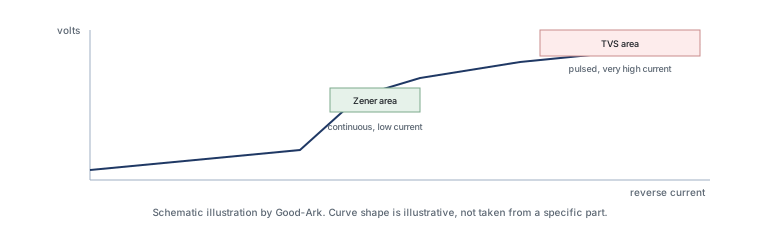
Both parts are diodes operated in reverse breakdown, both are drawn with the same symbol, and both are described in datasheets using the same three or four parameter names. The difference is what you are asking them to do all day: regulate a voltage continuously, or absorb a rare event and get out of the … Read more

Need a part number checked against your design?

Send the topology, current and voltage class. Good-Ark sales and application engineering will confirm the closest device, package and qualification status.

Copyright Suzhou Good-Ark Electronics Co., Ltd. All Rights Reserved