Electric Vehicles and Power Electronics: An Industry Report for Non-Specialists
EV power electronics market: how vehicle sales, semiconductor content per car and the value of the power devices fit together, and which numbers are comparable.
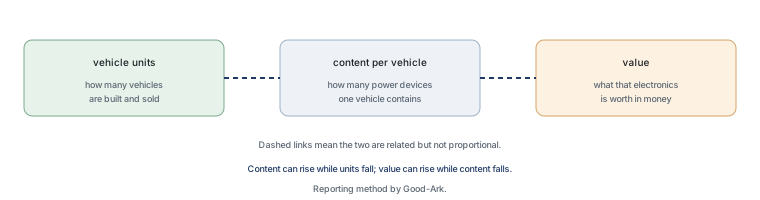
An electric vehicle report becomes misleading the moment three different numbers are put in the same sentence. Vehicle sales are counted in units, semiconductor content is counted in devices or in value per car, and the semiconductor market is counted in money. Each answers a different question, and a change in one does not imply a change in another. This report connects the three in order, so that a reader can tell which part of an EV story is being described.
How to read EV numbers
Start by asking what is being counted. A unit figure tells you how many vehicles were produced or sold. A content figure tells you how much electronics a typical vehicle of a given type carries. A value figure tells you what that electronics was worth. Production and sales also differ, because vehicles are built and then shipped, and inventory between the two can move a quarter’s numbers without any change in demand.
It is also worth separating the vehicle categories, because a battery-electric car, a plug-in hybrid and a mild hybrid have different power electronics and are frequently grouped together in a single percentage. A growth figure for “electrified vehicles” therefore describes a wider set than a growth figure for battery-electric cars, and the two can move in different directions.
Vehicle sales versus semiconductor content
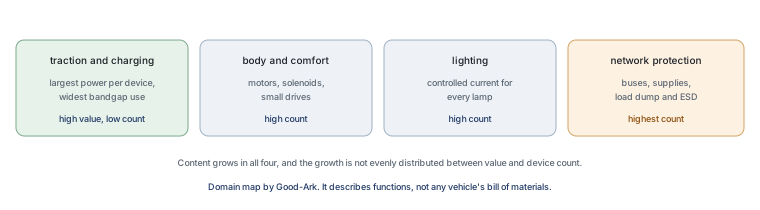
The second link in the chain is content per vehicle, and it is the reason this subject is interesting rather than merely cyclical. A vehicle with an electric drivetrain needs power devices to convert battery voltage to motor current, to charge the battery from the grid, to run the auxiliary systems and to protect every one of those circuits. A vehicle with a conventional drivetrain needs a much smaller set.
That means device demand can rise while vehicle production is flat, because the mix is shifting towards vehicles with more electronics. It also means the direction reverses: a fall in total production can outweigh a rise in content per vehicle, and both statements can appear in the same week without contradicting each other. The comparison that helps is a recipe that gets richer while fewer dinners are cooked.
Where the power devices sit
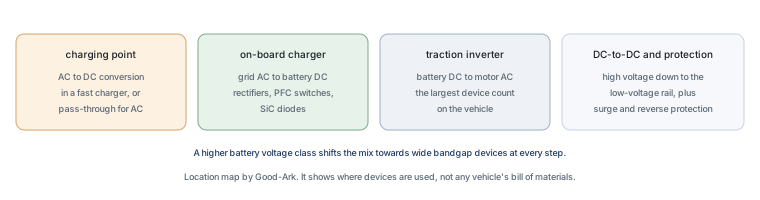
Four locations account for most of the power semiconductor content. The traction inverter converts direct current from the battery into the alternating current the motor needs, and it is usually the largest single consumer of power devices on the vehicle. The on-board charger converts alternating current from a charging point into the direct current the battery needs. The DC-to-DC converter steps the high battery voltage down to the low voltage used by control electronics and lighting. And every one of those circuits is surrounded by protection devices that clamp surges and transients.
| Location | Job | Typical devices |
|---|---|---|
| Traction inverter | Battery DC to motor AC | IGBTs or SiC MOSFETs, gate drivers, protection diodes |
| On-board charger | Grid AC to battery DC | Rectifiers, power factor correction switches, SiC diodes and MOSFETs |
| DC-to-DC converter | High-voltage battery to low-voltage rail | Power MOSFETs, rectifiers, controllers |
| Protection and auxiliaries | Clamping, reverse protection, load switching | Transient suppressors, Zener diodes, small power MOSFETs |
Voltage platforms and their effect on part mix
The battery voltage class shapes which devices are suitable, and this is a technical relationship rather than a market preference. A 400 V class pack gives the designer one set of options; an 800 V class pack allows the same power to be delivered at half the current, which reduces the copper cross-section, the cable weight and the resistive losses in the wiring. The cost is that the devices must block a higher voltage, and that every insulation and creepage requirement becomes stricter.
Higher blocking voltage favours a different device mix. Silicon insulated-gate bipolar transistors are widely used at the lower voltage class because they are robust and inexpensive at moderate switching frequencies. Moving to the higher class increases the benefit of silicon carbide metal-oxide-semiconductor field-effect transistors, whose lower switching loss allows the converter to run at a higher frequency with a smaller magnetic component.
Charging infrastructure demand
Charging adds a second set of power electronics that lives outside the vehicle. A direct-current fast charger contains an alternating-to-direct converter that performs most of the same functions as an on-board charger, only at a much higher power level, and it therefore uses more and larger power devices per unit. Alternating-current charging points use less power electronics and rely on the vehicle’s on-board charger instead.
The consequence for a component buyer is that the two segments have different part profiles and different qualification expectations. A charger installed outdoors also has to survive temperature cycling, humidity and pollution, so the protection devices and the enclosure requirements are more demanding than the equivalent function inside a vehicle.
Supply and cost pressure points
Three pressure points appear repeatedly in this chain. The first is qualification: an automotive power device has to be qualified to an automotive standard and to the customer’s own requirements, and that process takes time which cannot be compressed by paying more. The second is the substrate layer for wide bandgap devices, which is the slowest part of the chain to expand. The third is demand concentration, because a small number of large customers place orders that are large enough to consume a supplier’s capacity.
There is also a design-side pressure that buyers should know about. Automotive parts are specified with a safety margin and are often single-sourced at the design stage, which makes a later second source difficult: changing a device means re-qualification. That is why the time to ask about a second source is during design rather than during a shortage.
What the next five years depend on
Four conditions matter more than any forecast. Whether the average battery voltage class continues to rise, because that decides the device mix. Whether charging infrastructure is built at a rate that matches vehicle sales, because a charger contains power electronics of its own. Whether qualification capacity keeps pace, because a qualified part is the only kind that can be shipped. And whether the efficiency rules that apply to vehicles and chargers tighten further, because a rule changes a bill of materials directly.
Sources and caveats
Statements about vehicle markets should be attributed to a source that publishes its method, and the same figure should be checked for whether it counts production, registrations or deliveries. Statements about semiconductor content should say which vehicle category they describe. Statements about device value should say whether they are measured at the device sale or at the vehicle. Where a source does not say, the number is still evidence that a claim was made, and it is not evidence about the world.
There is one more caveat that applies to almost everything in this subject: the figures are revised. Production counts are restated, registration data is corrected after the fact, and a quarterly comparison can change direction once the final numbers are in. A reader who keeps the original figure and the revision side by side learns something about the reporting process as well as about the market, and a reader who treats the first number as final is occasionally surprised by a correction that arrives a month later.
FAQ
Is the EV market struggling?
That depends entirely on whether the question is about units, about the growth rate, or about a specific region. A market can set a record for unit sales in the same period that its growth rate falls, and reporting that conflates the two produces headlines that appear contradictory but are not. The question worth asking is which of the three a given article is describing.
What is power electronics in an electric vehicle?
It is the set of circuits that convert and control electrical energy rather than processing information. In a vehicle that means the traction inverter that drives the motor, the charger that fills the battery, the converter that supplies the low-voltage system, and the protection devices around all of them. The devices involved are rectifiers, MOSFETs, IGBTs, wide bandgap switches and suppressors.
What happens to electric vehicle batteries after eight years?
Most battery warranties are written in years and mileage, and after the warranty period a battery does not stop working; its usable capacity and power capability decline gradually. In practice used packs are either kept in service, repurposed into stationary storage where a lower energy density is acceptable, or recycled for their materials. Any specific capacity-retention figure belongs to a named study of a named cell chemistry and should not be generalised.
Does an electric vehicle contain more semiconductors than a conventional one?
Yes, and the increase is concentrated in power devices rather than in processors. A conventional vehicle has electronics for engine control, comfort and safety; an electrified one adds the conversion stages that move energy between the battery, the motor, the grid and the auxiliary systems, and each of those stages switches significant current.
Why does battery voltage matter to component buyers?
Because the blocking voltage of the devices has to exceed the pack voltage with margin, and because a higher pack voltage allows a lower current for the same power. Moving to a higher class therefore changes the device family, the losses, the cooling design and the isolation requirements, and it is one of the few changes in this industry that a buyer can see coming from a platform announcement.
What to do next
When you read an EV figure, write down which of the three counts it uses before comparing it with anything else. That one habit prevents most of the confusion in this subject. The semiconductor side of the same chain is described in why higher-voltage platforms use silicon carbide, inside an electric car’s power electronics, and the qualified device families in the automotive portfolio.
Background sources include the general reference on electric vehicles, charging infrastructure, automotive electronics, the automotive qualification standards at the Automotive Electronics Council, electrotechnical standards from IEC and sector material from the Semiconductor Industry Association. Sector and energy background is published by the US Department of Energy, NIST and ISO.
Tell Good-Ark the battery voltage class, the function and the ambient conditions, and we will point you at the automotive-qualified families and the documentation that comes with them.
Email sales@goodark.com, or start from the automotive electronics overview.
This article is published by Good-Ark, a manufacturer of discrete semiconductor devices. It publishes no market value or penetration figure of its own, and no vehicle model is assessed; the electrical values quoted are technical characteristics rather than measurements of a market.
Recommended
 Why Do Diodes Get Hot? Conduction and Switching Losses ExplainedInfoStandard, Fast Recovery, and Schottky Diodes: What’s the Difference?Info
 What Is a Fast Recovery Diode? Understanding “Fast Recovery”Info
 What Is a Diode? A Beginner’s Guide to How It WorksInfo
 Automotive Semiconductor Report 2026: Chips Per Car Keep RisingKnowledge