How Does a Surge Protector Work? (And When It Quietly Stops Working)
How does a surge protector work? Inside, a part sacrifices itself. What the joule figure measures, what clamping voltage means, and when a strip is spent.
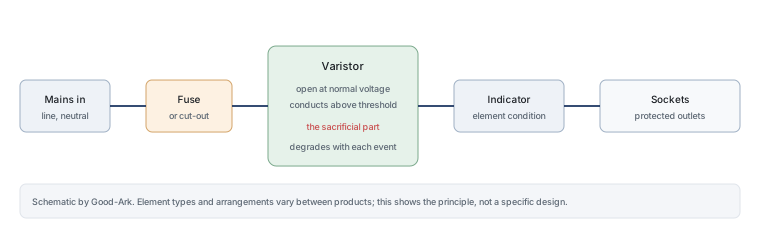
The component inside a surge protector is a sacrificial one. It conducts almost nothing for years, absorbs the energy of an event when one arrives, and comes back slightly worse than before. That is the whole design, and it explains both why the device works and why it eventually has to be thrown away.
Last updated:
What is inside the box
A surge-rated power strip usually contains three things. The first is one or more voltage-dependent resistors — commonly metal-oxide varistors — connected between line and neutral, or between each line and earth. At normal mains voltage they are effectively open; above a threshold they conduct heavily and divert the pulse. The second is a fuse or a thermal cut-out, which disconnects the strip if the protective element fails in a way that would otherwise overheat. The third is an indicator, usually a light or a small window, that shows whether the protective element is still intact.
Better strips add a second stage, often a gas discharge tube or a semiconductor clamp, and some add filtering for electromagnetic noise. The filtering is a genuine feature but it is a different job: it reduces interference on the mains, not the voltage of a surge.
It helps to know why the extra stages exist, because it explains what you are paying for. A single varistor connected between line and neutral diverts energy but lets a residual voltage through, and that residual still has to be tolerated by whatever is plugged in. A two-stage design splits the job: the first element takes the bulk of the energy, and the second, usually faster and with a lower clamping level, cleans up what remains. Filtering is a third, separate function that reduces interference rather than voltage, which is why a strip can be excellent at one of these jobs and useless at another.
Why it sacrifices itself
A varistor absorbs energy by conducting it, and every absorption changes the material slightly. Its threshold drifts, its leakage rises, and its ability to handle the next event falls. This is a deliberate trade: a component that could absorb unlimited events would be large, expensive and slow, and the economics of a consumer strip do not allow it.
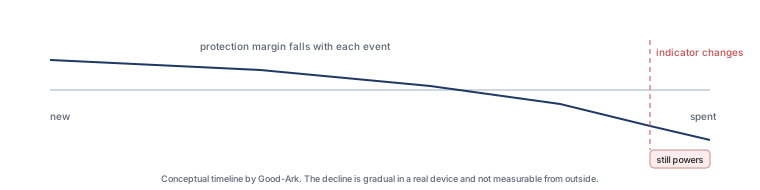
What that means in practice is that a strip is a consumable with an unknown service life. It may protect your equipment perfectly for a decade of small events and then be exhausted, or it may absorb one large event and be finished. Because the failure is gradual, the strip keeps working as an extension lead long after it has stopped working as a protector — which is exactly the situation the indicator exists to flag.
Reading the joule label honestly
The joule figure on a strip describes how much energy the protective elements are expected to absorb over their life. It is a durability number, not a performance number. A strip rated at a thousand joules can absorb more small events before it is spent than one rated at three hundred, and under a single large event both may reach the end of their usefulness.
Two consequences follow. A larger joule figure does not mean a lower voltage reaches your equipment. And a joule figure on its own is an incomplete specification, because it says nothing about how the device behaves during the event — which is what the next number covers.
Clamping voltage in plain words
The clamping voltage is the figure that decides whether your equipment is stressed. It describes the voltage the protective element lets through while it is conducting the surge current. A strip that clamps at a low voltage does more for a device rated for a narrow input tolerance than a strip that absorbs more energy but lets a higher voltage pass.
Because clamping voltage is quoted at a test current, a label without a test condition is only half a specification. Where a manufacturer publishes both numbers, compare them together: energy tells you how long the device lasts, and clamping tells you what it does while it lasts. Our own definitions are collected in the explanation of standoff and clamping voltage.
| Approach | What it protects against | What it does not do | Where it fits |
|---|---|---|---|
| Surge strip | Induced surges on one circuit | Does not stop an outage, and is exhausted by events | Desk equipment on a single socket group |
| Uninterruptible power supply | Outages, brief interruptions and some surges | Its surge element is small relative to its battery role | Equipment that must keep running or shut down safely |
| Clamp inside the device | The residual surge arriving at the input | Cannot handle more energy than it is rated for | Every well-designed product, whether or not you know it |
The indicator light question
On a strip that has an indicator for the protective element, the light is telling you about the varistor, not about the sockets. If it goes out, the strip still supplies power and provides no protection. On some designs the light is a window that visibly changes colour; on others it is a lamp or an LED tied to a thermal fuse.
What the indicator cannot tell you is how much life is left. It typically shows a binary state — intact or spent — so a strip whose light is still on may be close to the end without warning. That limitation is why strips are treated as consumables rather than as durable goods.
Disposal is worth a sentence because the failing part is a heat-damaged component. A spent strip should go to electrical waste rather than household rubbish, and it should not be passed on to somebody else as a working protector. There is no reliable way for a user to test the protective element, and a multimeter check of the sockets tells you only that power passes — which it will, whether or not any protection remains.
When to throw it away
Replace a strip if the indicator has changed state, if there has been a nearby strike or a visible event on the circuit, if the casing is discoloured or smells of hot plastic, or if it has been in service for many years on a circuit that sees frequent small surges. Replace it immediately if the cord, plug or sockets show any damage, because at that point the risk is the strip rather than the surge.
What you should not do is open it, repair it or attempt to test the protective element yourself. A varistor at the end of its life is a component that has been through thermal stress, and a strip is a cheap item with mains potential inside it.
Three external references help when a label makes a claim you want to check. The consumer category is explained under surge protectors, the component usually found inside a strip under varistors, and the pulse definitions behind published ratings come from the International Electrotechnical Commission and JEDEC. Assembly and installation expectations are covered by IPC, and industry-level material by the Semiconductor Industry Association. Standards and measurement background is published by NIST and ISO.
Buying checklist
Four questions separate a useful strip from a decorative one. Does the label state a clamping voltage as well as an energy figure? Is there an indicator for the protective element, and is it explained? Is the current rating adequate for what you will plug in? And does the manufacturer say anything about what the device is tested to, rather than only what it contains?
None of that requires technical knowledge to check at the shelf. What it does require is resisting the number that is printed largest, which is almost always the energy figure, and looking for the number that decides whether your equipment is stressed.
FAQ
What should you never plug into a surge protector?
Anything that draws more current than the strip is rated for — a space heater, a large motor, a welder or a high-power appliance. The risk there is not the surge but the strip’s own wiring and contacts. Some equipment manufacturers also advise against putting specific sensitive devices behind a strip whose clamping behaviour is unknown, so follow the equipment instruction where one exists.
Should I leave the surge protector on all the time?
Leaving it switched on does not harm the protective element; the part that degrades is affected by events, not by standby time. Some strips consume a small amount of power for their indicator. If you want the most reliable protection, the plug is still the definitive disconnection, and unplugging during a storm is more effective than any switch on the strip.
How do I know if my surge protector is working?
The only reliable external signal is the indicator the manufacturer provided, and it usually reports a binary state rather than remaining capacity. Without an indicator there is no way to know from outside. That is a design limitation of the product category, not a fault of yours, and it is the reason strips are replaced on a schedule or after major events rather than tested.
What are the downsides of using a surge protector?
Three worth knowing. It occupies socket space and adds a cable that can be a trip hazard. It adds a small series impedance, which is irrelevant for most loads but can matter for high-current equipment. And it creates a false sense of completeness, because a strip on one socket group does nothing for the rest of the building — the building layer is a separate job.
Is a surge protector the same as a voltage stabiliser?
No. A stabiliser or regulator acts on sustained voltage variation, holding the output within a range while the input wanders. A surge protector acts on brief events and does nothing during normal operation. A device with both functions exists, but the two capabilities should be checked separately rather than assumed from one label.
What to do next
Look at the strip under your desk and find two numbers: the energy figure and, if it exists, the clamping voltage. If only the first is printed, you now know why the second matters. For the building-level layer, the companion article on where protection sits in a home explains the sequence, and the device-level definitions are in the guide to TVS voltage selection.
Good-Ark can help turn an interface and an expected event into a clamping specification, and point to the families that meet it.
Email sales@goodark.com, or begin at the product family learning centre.
This article is published by Good-Ark, a manufacturer of semiconductor protection devices rather than of consumer power strips. The varistors common in consumer strips are described here as general industry practice and are not a product of this company.
Continue through this engineering topic
For the complete selection, design, verification, and troubleshooting path, explore the TVS ESD and Surge Protection Hub.
- Practical guide: Lightning, Surges and Home Electronics: Where Protection Actually Sits
- Practical guide: ESD Protection for Beginners: Why a Tiny Diode Saves Your Phone
- Practical guide: Protection Diodes: TVS, Reverse Polarity, Flyback and Input Clamps
- Ask Good-Ark technical support about this application
Recommended
 Why Do Diodes Get Hot? Conduction and Switching Losses ExplainedInfoStandard, Fast Recovery, and Schottky Diodes: What’s the Difference?Info
 What Is a Fast Recovery Diode? Understanding “Fast Recovery”Info
 What Is a Diode? A Beginner’s Guide to How It WorksInfo
 Automotive Semiconductor Report 2026: Chips Per Car Keep RisingKnowledge