Lightning, Surges and Home Electronics: Where Protection Actually Sits
Lightning surge protection for home electronics has three layers: the building, the outlet strip and the circuit inside. What each layer can and cannot do.
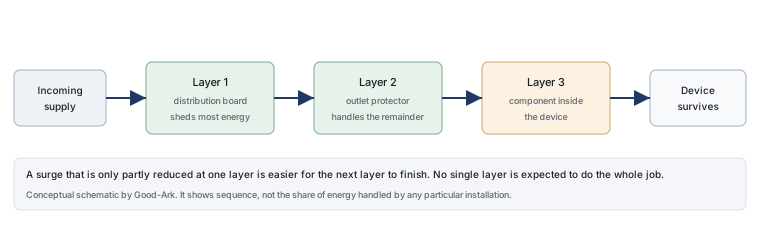
A direct lightning strike is rare and usually destroys things whatever you do. The far more common case is a surge induced on the wiring by a nearby strike, and that one arrives in stages — which is exactly what makes it defensible. Protection is not a single device; it is a sequence of places where the energy can be shed before it reaches the thing you care about.
Last updated:
How lightning reaches your devices
Lightning does not need to hit your house to affect it. A strike a few hundred metres away creates a rapidly changing electromagnetic field, and that field induces voltage on the same conductors that carry power and data into your home. The result is a travelling pulse that enters through the mains wiring, the phone or cable line, or the outdoor unit of an air conditioner — anything with a conductor that goes outside.
Two properties of that pulse decide how you defend against it. It arrives fast, in microseconds or less, so slow protective devices act too late. And it carries far more energy than a static discharge, so the small components designed for ESD are simply the wrong size. This is why the answer to “which device protects my house” is never one device.
Layer 1: the building
The first layer is where the supply enters the building. A service-entrance protective device, installed at the distribution board, gives the incoming surge a low-impedance path to earth before it travels through the internal wiring. Its job is not to protect your laptop; it is to reduce the energy that reaches every outlet in the house, so the later layers have something survivable to work with.
This layer is the one most homeowners do not know they have, and the reason an electrician is involved rather than a shopping trip. It also explains why a single outlet strip cannot substitute for it: a device at one socket cannot reduce the surge arriving at another room’s wiring.
Layer 2: the outlet protector
The familiar power strip with a surge rating is the middle layer. Inside, it typically contains one or more metal-oxide varistors, sometimes combined with a fuse or a thermal cut-out. A varistor behaves like a voltage-dependent resistor: at normal mains voltage it is effectively an open circuit, and above a threshold it conducts heavily and diverts the pulse.
Two things limit what this layer can do. The first is energy: a strip has to absorb whatever reaches it, and a large surge will either be absorbed at the cost of the varistor or pass through as the varistor degrades. The second is that a varistor wears out rather than switching cleanly, so its protection margin shrinks with every event it absorbs — which is the subject of the companion article on what actually happens inside a surge protector.
Layer 3: the diode inside the device
Every well-designed device has its own protection at the point where power and signals enter it. In a laptop adapter that is a component near the input; in a television it is a clamp on the mains stage and another on the signal connectors. This layer exists because a designer cannot assume the first two layers are present, and because even a reduced surge is still enough to damage the first semiconductor it reaches.
This is where semiconductor clamping devices rather than varistors are usually found, because they respond faster and are specified by pulse energy in a way that can be matched to the threat. The general principle is covered in the introduction to transient voltage suppression.
Why one layer is never enough
Each layer fails for a different reason. The building layer cannot stop everything, because the surge can also enter through data and antenna cables. The outlet layer may not be there at all, and if it is, it sits on one circuit. The device layer is small by necessity, because it has to fit inside a product and not disturb the signals it protects.
There is also a coordination problem. A very effective layer early in the chain can make things worse if nothing downstream is prepared for the resulting current, and a weak layer in the middle does nothing except fail. This is why professional protection design specifies the sequence together rather than choosing one impressive component.
A second, quieter problem is the ground reference. A protective device only works if there is somewhere for the energy to go, and the quality of that path matters as much as the device. In a building, that is the earthing system and the work of an electrician. Inside a product, it is the board layout — which is why a protection component placed a few centimetres from a connector can be present, correct, and useless.
What a cheap power strip does not do
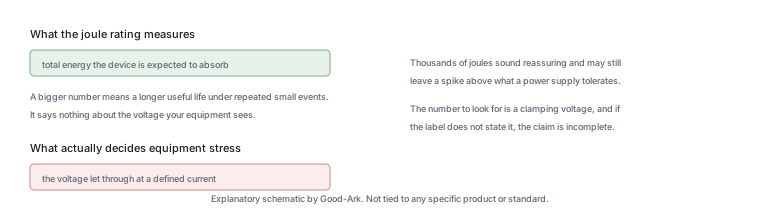
A cheap strip with a switch and sockets is a convenience item with no protective element at all, however it is marketed. A strip that advertises a joule figure does contain a varistor, but the number describes how much energy it is expected to absorb over its life, not how well it clamps the voltage. Those are different claims, and the second is the one your equipment depends on.
| Product | What it typically contains | What it does not do |
|---|---|---|
| Basic power strip | Sockets and a switch | No protection at all |
| Surge-rated strip | One or more varistors, sometimes a fuse | Does not stop a large direct surge, and degrades with use |
| Uninterruptible power supply | A battery, an inverter and some input protection | Protects against outages and short interruptions, not against a large surge |
| Protection inside the device | Semiconductor clamps at the entry points | Cannot handle an event larger than its specified rating |
| Whole-home protector | A device at the distribution board | Requires an electrician, and does not replace outlet or device protection |
Insurance-style maths: cost versus risk
The rational way to spend on protection is to compare the cost of each layer with what it protects. A whole-home device covers the wiring and everything plugged in, which makes it the highest-value layer for a house with a lot of electronics. An outlet strip covers one circuit and a handful of devices. Device-level protection is already paid for when you choose equipment that has it.
The comparison is not the same everywhere. In a region with frequent thunderstorms, the first layer earns its cost quickly. In a flat served by buried cables, the induced-surge risk is lower. What does not change is the direction of the logic: spend where the energy is largest and the coverage is widest, then work inward. Buying the most expensive outlet strip before covering the building is the classic inversion.
Four external references are useful when you want to check what is behind a label. The consumer product category is described under surge protectors and the atmospheric event itself under lightning. The test waveforms that make surge ratings comparable come from the International Electrotechnical Commission, measurement guidance from the US National Institute of Standards and Technology, installation and assembly expectations from IPC, and sector-level context from the Semiconductor Industry Association. Standards and measurement background is published by JEDEC and ISO.
Practical checklist
For a home, five actions cover most of the available benefit and none of them requires opening a device.
- Ask an electrician whether the distribution board has surge protection, and add it if not.
- Use a surge-rated strip for equipment that is expensive to replace, and check that it states a clamping voltage rather than only a joule figure.
- Include the data and antenna entries, not only the power sockets, because surges arrive on those conductors too.
- Unplug equipment during a storm if you are present — the plug is still the most reliable disconnection.
- Replace a strip that has absorbed a significant event, especially if it has an indicator that has changed state.
FAQ
Do surge protectors actually work against lightning?
They work against the surges that lightning induces on wiring, which is the common case, and they reduce the energy that reaches your equipment. They do not make a device immune to a direct strike on or near the building, and they do not survive every event. The realistic claim is that each layer lowers the probability of damage, not that any single product eliminates it.
What device can protect my house from lightning strikes?
The first device is a surge protective device installed at the distribution board by an electrician, which addresses the whole installation. Beyond that, protection is a combination: an air termination system for the structure in high-risk locations, outlet-level protection for sensitive equipment, and the protection already built into the equipment itself. No single product covers the building and everything in it.
What devices should not be plugged into a surge protector?
High-current appliances are the usual concern, because a strip rated for a few amps should not carry a heater, a large motor or a similar load; the risk there is the strip itself, not the surge. Some manufacturers also advise against using certain sensitive devices behind a strip with a low clamping voltage, because the protection can interact with the equipment. Follow the equipment manufacturer’s instruction where one exists.
What is the difference between a surge protector and a lightning protector?
A surge protector limits the voltage that reaches the equipment behind it, and it is specified by how much energy it can absorb and what voltage it lets through. A lightning protection system is a structural installation — air terminations and down conductors — whose job is to give a direct strike a safe path to earth so it does not travel through the building fabric. They address different events and are used together, not instead of each other.
Why does my strip have an indicator light?
On most strips the light indicates that the protective element is still functional, not that the sockets are powered. A light that has gone out on a surge-rated strip usually means the varistor has reached the end of its useful life, and the strip should be replaced rather than treated as a plain extension lead. This is covered in more detail in the companion piece on how surge protectors work.
What to do next
Start with the layer you do not control: find out what protection exists at your distribution board. Then add outlet protection where the expensive equipment is, and treat any strip with a spent indicator as a consumable. If you want the device-level side of the same subject, the definitions used for clamping behaviour are set out in the guide to clamping and standoff voltage.
Good-Ark can help define the node, the expected event and the voltage the circuit can tolerate, and point to the protection families that fit that combination.
Email sales@goodark.com, or start from the TVS portfolio page.
This article is published by Good-Ark, a manufacturer of the protection components described at layer three. It is written for homeowners rather than installers, gives no product recommendations for consumer strips, and does not replace the advice of a qualified electrician.
Continue through this engineering topic
For the complete selection, design, verification, and troubleshooting path, explore the TVS ESD and Surge Protection Hub.
- Practical guide: ESD Protection for Beginners: Why a Tiny Diode Saves Your Phone
- Practical guide: Protection Diodes: TVS, Reverse Polarity, Flyback and Input Clamps
- Practical guide: TVS vs Zener Diode: Two Similar Parts With Two Very Different Jobs
- Ask Good-Ark technical support about this application
Recommended
 Why Do Diodes Get Hot? Conduction and Switching Losses ExplainedInfoStandard, Fast Recovery, and Schottky Diodes: What’s the Difference?Info
 What Is a Fast Recovery Diode? Understanding “Fast Recovery”Info
 What Is a Diode? A Beginner’s Guide to How It WorksInfo
 Automotive Semiconductor Report 2026: Chips Per Car Keep RisingKnowledge