Good-Ark — discrete power semiconductors: rectifiers, Schottky, TVS, MOSFETs, SiC and IGBT
Request a Quote

How to Read a Diode Datasheet: Key Parameters for Beginners

A diode datasheet may begin with a page full of abbreviations: VRRM, IF(AV), VF, and trr. Choosing the largest current or the smallest time is tempting, but the conditions beside each number are just as important. When learning how to read a diode datasheet, treat it as a description of capability under stated conditions. Start … Read more

Why Do Diodes Get Hot? Conduction and Switching Losses Explained

Why Do Diodes Get Hot? Conduction and Switching Losses Explained

A diode can be working correctly and still become warm. It carries power to a load, but some electrical energy is dissipated inside the device and becomes heat. Whether that heat causes a modest temperature rise or a serious problem depends on the circuit and the way the device is mounted. To understand why diodes … Read more

Standard, Fast Recovery, and Schottky Diodes: What’s the Difference?

Standard, fast recovery, and Schottky diodes can look almost identical on a circuit board. All can provide a directional current path, but their voltage drop, heating, and behavior during switching can differ. The most useful starting question is what the diode must do at its circuit position. In this comparison, “standard diode” means a standard … Read more

What Is a Fast Recovery Diode? Understanding “Fast Recovery”

What Is a Fast Recovery Diode? Understanding “Fast Recovery”

If a diode behaves like a one-way valve, why does a power supply need a “fast recovery” version? Shouldn’t an ordinary diode stop reverse current as soon as the voltage changes? The answer lies in the transition. A conducting PN junction contains stored charge. When the circuit asks the diode to block reverse voltage, that … Read more

What Is a Diode? A Beginner’s Guide to How It Works

What Is a Diode? A Beginner’s Guide to How It Works

A small component with two leads can determine which way current travels through a circuit. That component is a diode. You may see one as a black cylinder with a band near one end, or as a tiny rectangular package soldered directly to a circuit board. A useful starting point is a one-way valve in … Read more

PV Bypass Diode Failures in the Field: Hot Spots and Thermal Stress

PV bypass diode failures appear as string underperformance or a damaged junction box, and the evidence chain runs from the shading pattern to the junction-box temperature. This guide covers the failure mechanisms, the hot-spot damage patterns, the thermal evidence, and the module-versus-device attribution. Why Bypass Diodes Fail in the Field The bypass diode conducts the … Read more

How to Select a PV Bypass Diode: VF, Leakage, Surge, and the Junction Box

A PV bypass diode is selected by five numbers—forward current, forward drop, leakage at temperature, surge capability, and thermal resistance—and the selection only works when those numbers are checked inside the real junction-box heat-flow route. The part that looks best at 25 °C often fails the hot, shaded-hour test. This guide walks through the selection … Read more

Protection Diodes: TVS, Reverse Polarity, Flyback and Input Clamps

Protection Diodes: TVS, Reverse Polarity, Flyback and Input Clamps

Protection diodes can clamp a transient, block unwanted current or provide a path for an inductive load when a switch turns off. Those are different jobs. A TVS across a supply does not automatically provide series reverse-polarity isolation, and a relay flyback diode is not a universal surge protector. Start with the event and current … Read more

High Voltage MOSFETs: Ratings, Losses and Circuit Design Checks

High Voltage MOSFETs: Ratings, Losses and Circuit Design Checks

A high voltage MOSFET must block the voltage at its own terminals, including switching excursions, while meeting the converter’s loss and thermal limits. A large drain–source rating alone cannot establish suitability. The design also depends on gate drive, reverse-current behavior, operating mode and the physical current loops. Reading those conditions together is more useful than … Read more

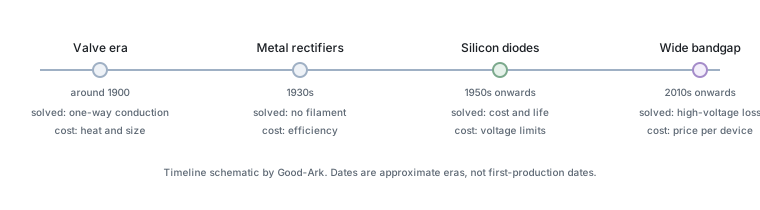
Good-Ark Company History: Riding a Century of Electronics, From Radio Valves to Electric Cars

Good-Ark Company History: Riding a Century of Electronics, From Radio Valves to Electric Cars

Every generation of electronics leaves a layer behind, and those layers are still on the board. The adapter on your desk contains the descendants of parts invented to make radio work, and the fuse-box logic of a modern car traces back to the same idea: change the voltage, protect what comes after. Understanding that lineage … Read more

Transistors for Power and Signal Design: Types and Selection

Transistors for Power and Signal Design: Types and Selection

Transistors are semiconductor devices that control current and can provide switching or amplification. In signal circuits they shape, amplify or buffer an electrical signal. In power circuits they control energy delivered to a load. Choosing a transistor starts with its job in the circuit, then its voltage, current, drive, bandwidth and thermal requirements. Last updated: … Read more

Power MOSFETs for SMPS, PV Inverters and Automotive Circuits

Power MOSFETs for SMPS, PV Inverters and Automotive Circuits

A power MOSFET is a transistor used to switch or control electrical power with a gate voltage. In a switching power supply it helps convert energy efficiently; in a photovoltaic inverter it helps synthesize AC from a DC source; in automotive electronics it can switch loads or protect a supply path. Selecting one requires the … Read more

Need a part number checked against your design?

Send the topology, current and voltage class. Good-Ark sales and application engineering will confirm the closest device, package and qualification status.

Copyright Suzhou Good-Ark Electronics Co., Ltd. All Rights Reserved