MOSFET vs BJT vs IGBT: Three Transistors, Three Very Different Jobs
MOSFET vs BJT vs IGBT: three families exist because one could not do every job. How each is controlled, where each is used, and how to tell quickly.
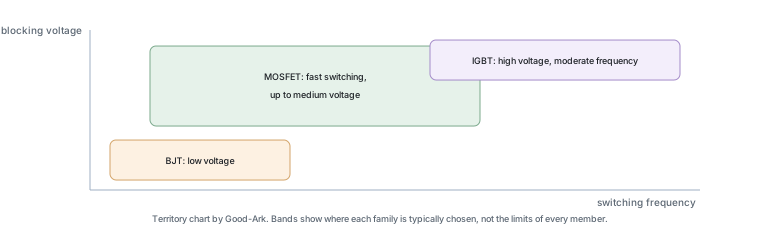
Three transistor families exist because one design could not do every job well. The bipolar junction transistor switches cleanly and cheaply at low voltage, the MOSFET switches quickly with almost no drive power, and the IGBT combines a field-effect input with a bipolar output to handle very high power at moderate speed. Knowing which is which explains most of what a circuit designer is actually choosing.
Why three types exist at all
The underlying problem is a trade-off between three properties: how much drive power the control input needs, how much current the device can carry with low loss, and how quickly it can switch. No single structure wins on all three, so the industry built three that win on different combinations.
The analogy that fits is three kinds of gate. A small hinged gate that you push open yourself is easy to operate and only suits a narrow opening. A large sluice gate on a canal carries enormous flow but needs machinery and takes time to move. And a gate with a hydraulic control on a heavy door carries a lot and moves reasonably quickly, at a cost in complexity. That third one is the IGBT: not the best at anything, but the best available combination above a certain power level.
BJT: current-controlled
A bipolar junction transistor is controlled by current into its base terminal. The base-emitter junction behaves like a diode, so the control input needs a defined current flowing continuously while the device is on. In exchange, the device has a low saturation voltage when conducting, which makes it efficient at low voltages and modest currents.
Its weaknesses follow from the same mechanism. The continuous base current is a real cost in battery circuits and in high-current applications, and the stored charge in the base means the device switches relatively slowly. It is also prone to thermal runaway in some configurations, because a hot bipolar device conducts more easily and so takes more of the share in a parallel arrangement — the opposite of a MOSFET, where heating tends to reduce the current it takes.
MOSFET: voltage-controlled
A MOSFET is controlled by a voltage at an insulated gate, and once that gate is charged the control current is essentially zero. That is why a logic pin can drive a device switching many amps, and why MOSFETs dominate low-voltage and medium-power switching. They also switch fastest of the three, which matters for converters running at high frequency.
Their limitation is on-resistance, and its behaviour with voltage. As the blocking voltage rises, the resistance of the conducting path rises with it, so at high voltages the conduction loss becomes unmanageable in silicon. That single fact is why the IGBT exists, and why silicon carbide exists above it.
IGBT: the high-power hybrid
An insulated-gate bipolar transistor takes the input side of a MOSFET — an insulated gate, controlled by voltage with almost no drive current — and the output side of a bipolar device, which conducts with a low voltage drop rather than a resistance. The result is a switch that is easy to drive and efficient at high currents, at the cost of switching speed.
The structural consequence is a tail current: after the gate turns off, stored charge has to clear before the device stops conducting, so the turn-off is not clean. At low switching frequencies that is irrelevant, which is why IGBTs dominate motor drives, induction heating and traction applications where the frequency is measured in kilohertz rather than hundreds of kilohertz.
Voltage and frequency ranges simply
At low voltage and low power, the bipolar transistor is often the cheapest and simplest choice, and it still appears constantly as a small signal switch. At low and medium voltage with a need for speed or efficient drive, the MOSFET wins. At high voltage and moderate frequency, the IGBT wins, because the MOSFET’s on-resistance at that voltage would waste more energy than the IGBT’s tail current does.
The boundary between MOSFET and IGBT moves. It depends on the switching frequency, the current, the cost of the devices and the price of the cooling hardware. As MOSFET performance improves and silicon carbide extends it upwards, the boundary moves towards higher voltages, which is why IGBTs face competition in applications they once owned outright.
| Property | BJT | MOSFET | IGBT |
|---|---|---|---|
| Control input | Base current | Gate voltage | Gate voltage |
| Drive power while on | Continuous | Almost none | Almost none |
| Switching speed | Slowest | Fastest | Moderate, with a turn-off tail |
| Conduction behaviour | Low saturation voltage | Resistance, rising with voltage rating | Low saturation voltage at high current |
| Typical territory | Low voltage, low power, signal switching | Low to medium voltage, high frequency | High voltage, moderate frequency, high power |
| Everyday example | A small signal switch or an older amplifier | A phone charger’s switching stage | An industrial motor drive or an induction cooker |
| Heat behaviour in parallel | Prone to thermal runaway | Self-limiting, because heat raises resistance | Needs care, being partly bipolar |
Everyday examples of each
The bipolar transistor survives in huge numbers as a small signal switch and as a simple driver: turning on a relay, driving a small LED, amplifying a sensor signal. It is cheap, robust against static and predictable, which is why it remains the first three-terminal device many people learn.
The MOSFET is the workhorse of modern power electronics. It switches the current in phone chargers, laptop power supplies, battery management systems, LED drivers and motor controllers, and it does so hundreds of thousands of times a second in some designs. If a product converts or controls significant power and it was designed recently, a MOSFET is probably involved.
The IGBT appears where the voltage and current are both high and the switching frequency is modest. Industrial motor drives, induction heating, welding equipment, rail traction and electric vehicle traction inverters in earlier generations all relied on it. It is not obsolete anywhere its frequency range suits: it is simply the right tool for a territory the MOSFET cannot reach economically.
One table to remember
If you remember one thing, remember the control input, because it predicts everything else. A base current means continuous drive power and stored charge, so the device is slower and needs a driver that can supply current. A gate voltage with an insulated input means almost no drive power and fast switching, so the device suits high frequency and easy interfacing. And a gate-driven device with a bipolar output means easy drive with low conduction loss at high current, so it suits high power at moderate speed.
The second thing worth remembering is the direction of the self-heating feedback, because it matters when devices are paralleled. A MOSFET that gets hot takes less current, which tends to equalise a parallel group. A bipolar device that gets hot takes more, which tends to concentrate current in one device — and an IGBT, being partly bipolar, sits in between and needs more care than a MOSFET in parallel operation.
Common questions
The most frequent misunderstanding is that these are successive generations, with each replacing the last. They are not. All three are in production in enormous volumes, because each occupies a territory where it is the economical choice. A designer choosing between them is deciding which combination of drive power, switching speed and conduction loss suits the application, not which technology is newer.
The second is that switching speed is always an advantage. It is not, if the application does not need it: faster switching produces more high-frequency noise, requires more careful layout and filtering, and can cost more than the efficiency it saves. In a motor drive running at a few kilohertz, the IGBT’s slower edges are a benefit rather than a limitation.
The related reading on this site covers bipolar junction transistors, MOSFETs and insulated-gate bipolar transistors. Device test methods come from JEDEC, thermal and assembly expectations from IPC, and sector-level context from the Semiconductor Industry Association. Device and quality background is published by ISO, NIST and IEC.
FAQ
Are MOSFETs or BJTs better?
Neither in general; they win in different places. A bipolar transistor needs continuous base current but conducts with a low saturation voltage, which suits low-voltage switching and simple amplification. A MOSFET needs almost no drive current and switches much faster, which suits high-frequency power conversion. At the low-voltage end the bipolar part is often cheaper and simpler, and at the power-conversion end the MOSFET is almost always the answer.
Why use an IGBT instead of a MOSFET?
Because at high blocking voltages a silicon MOSFET’s on-resistance rises to the point where its conduction loss exceeds what the IGBT’s slower switching costs. The IGBT also conducts with a roughly constant voltage drop rather than a resistance, so its loss grows linearly with current rather than with the square. That is why it dominates high-power motor drives and induction heating, where the frequency is moderate.
Which is faster, IGBT or MOSFET?
The MOSFET. An IGBT carries stored charge in its output side, so it has a turn-off tail: current continues briefly after the gate is turned off while that charge clears. That limits its practical switching frequency. A MOSFET has no such storage in the conducting path, which is why it is chosen wherever the frequency is high.
Is a BJT faster than a MOSFET?
No, and it is slower for the same reason the IGBT is: stored charge in the base has to be removed before the device stops conducting. Small bipolar transistors can switch quite quickly at low currents, which is why they remain useful for signal work, but at power levels the MOSFET is faster.
Is one of these technologies obsolete?
No. All three are manufactured in large volumes because each occupies a territory where it is the economical choice, and the boundaries between the territories move as device performance and prices change. Silicon carbide is currently moving the MOSFET boundary upwards into territory the IGBT used to hold, but that is a shift rather than a replacement.
What to do next
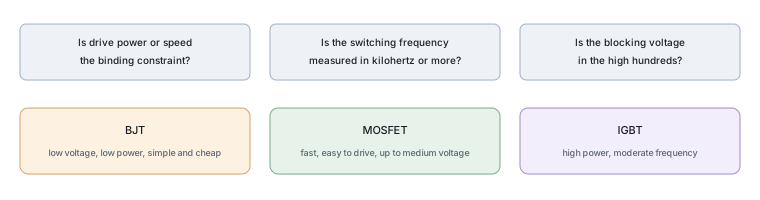
Take a product you own that handles mains power or drives a motor and try to work out which family it uses from the three questions above: whether drive power mattered, how fast it switches, and how high the voltage is. That exercise makes the division of labour concrete, and it is a good deal more useful than remembering the names. The MOSFET-specific material is in our article on what a MOSFET is.
Tell Good-Ark the blocking voltage, the current and the switching frequency, and we can say which family fits and where the boundary between them sits for your case.
Email sales@goodark.com, or start from the product family learning centre.
This article is published by Good-Ark, a manufacturer of MOSFETs, IGBTs and other discrete devices. It compares device families rather than specific products, and no part numbers or performance figures for particular devices are quoted.
Recommended
 Why Do Diodes Get Hot? Conduction and Switching Losses ExplainedInfoStandard, Fast Recovery, and Schottky Diodes: What’s the Difference?Info
 What Is a Fast Recovery Diode? Understanding “Fast Recovery”Info
 What Is a Diode? A Beginner’s Guide to How It WorksInfo
 Automotive Semiconductor Report 2026: Chips Per Car Keep RisingKnowledge