Good-Ark — discrete power semiconductors: rectifiers, Schottky, TVS, MOSFETs, SiC and IGBT
Request a Quote

What Is the GSD Series Used For? A Plain-Language Guide for Buyers and Beginners
What Is the GSD Series Used For? A Plain-Language Guide for Buyers and Beginners

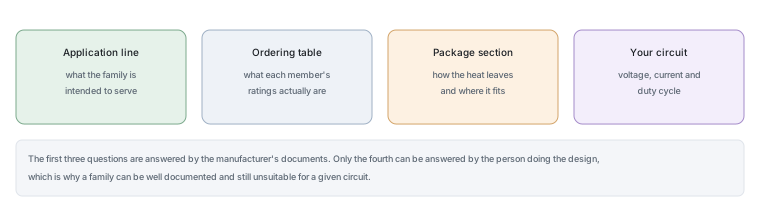
The useful question about any component family is not what its name means but what the parts in it are specified to do. That answer lives in two documents — the family’s product page for its intended application, and its datasheet for the member ratings — and both are more reliable than any summary written … Read more
Low RDS(on) Explained: Why It Decides Your Battery Life

Low RDS(on) Explained: Why It Decides Your Battery Life

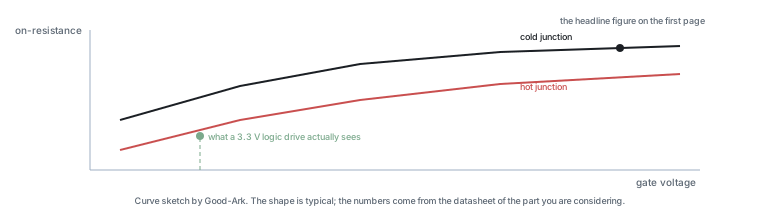
On-resistance is the toll a MOSFET charges on every amp that passes through it, and in a battery-powered product that toll is paid out of the battery. The size of the toll depends on two conditions the datasheet states and that beginners routinely ignore: the gate voltage and the junction temperature. Battery life is a … Read more

Choosing a MOSFET for Your First Project: A Beginner Checklist

Choosing a MOSFET for Your First Project: A Beginner Checklist

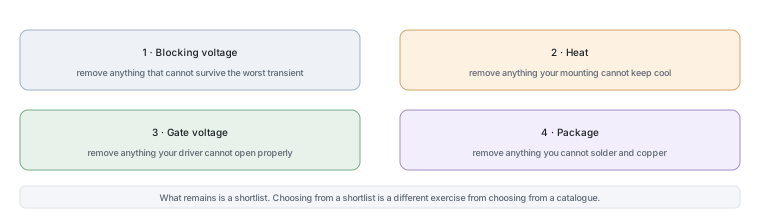
Four questions answer most first-project selections, and three of them are about the circuit rather than the part. Answer those before opening a catalogue and the choice usually narrows to a handful of candidates that are all capable of doing the job. Four questions before you open a catalogue What voltage must the device block, … Read more

N-Channel and P-Channel MOSFET Wiring: A Beginner Practice Circuit

N-Channel and P-Channel MOSFET Wiring: A Beginner Practice Circuit

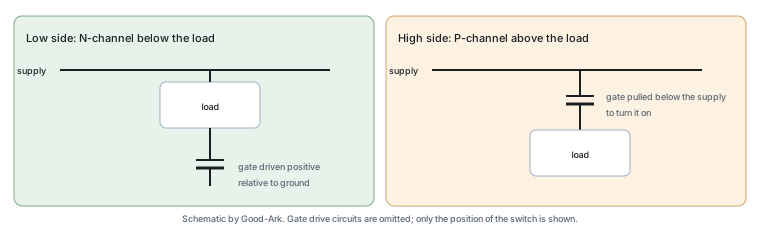
For a beginner wiring exercise, identify the source reference and the load connection before choosing an N-channel or P-channel MOSFET. The gate must be driven relative to its own source. Performance, voltage, loss, and driver requirements still matter when selecting the actual part. Last updated: October 16, 2026 Two polarities in one picture An n-channel … Read more

What Does the GS Prefix Mean? Decoding MOSFET Part Numbers Without Guessing

What Does the GS Prefix Mean? Decoding MOSFET Part Numbers Without Guessing

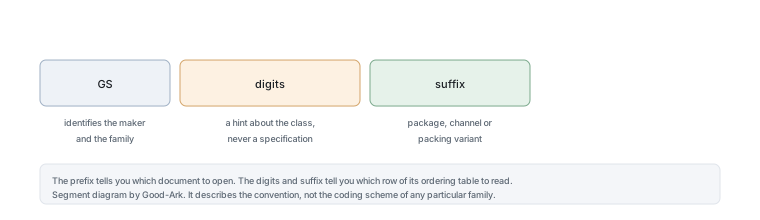
The letters at the start of a component part number almost always identify the manufacturer or the product family, and they carry no rating information at all. Everything useful sits later in the string, and the only reliable way to read it is the ordering table in the current datasheet for that specific family. Why … Read more

What Is the GSMDJ Series Used For? A Beginner-Friendly Explanation

What Is the GSMDJ Series Used For? A Beginner-Friendly Explanation

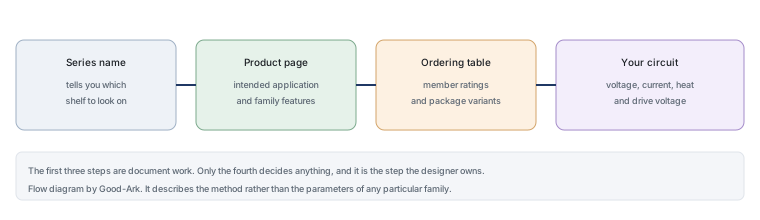
A series code is a shelf label rather than a specification, and the practical question a buyer needs answered is which shelf holds parts that suit their circuit. That answer comes from two documents — the family’s product page and its datasheet — and both are more useful than any summary written about them. The … Read more

Gate, Drain, Source: The Three Pins of a MOSFET Explained With a Water Analogy

Gate, Drain, Source: The Three Pins of a MOSFET Explained With a Water Analogy

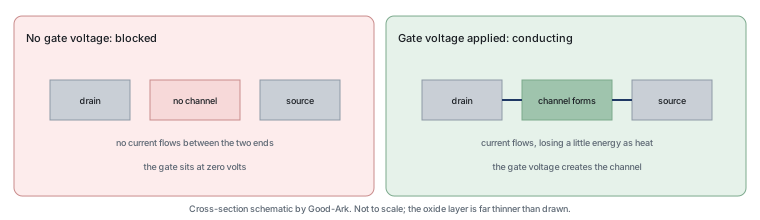
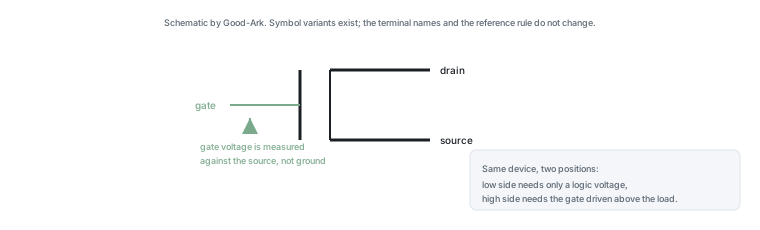
Most beginner wiring mistakes with a MOSFET come from one misunderstanding: the gate voltage is measured between the gate and the source, not between the gate and the circuit’s ground. Once that rule is clear, the three terminal names stop being arbitrary and start predicting what a circuit will do. Last updated: October 11, 2026 … Read more

Need a part number checked against your design?

Send the topology, current and voltage class. Good-Ark sales and application engineering will confirm the closest device, package and qualification status.

Copyright Suzhou Good-Ark Electronics Co., Ltd. All Rights Reserved