Good-Ark Automotive Parts in Plain Language: What Actually Goes Into a Car
Good-Ark automotive parts sit in a network of small computers sharing a noisy electrical environment. Where the discrete devices sit, and why they are graded.
A car is not one electronic product; it is dozens of small ones sharing a wiring harness and an electrical environment that is unusually hostile. Understanding that environment explains why a diode that costs a few cents in a phone costs considerably more in a vehicle, and why the qualification paperwork matters as much as the part.
A car is a rolling electronics network
Modern vehicles distribute computing rather than centralising it. Instead of one computer, there are control units for the engine, the transmission, the brakes, the body, the dashboard, the seats, the lighting and the doors, each with its own processor and its own power supply. They communicate over shared serial buses, and each has to keep working while the others switch loads on and off.
The analogy that fits is a building with a hundred independent thermostats sharing one electrical installation. Every unit works locally, but every unit also experiences the noise its neighbours create. In a car that noise arrives as voltage transients, and the components at each unit’s input are what stop those transients reaching the silicon behind them.
Where the diodes sit, by area of the car
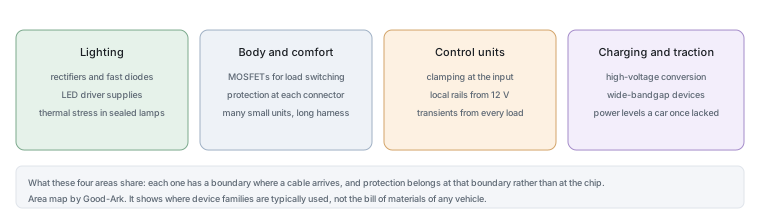
The components are distributed according to where the electrical stress happens rather than where the computing happens. At connectors, protection devices absorb the transients that a harness can collect. In lighting modules, rectifiers and drivers convert and regulate supply for the LED strings. In the body and power switching circuits, MOSFETs turn loads on and off without contacts to wear. In the charging and traction systems of electrified vehicles, higher-voltage devices handle conversion at power levels a conventional car never sees.
The pattern that repeats is proximity to a boundary. Anywhere a wire leaves one module and arrives at another, or leaves the vehicle altogether, there is a place where protection belongs and where the requirements are stricter than they would be inside a sealed consumer device.
What “automotive grade” means for a normal person
An automotive-grade component has been qualified against a set of tests that simulate the conditions a vehicle imposes: large temperature swings, vibration, humidity, and electrical transients of defined shapes and energies. It also carries traceability, so a batch can be connected to the qualification evidence that covers it.
The practical consequence is that a commercial part with similar electrical ratings is not a substitute, because its ratings were established under different conditions and its documentation does not connect it to the vehicle environment. That is not a statement about quality; it is a statement about what has been demonstrated and recorded.
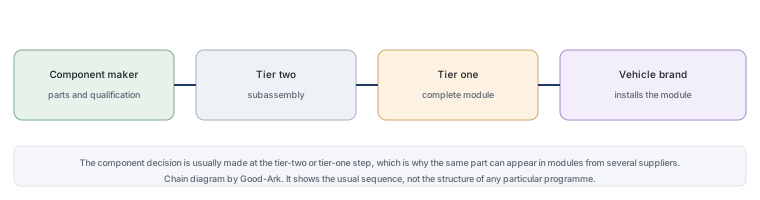
The supply chain is worth understanding for one practical reason: it explains why a component decision is usually made by a supplier several steps away from the vehicle brand. The vehicle manufacturer defines what the system must do, the module supplier chooses the parts, and the component maker provides the qualification evidence. That is why a part number in a car is often a supplier-specific variant rather than a catalogue item, and why asking the vehicle brand about a component rarely produces an answer.
Three external references are useful for the standards side. Automotive electronics generally is described under automotive electronics, the qualification framework for discrete devices by the Automotive Electronics Council, and the assembly and workmanship expectations for the boards inside a module by IPC. Device test methods come from JEDEC, quality management requirements from ISO, electrical safety and testing standards from the International Electrotechnical Commission, and sector-level context from the Semiconductor Industry Association.
Why car parts are tested so harshly
Two reasons. The first is the environment: a component may spend its life cycling between a cold start in winter and a hot engine bay in summer, while being vibrated and exposed to moisture. The second is the consequence of failure. A component that fails in a phone ends a call; the same failure in a braking or steering system has a different order of importance, which changes the amount of evidence required before a part is accepted.
Those two reasons also explain why automotive qualification is defined by standards rather than by a single test. The standards specify waveforms, temperature profiles and acceptance criteria so that a component’s claimed capability can be compared with a vehicle’s requirement in a common language. Our article on what automotive grade means in practice covers the detail.
There is one more thing worth understanding about the environment, and it is the reason automotive electronics has its own vocabulary. In a consumer device, an electrical event usually has one source and one victim. In a vehicle, the wiring harness connects dozens of units, so an event generated inside one module travels along the harness and arrives at every module connected to it. That is why the qualification work concentrates on the connector rather than on the circuit: the connector is where someone else’s problem becomes yours.
The parts Good-Ark supplies for vehicles
Good-Ark publishes an automotive product line covering rectifiers, Schottky rectifiers, MOSFETs, protection devices and small-signal parts, and it dates the automotive-grade line to 2010. The functional grouping — which family serves which part of a vehicle — is on the automotive portfolio page, and the wider range is in the product family learning centre.
What that range means for a buyer is that several functions around a control unit can come from one manufacturer, which simplifies qualification and long-term supply. It does not mean that every part in the vehicle should come from one source, and the argument for a second source is exactly as strong here as anywhere else.
| Area | Typical requirement | Why the requirement is strict there |
|---|---|---|
| Control unit inputs | Transient absorption at the connector | Every load on the harness can generate an event that arrives here |
| Lighting modules | Thermal durability in a sealed housing | Heat cannot escape easily and the unit runs whenever the light is on |
| Body switching | Load switching over many cycles | Mechanical switches wear, so semiconductor switching is preferred |
| Traction and charging | High voltage with high efficiency | Power levels are high and range depends on conversion losses |
| Everywhere | Traceability of the shipped lot | A warranty claim needs to be connected to qualification evidence |
How a part ends up in a car
The path is longer than most people expect. A vehicle manufacturer defines system requirements. A tier-one supplier designs the module against those requirements and selects components that meet them. The component manufacturer provides qualification evidence and samples, the module is validated, and the part is released into production with a change-notification agreement attached.
That structure explains two things a buyer or repairer notices. The part number in a module may be a manufacturer-specific variant rather than a catalogue item, and a revision change may be significant even when the label looks similar. It also explains why automotive parts have longer lead times: qualification and traceability are part of the product, not optional extras.
Questions car owners ask
The most common is whether a cheaper replacement can be used for a failed module. The honest answer is that the electronics in a vehicle are specified for an environment that consumer parts are not, so a substitute with similar headline ratings has not been demonstrated against those conditions, and the failure mode may be worse than the original fault.
The second is whether electronics are involved in most faults. They are involved in many, but the cause is more often a connector, a harness or a mechanical fault than a failed semiconductor. That is why diagnosis starts with connections and evidence rather than with replacing components, and why the sequence in a workshop manual exists.
FAQ
Can I replace an automotive component with a cheaper commercial equivalent?
Electrically similar does not mean qualified for the environment. The commercial part has not been tested against the temperature cycling, vibration and transients a vehicle imposes, and its documentation does not connect it to those tests. In a non-safety function that may be an acceptable risk for a repair; in anything related to safety systems it is not a decision a repairer should make.
Why are automotive parts more expensive?
Because the price includes qualification testing, tighter process control, traceability from lot to evidence, and often a commitment to long-term availability. Those are engineering and administrative costs, not marketing ones, and they exist because the consequences of failure are different. Our article on automotive grade breaks the components of that cost down.
Are discrete components still used in cars, or is everything integrated?
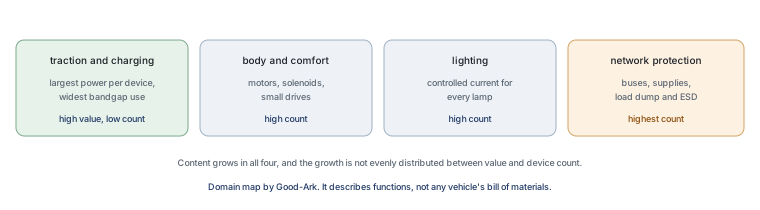
Discretes remain essential. Integrated circuits handle computation, but the functions around them — converting voltage, switching current, absorbing transients — are performed by individual devices because they handle power rather than information, and power has to be managed with parts that can survive it. That is why the discrete category has grown with vehicle electronics rather than shrinking.
What is the difference between a tier-one and a tier-two supplier?
A tier-one supplier delivers a complete system or module to the vehicle manufacturer. Tier-two suppliers provide components or subassemblies to the tier-one. A component manufacturer may therefore be several steps away from the vehicle brand, which is why the same part can appear inside modules from several different suppliers.
Does Good-Ark supply parts directly to vehicle manufacturers?
The company publishes an automotive product line and states that its automotive-grade range dates from 2010, and its portfolio page groups the families by vehicle function. We do not list customer names or supply relationships here, because those are commercial details that belong to the companies involved, and this article avoids claims of that kind.
What to do next
If you are buying for a vehicle programme, the useful first step is to write down the environment and the test waveform your module has to survive, then check whether a candidate part’s qualification evidence covers it. If you are a car owner, the useful first step is simpler: treat electrical faults as a diagnosis problem rather than a parts problem. The functional view of the automotive families is in the automotive portfolio article.
Tell Good-Ark the rail voltage, the transient profile and the temperature range, and we can point to the automotive-qualified families that fit and the documentation that covers them.
Email sales@goodark.com, or start from the automotive portfolio page.
This article is published by Good-Ark, a manufacturer of automotive-qualified discrete devices. It does not name customers or claim supply relationships, and it does not provide instructions for vehicle electrical work, which belongs to trained technicians using the manufacturer’s procedures.
Recommended
 Why Do Diodes Get Hot? Conduction and Switching Losses ExplainedInfoStandard, Fast Recovery, and Schottky Diodes: What’s the Difference?Info
 What Is a Fast Recovery Diode? Understanding “Fast Recovery”Info
 What Is a Diode? A Beginner’s Guide to How It WorksInfo
 Automotive Semiconductor Report 2026: Chips Per Car Keep RisingKnowledge