N-Channel and P-Channel MOSFET Wiring: A Beginner Practice Circuit
For a beginner wiring exercise, identify the source reference and the load connection before choosing an N-channel or P-channel MOSFET. The gate must be.
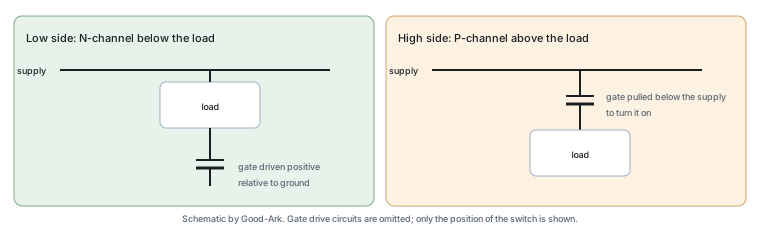
For a beginner wiring exercise, identify the source reference and the load connection before choosing an N-channel or P-channel MOSFET. The gate must be driven relative to its own source. Performance, voltage, loss, and driver requirements still matter when selecting the actual part.
Last updated:
Two polarities in one picture
An n-channel device conducts when its gate is driven above its source, so it is normally placed between the load and the negative supply — a low-side switch. A p-channel device conducts when its gate is pulled below its source, so it is normally placed between the positive supply and the load — a high-side switch.
The analogy worth holding is a valve in a water main. A low-side valve sits downstream of the load and lets water out; a high-side valve sits upstream and lets water in. Both stop the flow, both can be operated from the same hand, and the choice of which to install depends on where it is convenient to cut the pipe.
The wiring rule beginners can remember
One sentence covers the common cases: n-channel goes below the load, p-channel goes above it. If you find yourself trying to place an n-channel device between the positive supply and the load, you are working against the device’s natural behaviour, and you will need extra circuitry to drive the gate above the supply.
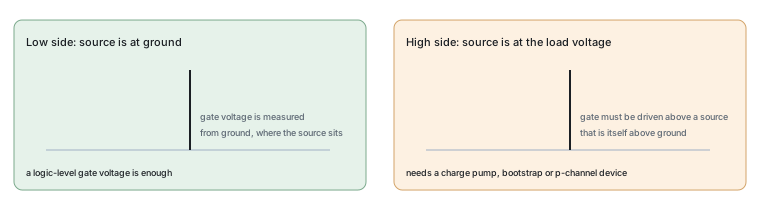
The reason is the gate voltage reference. A MOSFET’s gate voltage is measured relative to its source, not relative to ground. In a low-side n-channel arrangement the source sits at ground, so a gate voltage above ground turns the device on. In a high-side n-channel arrangement the source sits at the load voltage, so the gate has to be driven above that — which needs either a separate supply, a charge pump or a bootstrap circuit.
Symbols that confuse everyone at first
P-channel symbols usually have the arrow pointing in the opposite direction to n-channel ones, and the body diode inside the device also points the other way. That last detail is worth understanding rather than memorising, because it explains the behaviour when the device is off: the internal diode gives current an unintended path, and in a high-side p-channel arrangement that path can be exactly what you wanted, while in other circuits it is a fault.
The practical version of this is simple. Check the body diode direction in the datasheet before deciding that a switch is off when its gate says it should be. A device that is not conducting through its channel may still be conducting through its diode, and the circuit will behave accordingly.
Common wiring mistakes
Four mistakes account for most beginner failures with this choice. Placing an n-channel device high side and driving the gate from logic, which leaves it partially on and hot. Omitting the pull-up resistor on a p-channel gate, so the device turns on whenever the driving circuit is disconnected. Reversing the drain and source, which works for some devices in some circuits and destroys the switching behaviour in others. And forgetting that the body diode conducts, so a circuit that appears to switch off still has a path.
Each of those is visible in the schematic once you know the rule, and none of them is visible in a functional test, which is what makes them worth learning before rather than after building. Our article on gate drive design covers the drive side in more detail.
Practice circuit
The exercise worth doing is switching a small load two ways. Build a low-side circuit with an n-channel device driving an LED or a small motor, and note the gate voltage needed. Then build the same load as a high-side switch with a p-channel device, and note that the gate now has to be pulled to ground to turn it on and returned to the supply to turn it off.
Both circuits work, and the difference between them is the whole subject of this article. Use a low-voltage supply, disconnect before changing anything, and keep the load small enough that a mistake does not damage anything you care about. Our guide to choosing a MOSFET for a first project covers the part-selection side.
Check a low-voltage practice circuit one connection at a time
Before applying power, identify gate, drain, and source from the exact package drawing. Mark the load supply and return, then measure gate voltage relative to source. Use a suitable low-voltage, current-limited practice setup. The engineering polarity comparison handles driver headroom and losses; this page concentrates on tracing the wiring.
FAQ
When should I use n-channel or p-channel?
Use an n-channel device as a low-side switch, between the load and ground, whenever the load shares a ground with your control circuit. Use a p-channel device as a high-side switch, between the supply and the load, when the load must not have its ground interrupted or when its supply has to be switched. If you need high-side switching with an n-channel part, plan for the gate-drive circuitry as well.
How do I differentiate n-channel from p-channel?
Three ways. The part number usually indicates the family and polarity in its ordering table. The symbol has the arrow and body diode pointing in opposite directions for the two types. And a diode test between drain and source will show a conduction path in one direction through the body diode, whose polarity follows the device type. When the marking is unclear, the datasheet decides.
Which type is better, and why?
N-channel devices are better electrically for the same size, because their charge carriers move more readily, which gives a lower on-resistance. They are also cheaper and more widely available. P-channel devices are better only in terms of convenience for high-side switching, which is a real advantage but a narrow one.
What is an n-channel MOSFET used for?
Mainly low-side switching: turning a load’s return path on and off. That covers motor drives, LED drivers, battery management, heater control and the switching stages of most power converters, where n-channel devices are used in bridge configurations with gate drivers. It is the default choice unless the load’s position in the circuit requires otherwise.
Do I need a gate resistor?
Usually yes, for two reasons. It limits the peak current from the driving circuit when the gate capacitance charges, and it damps oscillation that fast edges can provoke. The value trades switching speed against those two benefits, so it is a design choice rather than a universal number. Our article on gate drive design explains the reasoning.
What to do next
Draw your circuit twice, once with the switch below the load and once above it, and work out what gate voltage each arrangement needs. That single exercise resolves most of the confusion around polarity, because it makes the source reference obvious. If you want the part-selection side next, our beginner checklist covers the four questions that decide which device to buy.
Tell Good-Ark where the switch sits in your circuit, the supply voltage and the load current, and we can point to the family and package that fit without extra drive circuitry.
Email sales@goodark.com, or start from the product family learning centre.
This article is published by Good-Ark, a manufacturer of MOSFETs and other discrete devices. It describes wiring conventions rather than specific parts; gate requirements and ratings belong to the current official datasheet.
Recommended
 Why Does Your Phone Charger Get Warm?Knowledge
 Energy Efficiency Rules Worldwide: How Regulations Shape Component ChoicesKnowledge
 Wide-Bandgap Semiconductors: Adoption Report 2026Knowledge
 The GaN Charger Market: Why Your Next Adapter Is SmallerKnowledge
 Component Lead Times in 2026: What Is Actually Normal NowKnowledge
 China’s Power Semiconductor Industry: Where It Stands in 2026Knowledge