The Diode Part Numbers Everyone Eventually Meets: 1N4007, 1N4148, SS14 and Friends
Common diode part numbers: the handful of types that turn up in almost every project, what each is for, and what to check before substituting one.
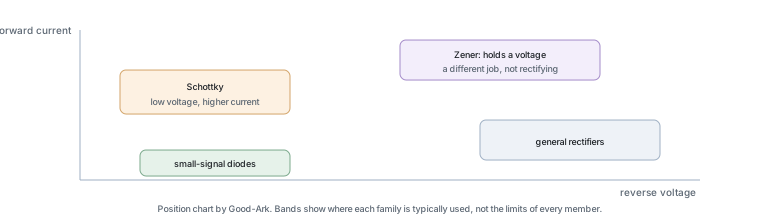
Four or five diode types turn up in almost every beginner project and in a large share of commercial ones, and knowing what each is for removes most of the guesswork from buying parts. This is a map of those types rather than a catalogue: what they are designed to do, where they stop being suitable, and what has to be checked before one replaces another.
Why the same part has several names
A registered part number describes a type, not a single product. Several manufacturers make parts against the same registration, each publishing its own guaranteed limits, its own marking and its own package options. That is why two datasheets for the same number can differ in detail and why a substitution is a specification decision rather than a naming decision.
There is also a naming layer on top. Manufacturers add suffixes for package, grade or packing, so the same electrical part can appear under several orderable numbers. When a project says “use a 1N4007”, what it usually means is “use something in that class”, and the class is defined by a handful of ratings rather than by the number itself.
The 1N400x family
This is the family most beginners meet first: general-purpose rectifier diodes in an axial package, with the members differing principally in reverse voltage rating while sharing a similar current class. They are used for mains-frequency rectification, for reverse-polarity protection and for blocking current in circuits where speed does not matter.
Two limitations are worth knowing. They are slow, so they are a poor choice in a high-frequency switching circuit where recovery losses matter. And they are ordinary silicon diodes with around a 0.7 volt forward drop, so they are a poor choice in a low-voltage output stage where that drop is a large fraction of the supply. Both limitations are about the job rather than the quality of the part.
| Family | What it is for | Usable voltage class | Where it stops being suitable |
|---|---|---|---|
| 1N400x general rectifier | Mains-frequency rectification and simple protection | Wide, with family members differing by voltage | High-frequency switching, and low-voltage outputs where the drop matters |
| 1N4148 small-signal switching | Fast signal switching and clamping | Low | Any power-carrying role; it is a signal device |
| SS-series Schottky rectifiers | Low-voltage rectification and freewheeling | Low to moderate | High blocking voltages, and hot environments where leakage matters |
| 1N58xx Schottky rectifiers | The axial equivalent, for low-voltage work | Low | The same limits as the SS series |
| Zener families | Holding a voltage steady or clamping it | Low to moderate, by part | Any role needing high accuracy, and high-power continuous use |
The 1N4148 signal diode
The other type everyone meets is a small signal diode designed for speed rather than power. It is used to steer signals, clamp small voltages, protect logic inputs and shape waveforms, and it is fast enough for switching work where a general rectifier would be too slow. It is not a rectifier for any meaningful current, and using it as one is the classic beginner error with this part.
It is also frequently mistaken for a Zener, because it is a small glass part with markings and because it appears in circuits that also contain Zeners. It is not one: its reverse behaviour is ordinary blocking rather than controlled breakdown at a specified voltage.
SS and SKY prefixes
Surface-mount Schottky rectifiers commonly appear under a short prefix with a number, and the same family appears in axial packages under a different series. Within such a family, the members usually differ in reverse voltage rating while sharing a current class and package, which is convenient but not a substitute for the datasheet.
Two cautions apply to this group. Because they are Schottky devices, their leakage rises sharply with temperature, so a part that looks comfortable in a bench test can behave differently inside a warm enclosure. And because the numbers vary between manufacturers’ families, two parts with similar-looking codes may not be interchangeable. Checking the reverse voltage and the package against the datasheet is what makes a substitution safe.
Zener families you will meet
Zener diodes appear under several numerical families, and the pattern within a family is usually that the digits encode the voltage in some way while a suffix or a series letter indicates the power class. That is convenient for reading a parts drawer and dangerous for substituting, because two parts that share a voltage but differ in power rating are not interchangeable in a circuit where the diode has to absorb current continuously.
The other trap is tolerance. A family member sold as a five per cent part and one sold as a one per cent part have the same nominal voltage and very different behaviour in a reference circuit. When a design depends on the Zener voltage, the tolerance is part of the specification rather than a quality detail.
Which ones to keep in a beginner kit
A small and deliberate set covers most experiments: a general rectifier family member for blocking and low-frequency rectification, a small-signal switching diode for signal work, a low-voltage Schottky for rectifying low voltages efficiently, and two or three Zener voltages around the levels you actually use. Add a bridge rectifier package if you are experimenting with supplies.
Keeping a small set is better than keeping a large one, because the useful skill is knowing which part is appropriate rather than having every option. A parts drawer with thirty unidentified types teaches less than one with five labelled ones.
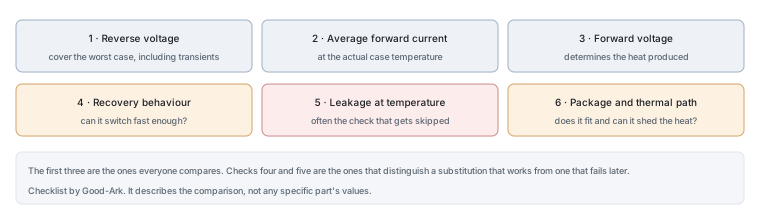
Two of those checks deserve a note about why they are skipped so often. Recovery behaviour is invisible in a static circuit: a slow diode substituted into a fast one works perfectly until current starts changing direction thousands of times a second, at which point it becomes a heat source and a noise generator. Leakage is invisible at room temperature for the same reason in reverse: the part behaves, and then behaves differently the first time it runs warm. Both checks cost a few minutes and address the two failure modes that are hardest to diagnose after the fact.
A third habit worth building is to write the substitution down. Recording which part replaced which, on what date, and what the two parts’ key ratings were turns a later investigation into a comparison rather than an archaeology exercise. In a repair context that record is often what distinguishes a genuine component failure from a design that was always marginal.
What to check before substituting
Six properties decide whether one diode can replace another. The reverse voltage rating, which must cover the worst-case voltage including transients. The average forward current at the relevant case temperature. The forward voltage, which determines the heat and, in low-voltage circuits, whether the circuit works at all. The recovery behaviour, which decides whether the part can switch fast enough. The leakage, particularly at high temperature. And the package, including its thermal path.
That list is longer than the three numbers most people compare, and the two extra items that matter most are recovery speed and leakage. A slow part substituted into a fast circuit produces heat and noise; a leaky part carried out of a cool environment into a warm one produces a slow, confusing failure.
Quick reference table
| If the job is… | Reach first for | Because |
|---|---|---|
| Mains-frequency rectification | A general rectifier | Voltage range and robustness, with speed irrelevant |
| Signal steering or clamping | A small-signal switching diode | Fast, small, and specified for low currents |
| Low-voltage output rectification | A Schottky rectifier | Lower forward drop and no recovery loss |
| Holding a voltage at a set level | A Zener of the right voltage and tolerance | It is specified for continuous conduction |
| Protecting a port from transients | A protection device, not a rectifier | Different specification: pulse energy rather than forward drop |
| Routing an alternating supply into direct current inside a product | A bridge rectifier package | Four diodes, one part, correct terminals marked |
Related reading on our own site covers diodes, Schottky diodes and Zener diodes. Component test methods come from JEDEC, assembly expectations from IPC, the documentation duties that make a revision traceable from ISO, and sector-level context from the Semiconductor Industry Association. Device and assembly background is published by NIST and IEC.
FAQ
What is the most common diode?
In terms of the types a beginner will meet, the general-purpose rectifier and the small-signal switching diode are the two that appear most often, because between them they cover blocking, rectification and signal steering. In terms of total manufactured volume, low-voltage rectifier diodes of the kind used in every mains-powered product are the largest category, simply because almost everything that plugs into a wall socket rectifies at some point.
What is a 1N4007 diode used for?
It is the highest-voltage member of a widely used general rectifier family, and it turns up in mains-frequency rectification, reverse-polarity protection, voltage blocking and simple clamp circuits. It is a slow, robust, general-purpose part rather than a precision one, which is exactly why it is a sensible default in circuits where the diodes are not the limiting factor.
Is a 1N4148 a Zener diode?
No. It is a small-signal switching diode, designed to conduct quickly at low currents and to block in reverse as an ordinary diode does. A Zener is designed to conduct in controlled reverse breakdown at a specified voltage, which is the opposite of what this part is for. The confusion arises because both appear in small glass packages and both are used near signal inputs.
How do I figure out what diode I have?
Read the marking and resolve it against the manufacturer’s own marking table; a full part number resolves quickly, and a two-letter code needs the maker before it means anything. If nothing is legible, measure the package, measure the forward voltage in both directions, and treat the part as characterised rather than identified. The workflow is set out in our article on decoding diode markings.
Can I always substitute a Schottky for a general rectifier?
Only within the Schottky’s voltage range and only where its leakage is acceptable at the operating temperature. In low-voltage circuits the substitution usually improves efficiency; at higher voltages the Schottky family may not have a part that blocks reliably, and in hot environments the leakage can make the replacement worse than the original. Check the reverse voltage and the leakage at temperature before committing.
What to do next
Sort the diodes you own into the five categories in the chart, and note which ones you are missing. That exercise takes twenty minutes and produces a parts drawer you can actually use, because the categories are what matter when a circuit needs a decision rather than a number. If you want the reading side of the same subject, our guide to reading a diode datasheet covers the five entries that decide a selection.
Describe the voltage, the current and the switching conditions, and Good-Ark can point to the family that fits and the datasheet that defines it.
Email sales@goodark.com, or start from the product family learning centre.
This article is published by Good-Ark, a manufacturer of diodes and other discrete devices. Ratings associated with registered part numbers are published independently by each manufacturer and differ between them and between revisions; confirm against the datasheet for the part you are buying or replacing.
Recommended
 Why Do Diodes Get Hot? Conduction and Switching Losses ExplainedInfoStandard, Fast Recovery, and Schottky Diodes: What’s the Difference?Info
 What Is a Fast Recovery Diode? Understanding “Fast Recovery”Info
 What Is a Diode? A Beginner’s Guide to How It WorksInfo
 Automotive Semiconductor Report 2026: Chips Per Car Keep RisingKnowledge