How to Read a Diode Datasheet When You Have Never Read One Before
How to read a diode datasheet: five lines do most of the work. What absolute maximum ratings mean, why typical values are not promises, and what a curve shows.
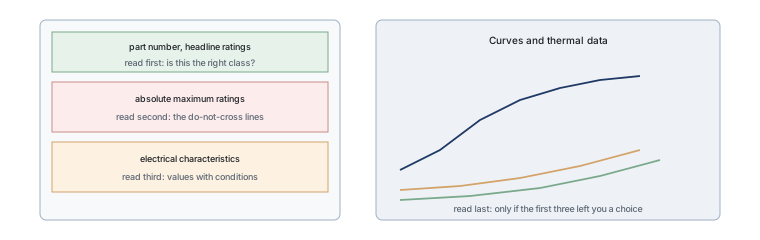
A diode datasheet runs to several pages of tables and curves, and most of it is not needed to make a first decision. Five entries settle whether a part is suitable, and the rest refine the answer. This article walks through those five in the order you should read them, then explains the two traps that catch beginners on the pages beyond.
The five lines beginners actually need
Read the reverse voltage rating first, because it is the number that disqualifies a part fastest. Then the average forward current, which tells you what it can carry continuously at a stated case temperature. Then the forward voltage at a defined current, which determines the heat. Then the reverse leakage at the rated voltage, which decides whether it will behave while blocking. And finally the package, because a part that does not fit cannot be used however good its numbers are.
Those five answers narrow any catalogue to a shortlist. Everything else on the datasheet — the surge rating, the recovery behaviour, the capacitance, the thermal curves — exists to distinguish between the survivors, and each of them matters only in circuits where that particular characteristic is stressed.
| Entry | What it decides | Condition you must not ignore |
|---|---|---|
| Reverse voltage rating | Whether the part can block your circuit’s worst voltage | The peak of the waveform, not the nominal value |
| Average forward current | What it can carry continuously | Quoted at a case temperature, which your enclosure may exceed |
| Forward voltage at a stated current | How much power becomes heat in your circuit | The current is specified; the number changes with it |
| Reverse leakage at rated voltage | Whether it behaves while blocking | Often quoted at an elevated temperature, which matters |
| Package and outline | Whether it fits and how it sheds heat | Surface-mount parts need copper to reach their rating |
What the part number tells you
Registered part numbers identify a type rather than a specification, and several manufacturers may make the same registered type with their own suffix for grade, package or packing. That is why the number alone is not enough: it tells you which family of ratings to expect, and the datasheet for that specific device tells you what those ratings actually are for the part in your hand.
Prefixes are also worth recognising. A simple two-terminal diode usually carries a prefix that identifies the registration scheme, and the digits are a sequence number from that scheme rather than a code for voltage. Series with a letter or digit pattern — such as a family where members differ only in reverse voltage — use the number to signal the class, which is convenient but still not a substitute for the datasheet.
Absolute maximum: the “do not cross” line
Absolute maximum ratings are limits, not operating points. They describe the conditions the device can survive without being damaged, and a design that runs at one of those values is not a good design even if it works on the bench. The usual rule is to keep normal operation well inside them, leaving room for tolerance, transients and temperature.
The most misread entry in this table is the reverse voltage. It is often stated at a specified leakage current and temperature, which means the part may begin to leak noticeably before it reaches the number. The second most misread is the surge current, which is quoted for a specific waveform and a specific number of events, not as a continuous capability. Reading the conditions attached to a limit is the difference between using the datasheet and being defeated by it.
Typical values are not promises
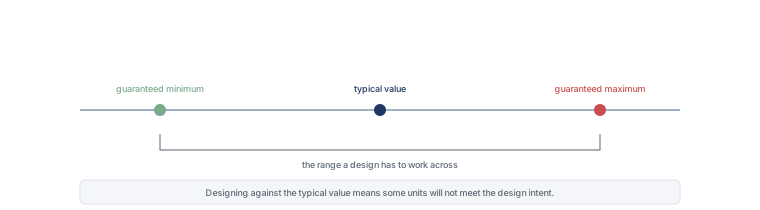
Datasheet tables often show two columns for the same parameter: a typical value and a maximum or minimum. The typical value describes what a sample of parts usually measured. The maximum or minimum is what the manufacturer guarantees across the specified conditions, and it is the number a design should be checked against.
This distinction explains a great deal of confusion in repair and prototyping. A circuit designed around typical values may work with most parts and fail with the occasional one, and the failure looks like a bad component when it is actually a design that never accounted for the guaranteed range. If a parameter has a guaranteed limit, design to that limit.
Reading a graph without panic
Every diode datasheet includes curves, and they reward three habits. Read the axes first, including the units and whether either is logarithmic. Find the operating point you actually care about rather than looking at the whole curve. And look for how many curves are drawn on the same axes, because the multiple lines usually represent different temperatures, and the one you need is the one matching your worst case rather than the room-temperature line.
The three curves worth checking for a first design are forward voltage against current at your temperature, leakage against temperature at your voltage, and the thermal derating curve that reduces the current rating as the case gets hotter. Those three are where a part that looked comfortable on the headline table turns out to be marginal in a real enclosure.
One more habit is worth adopting on the first pass through a datasheet, and it costs nothing. Highlight every number that has a condition attached and leave the bare numbers alone until later. After a couple of pages the pattern becomes obvious: the numbers with conditions are the ones a designer can rely on, and the ones without are either summary figures or marketing. Reading the datasheet that way turns an intimidating document into a short list of usable facts.
Where suppliers hide key information
Two details are frequently buried. The first is the test condition attached to a headline rating — a current quoted at a case temperature of twenty-five degrees is not the same device as one quoted at a hundred, and comparing them directly is a common error. The second is the thermal resistance, which is buried in the thermal characteristics section and is what actually decides whether a part survives in a sealed box.
If you can find those two and read them, the datasheet has done its job. If a supplier’s page shows ratings without conditions at all, that is itself information about the supplier, and our guide to finding and verifying datasheets covers how to check a document’s origin and revision.
There is one further distinction that pays off immediately, and it concerns the difference between a rating and a characteristic. A rating is a limit the device must not exceed; a characteristic is how the device behaves within those limits. Absolute maximum tables list ratings, and electrical characteristic tables list behaviour with test conditions attached. Beginners often treat the two tables as the same kind of information, which is why a part can appear to meet a specification while being outside its limits in practice.
The practical rule that follows is to write the design intent before reading the datasheet. If you have already decided the worst-case voltage, current and temperature your circuit will impose, every datasheet entry becomes a comparison against a known number. If you read the datasheet first, you tend to design around whatever values the page happens to make memorable.
A one-page worksheet
The routine that works, in order, for any diode in any circuit.
- Write down the circuit’s worst-case reverse voltage, including transients, and its worst-case current.
- Find the reverse voltage rating and the average current rating, and check both with margin.
- Find the forward voltage at your current and estimate the heat it will produce.
- Find the thermal resistance and estimate the junction temperature in your enclosure, not on a bench.
- Find the leakage at your expected junction temperature and check it is acceptable in the blocked state.
- Check the package against your footprint and your board’s copper area.
- Only then compare candidates on the details that separate them.
Background written for beginners covers datasheets and diodes. The test methods that make two manufacturers’ numbers comparable come from JEDEC, thermal and assembly expectations from IPC, the documentation duties that keep a revision traceable from ISO, and sector-level context from the Semiconductor Industry Association. Device and assembly background is published by NIST and IEC.
FAQ
How do I read a diode datasheet?
Read the reverse voltage rating, the average forward current, the forward voltage at your operating current, the reverse leakage at your expected temperature, and the package — in that order. Everything else refines the decision between survivors. The most important habit is to read the conditions attached to each number, because a rating without its test condition is not usable information.
What do the numbers on a diode mean?
Numbers on the package are usually a part number plus a date or lot code; numbers in the datasheet are ratings with conditions attached. A package code identifies a type, and a registered type has published ratings that several manufacturers may make. A date or lot code tells you when and in which batch the part was made. Our article on reading the markings on a component covers the package side.
How does a diode work, for the purposes of reading a datasheet?
It conducts in one direction and blocks in the other, which is why the datasheet splits its parameters into forward characteristics and reverse characteristics. If the mechanism itself is what you want, our article on how a diode works explains it in plain language.
What kills diodes?
Excessive forward current, reverse voltage beyond the rating, a surge beyond the non-repetitive capability, and thermal fatigue. In datasheet terms, those correspond to the average current rating, the reverse voltage rating, the surge rating and the thermal cycling data, which is why those four entries are the ones worth reading most carefully. The manufacturing side of the question is covered in how diodes are manufactured.
Why do two datasheets for the same part number disagree?
Because the part number is a registered type rather than a single specification, and manufacturers publish their own guaranteed limits for it. Different revisions of the same manufacturer’s datasheet can also differ, since limits are sometimes tightened or conditions clarified over time. Compare the revision dates, and compare guaranteed limits rather than typical values, or the comparison is not meaningful.
What to do next
Find a diode you already own, look up its datasheet, and answer the seven questions in the worksheet for it. Nothing about that exercise requires building a circuit, and it will teach you more about how these documents work than reading several datasheets end to end. The next step in this cluster is our guide to the part numbers everyone eventually meets.
Send Good-Ark the operating voltage, current and ambient temperature, and we can confirm the datasheet revision that applies and where the margin is thinnest.
Email sales@goodark.com, or start from the datasheet verification guide.
This article is published by Good-Ark, a manufacturer of diodes and other discrete devices. It describes how to read documentation rather than what any specific part’s values are; those belong to the current official datasheet for the part you are considering.
Recommended
 Why Do Diodes Get Hot? Conduction and Switching Losses ExplainedInfoStandard, Fast Recovery, and Schottky Diodes: What’s the Difference?Info
 What Is a Fast Recovery Diode? Understanding “Fast Recovery”Info
 What Is a Diode? A Beginner’s Guide to How It WorksInfo
 Automotive Semiconductor Report 2026: Chips Per Car Keep RisingKnowledge