Rectifier Selection and Ratings
Use the Rectifier Selection and Ratings to choose devices, check ratings, solve failures, verify alternatives, and reach the right Good-Ark technical support path.
39 guides
Choose a rectifier by the job it must do: the input waveform, load current, switching conditions and available cooling. Start with the diode basics if the terminology is new, then use the ratings and application guides to compare candidates.
Understand the device
Build a useful picture of how a diode conducts before comparing part numbers.
Discrete Power Devices: Types, Examples and Why They Matter
Discrete power devices are semiconductor components used to switch, rectify or protect the flow of electrical power. Examples include power diodes, MOSFETs, IGBTs and thyristors. They work alongside controller…
How Does a Diode Work? The PN Junction in Plain Language
Everything a diode does comes from one thin boundary inside it. The package, the leads and the markings are just delivery; the behaviour lives in a zone a few micrometres wide where two differently treated…
Rectifier Voltage Ratings Explained: VRRM, VRMS, VDC, and the Margin Rule
Three voltage columns on a rectifier datasheet answer three different questions: VRRM is the repetitive peak reverse voltage the part blocks, VRMS is the RMS AC level it can handle, and VDC is its DC blocking…
Silicon PN Rectifier Diodes: Physics, Recovery Behavior and Technology Trade-Offs
A silicon PN rectifier trades stored charge for robust voltage blocking, mature manufacturing, and attractive cost. This page explains that trade at device-physics level: how the depletion region blocks…
What Is a Diode? The One-Way Valve of Electronics, Explained With Everyday Pictures
A diode is the simplest interesting component in electronics: it conducts in one direction and blocks in the other. What makes it worth learning first is that almost every power supply, every battery circuit…
Read the ratings
Read voltage, current, losses and recovery together. These guides explain what the ratings mean and which operating conditions to check.
1F4G Fast Recovery Rectifier: 400 V Ratings and Replacement Checks
The Good-Ark 1F4G fast recovery rectifier is a 1 A, 400 V silicon diode in an R-1 axial package. Its maximum reverse recovery time is 150 ns under the manufacturer’s specified test conditions. The 400 V…
1F5G Fast Recovery Rectifier: Specs, Polarity and Replacements
The Good-Ark 1F5G fast recovery rectifier is a single silicon diode rated at 1 A average forward current and 600 V repetitive peak reverse voltage, in an R-1 axial package. Its maximum reverse recovery time is…
1N4001G Rectifier Diode: Key Specs and Low-Voltage Circuit Checks
The Good-Ark 1N4001G diode is the 50 V reverse-voltage member of its standard 1 A rectifier family. It is commonly considered for suitable low-voltage rectification and blocking paths, but its 50 V limit must…
400 Hz Aircraft AC Rectification: Bridge Loss, Harmonics, and Validation
Aircraft AC distribution runs at 400 Hz, and the frequency changes the rectifier’s loss story: the recovery event repeats at every half-cycle, so the bridge choice is decided by the loss estimate, the…
Conduction, Switching, and Recovery: The Loss Equation Every Power Design Starts With
Every power design starts with a loss number, and most loss numbers are wrong in the same way: they count the obvious term and miss the one that grows with frequency. A diode in a power circuit loses power in…
Diode Forward Voltage Drop: Physics, Temperature, and Power Loss
Forward voltage (VF) is not a fixed datasheet number; it is a function of current, junction temperature, and device construction. Design with the maximum VF at the operating temperature, and the loss…
Diode Rectifier vs Synchronous Rectification: The Efficiency Break-Even
Synchronous rectification replaces the output diode with a driven MOSFET, cutting the drop to an RDS(on) product—and paying a control cost in the driver, the dead time, and the failure modes. This guide covers…
Fast Recovery Diode Guide: Reverse Recovery, Losses, and Selection
A fast recovery diode is selected by its reverse recovery time (trr), and that number only means something inside a switching context: at high frequency, the charge stored in a PN junction must be cleared at…
Fast Recovery Diodes: Reverse Recovery, Losses and Selection
A fast recovery diode is a rectifier designed to change from forward conduction to reverse blocking with shorter recovery than a standard-recovery device under comparable conditions. It can reduce…
How to Choose the Right Power Rectifier: Ratings and Losses
To choose the right power rectifier, first identify its circuit role, then check reverse voltage, the full current waveform, switching behavior and cooling. A diode that matches the load current can still be…
How to Choose the Right Ultra Fast Recovery Rectifier Diode?
An ultrafast rectifier is chosen by recovery charge at your switching conditions, not the headline trr. How voltage, heat and softness decide the part.
Inrush Current at Power-On: Diode IFSM Margins and the NTC Trade-Off
Switch on a capacitor-charging supply and the first few milliseconds carry a surge that dwarfs the steady-state current: a rectifier fed into a discharged capacitor can briefly push ten times its rated…
Rectifier Datasheet Tour: VRRM, I_avg, IFSM, VF, and IR in One Readable Order
A rectifier datasheet is a dense page of numbers, and most engineers read it in the wrong order — jumping to the current rating and ignoring everything else until a failure forces a return visit. The numbers…
Standard Rectifier vs Fast Recovery Diode: When Is Standard Recovery Enough?
The decisive question is not whether a standard rectifier can conduct the required current, but whether it can stop conducting before the next switching transition. Standard-recovery silicon diodes are…
The 0.7 V Isn’t Constant: How Current and Temperature Move a Diode’s Forward Voltage
Every electronics course teaches that “a silicon diode drops about 0.7 V.” Then the first real measurement produces 0.62 V at low current, the lab power supply shows 0.85 V at high current, and the number…
Choose for the application
Follow the guide for the circuit you are building, rather than borrowing a rating from a different power stage.
AC-DC Adapter Rectifier Design: The Low-Drop Race Under Efficiency Rules
In an AC-DC adapter, the output rectifier’s forward drop is the last big lever left for efficiency, and every 0.1 V at the output current is a watt of heat in a sealed case. This guide follows the loss through…
Consumer Appliance Power Design: Cost-Sensitive Rectifier Choices That Last
Appliances run for a decade on cost-sensitive power stages, and the rectifier choice is a balance: the general-purpose class wins where the voltage, frequency, and loss budget allow, and the upgrade families…
How to Select Rectifier Diodes for SMPS?
Select SMPS rectifier diodes by circuit role: Schottky, ultrafast and SiC compared, reverse-recovery loss worked out, and the datasheet checks that matter.
Industrial Motor Drive Rectifier Design: Three-Phase Inputs and the Harsh Grid
An industrial motor drive rectifies a three-phase grid that is not clean: voltage dips, surges, and harmonics are the norm, and the input bridge must survive them. This guide covers the harsh-grid reality, the…
LED Driver Rectifier Selection: Constant-Current Rails and Low-Drop Components
An LED driver regulates current, not voltage, and that changes the rectifier’s loss story: the current is fixed by the LED string, so the forward drop multiplies directly into watts. This guide covers the…
LED Driver Rectifiers: Constant-Current Rails, Low-Drop Choices, and Dimming Edges
An LED driver is not a voltage supply with LEDs attached; it is a constant-current system, and the rectifier sees that system’s unique stress. The rail holds a fixed current, the PWM dimming writes sharp edges…
On-Board Charger Rectifier Design: PFC and DC-DC, Two Different Mindsets
An on-board charger contains two rectifier problems with two different mindsets: the PFC stage blocks a high-voltage bus at high frequency, and the isolated DC-DC secondary carries high current at low voltage…
Rectifier Selection for SMPS: Three Roles, Three Different Enemies
Inside one switch-mode power supply, rectifiers do three different jobs with three different constraints: the input bridge survives surge and voltage, the PFC stage manages frequency and recovery, and the…
Server Power at 48 V: Rectification and the Efficiency-Margin Race in Data Centers
In a data center, a 1% efficiency gain on a 48 V server supply is not a rounding error; it is the difference between a profitable rack and a heat-bill loss. At 40 A and 48 V, each point of efficiency saves…
Server Power Supply Rectifier Design: Thermal-First Thinking at 40 A
Server power supplies run at high power density, and the output rectifier is where the thermal design is won: 40 A of load current turns every 0.1 V of forward drop into 4 W of heat inside a rack full of…
Check common part numbers
Use these references to confirm a familiar part number and the conditions that matter before considering a replacement.
1N4002G Rectifier Diode: Specs, Polarity, Uses and Replacements
The 1N4002G is a general-purpose silicon rectifier with a 1 A average-current rating and a 100 V repetitive reverse-voltage rating. Its axial leads suit through-hole circuits. It can rectify low-frequency AC,…
1N4004G Rectifier Diode: Specifications, Polarity and Applications
The 1N4004G is a 400 V, 1 A general-purpose rectifier diode. Learn its ratings, derating and when a fast-recovery or Schottky part is the better choice.
Flyback Diodes on Relays: Placement, Orientation, and the Release-Time Trade-Off
Relay circuits fail in the same surprising way over and over: the coil is fine, the switch is fine, everything reads correct on the bench — and the relay or the things around it keep dying. The usual culprit…
General Purpose Rectifier Diodes for 50/60 Hz Power Supplies: Selection and Applications
General purpose rectifier diodes are the practical choice for 50/60 Hz transformer secondaries, low-frequency bridge rectifiers, relay flyback paths, and simple reverse-polarity protection. This guide answers…
Good-Ark 10A05 Rectifier: Specifications, Polarity and Applications
The Good-Ark 10A05 rectifier is a standard silicon rectifier with a listed 10 A average-current rating and a 50 V repetitive peak reverse-voltage rating, in an R-6/P600 axial package. It passes useful forward…
Power Rectifier Diodes in High-Current Systems: Thermal, Surge and Switching Design
In high-current rectification, RMS heating, surge energy, and the thermal interface often matter more than the headline current rating. This guide treats the diode as part of a power assembly: semiconductor,…
Power Rectifiers: How AC-to-DC Conversion Works and How to Choose
A power rectifier converts alternating current into current that flows in one direction, using diodes or controlled semiconductor switches. Its basic output is pulsating DC. Filtering reduces the ripple, while…
Silicon Rectifier Diode Guide: Roles, Ratings, and When General-Purpose Parts Are Enough
A general-purpose silicon rectifier diode does four jobs in a circuit—rectify, freewheel, clamp, and block reverse current—and it is the right part whenever the voltage fits, the frequency is low, and the loss…
Smoothing Capacitor Sizing: A Paper-and-Pencil Calculation for 50 and 60 Hz Rails
Ask three people how to size the capacitor after a bridge rectifier and you will hear “1000 µF per amp” from two of them. That rule works well enough in a surprising number of low-power circuits, which is…
Need help with a particular circuit?
Include the circuit position, operating conditions and the part number or marking when you contact Good-Ark technical support.
Recommended
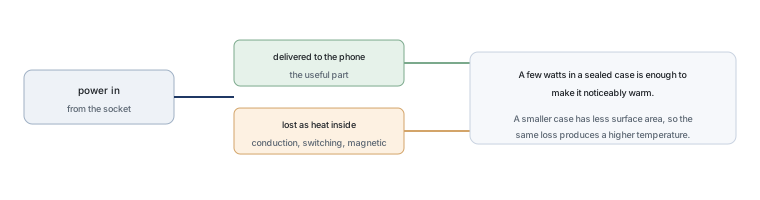 Why Does Your Phone Charger Get Warm?Knowledge
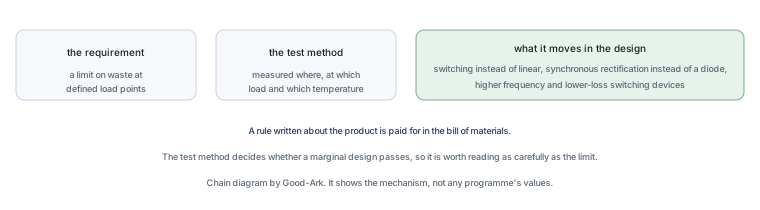 Energy Efficiency Rules Worldwide: How Regulations Shape Component ChoicesKnowledge
 Wide-Bandgap Semiconductors: Adoption Report 2026Knowledge
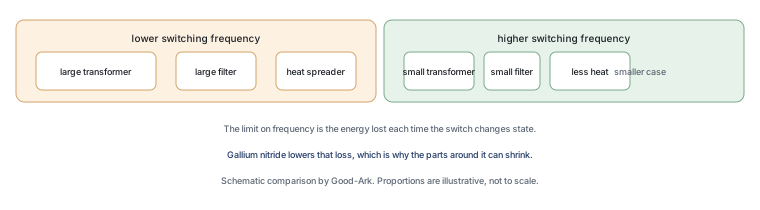 The GaN Charger Market: Why Your Next Adapter Is SmallerKnowledge
 Component Lead Times in 2026: What Is Actually Normal NowKnowledge
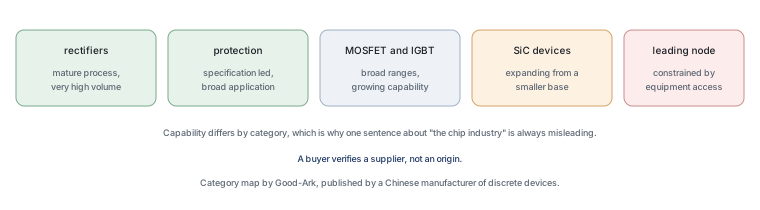 China’s Power Semiconductor Industry: Where It Stands in 2026Knowledge