1N4002G Rectifier Diode: Specs, Polarity, Uses and Replacements
The 1N4002G is a 1 A, 100 V glass-passivated rectifier diode in a DO-41 package. See its specs, applications, and how it compares to the 1N400xG series.

The 1N4002G is a general-purpose silicon rectifier with a 1 A average-current rating and a 100 V repetitive reverse-voltage rating. Its axial leads suit through-hole circuits. It can rectify low-frequency AC, but the manufacturer matters: the suffix, forward drop and other specifications must come from the data sheet for the actual part.
If you are identifying a diode on a board or choosing a replacement, start with its maker and cathode band. Then check voltage stress, current waveform and switching speed. A matching number alone does not settle those questions.
Last updated:
What does the G in 1N4002G mean?
The G suffix depends on the manufacturer.
Do not interpret it as a universal performance grade. For example, onsemi lists G ordering variants as Pb-free, while Diodes describes its 1N400xG family as glass-passivated.
Use the onsemi 1N4001 series data sheet or the Diodes 1N4001G–1N4007G data sheet, depending on the manufacturer. Both cover several voltage grades; find the 1N4002 column rather than copying the first column.
Glass passivation refers to protection of the semiconductor die. It does not mean the component has a glass outer body: these documents describe molded epoxy or plastic packages. Treat body markings, packaging labels and the full order code as identification evidence. For a loose component with an unknown origin, an electrical test can show basic diode behavior, but it cannot establish the manufacturer or rated voltage.
Which 1N4002G specifications should you check?
Check the ratings and their stated test conditions.
The 100 V and 1 A labels describe different limits. The remaining numbers below illustrate why specifications from different manufacturers should not be combined into one generic table.
| Parameter | onsemi 1N4002G | Diodes 1N4002G |
|---|---|---|
| Repetitive reverse voltage | 100 V | 100 V |
| Average rectified current | 1 A; specified 60 Hz load conditions | 1 A; specified lead/ambient conditions |
| Forward voltage at 1 A | 1.1 V maximum at 25°C junction | 1.0 V maximum |
| Reverse leakage at rated voltage | 10 µA maximum at 25°C junction | 5 µA maximum at 25°C ambient |
| Reverse recovery | No numerical value in the cited electrical table | 2 µs typical under specified test conditions |
These are readings from the linked documents, not a specification for every product sold under this name. Diodes also gives the part’s parameters on its 1N4002G product page. Use the document revision associated with your purchased component.
Distinguish a typical value from a guaranteed maximum. Also check the current derating curve and surge waveform before treating a short pulse as permissible repeated operation. A warm enclosure, short leads or a capacitor charging load can change the practical current limit.
How do you identify the anode and cathode?
The band marks the cathode.
The opposite lead is the anode. In normal forward conduction, conventional current flows from anode to cathode when sufficient forward voltage is applied.
For rectification, orientation decides which AC half-cycle reaches the load. For a diode placed in series with a positive DC supply, the cathode normally faces the load. For a flyback diode across a DC coil, the cathode faces the coil’s positive supply terminal so the diode stays reverse-biased while the coil is energized.
Copying orientation from a photograph is unreliable when the board layout differs. Trace the circuit connections and compare them with its schematic before fitting a replacement.
Where can you use a 1N4002G?
It suits low-frequency rectification and selected protection tasks.
Common roles include a low-voltage transformer rectifier, series reverse-polarity protection and a discharge path across a slowly switched DC relay coil.
In a rectifier, the diode passes current toward the load during the appropriate part of the AC cycle. A capacitor can smooth the output, but also concentrates charging into pulses. For the waveform basics, see our related 1N4001G guide; its lower voltage grade must not be confused with this part.
Series protection has a forward-voltage loss and dissipates heat. A coil clamp requires both the correct connection and a check of the turn-off current. It can also lengthen relay release time. These are circuit design decisions, rather than benefits automatically conferred by the diode’s current rating.
Do not infer automotive qualification, immunity to supply transients or suitability for every power supply from a list of applications. Those claims require the exact component specification and system conditions.
How much AC voltage can it rectify?
The allowable AC input depends on the rectifier topology.
A 100 V reverse rating is not a 100 V AC-input rating. Calculate the largest reverse voltage across each diode, including stored capacitor voltage and transients.
For a sinusoid, peak voltage is RMS voltage multiplied by the square root of two. Consider an ideal 24 V RMS source: its peak is about 33.9 V. In a half-wave rectifier with a reservoir capacitor, the capacitor can remain near the positive peak while the source approaches the negative peak. The blocked diode then sees about 67.9 V.

Apply the same model to 48 V RMS and the reverse stress approaches 135.8 V, exceeding the rating. A bridge or center-tapped rectifier requires its own analysis. Transformer regulation, supply tolerance and spikes also consume margin; do not operate at the calculated limit.
Direct 120 V or 230 V mains rectification exceeds this part’s voltage class. Choosing a higher-voltage diode still requires an appropriate circuit design.
Is it suitable for a switching power supply?
It is not a default choice for switching rectification.
Standard-recovery behavior can cause additional losses when current reverses rapidly. An application in a switching supply needs analysis of the actual diode waveform.
Being located in a low-voltage auxiliary circuit does not make the switching frequency low. See how an SMPS works for the distinction between input rectification and switched energy conversion.
Where rapid commutation is required, evaluate a fast-recovery or Schottky rectifier with sufficient reverse-voltage and current ratings. The alternative also needs an acceptable leakage level, package and thermal design. There is no universal frequency cutoff that makes every 1N4002G suitable below it.
How do you test it with a multimeter?
Compare its forward and reverse diode-mode readings.
Disconnect power and discharge capacitors first. Follow the meter’s manual; isolate a diode lead if other components provide parallel current paths.
- Select diode mode.
- Place the red probe on the anode and black probe on the banded cathode.
- Record the forward-voltage reading, then reverse the probes.
- Look for conduction in one direction and an open indication in the other.
Fluke’s diode-testing guidance explains that probe orientation and forward versus reverse readings matter. A low reading in both directions suggests a short; an open reading in both may indicate an open diode or a measurement problem.
The meter uses a small test current. Its reading is not the data-sheet forward voltage at 1 A, and the test cannot confirm 100 V blocking ability, recovery speed or performance when hot.
Can you replace it with a 1N4007 or another diode?
A replacement must match the circuit’s requirements.
A higher reverse-voltage grade may be a candidate for low-frequency rectification, but compare the exact manufacturer’s electrical and mechanical data before substitution.
| Candidate | First check | Remaining checks |
|---|---|---|
| 1N4002 from another maker | Suffix and full specification | Package, temperature, surge and recovery |
| 1N4007-family part | Higher blocking rating | Forward loss, speed, footprint and qualification |
| 1N4001-family part | Lower blocking rating | Accept only after verifying reverse stress |
| Fast or Schottky diode | Required dynamic behavior | Leakage, voltage margin and heating |
Record why the original failed before installing a substitute. A shorted load, damaged capacitor or excessive reverse stress may destroy the new component too. Our 1N4004G guide provides related family context; the chosen manufacturer’s data sheet remains the specification.
Use the exact 1N4002G document for a substitution
Retain the manufacturer, voltage grade, package drawing, and test conditions when comparing another 1N400x device. Similar names do not establish interchangeable surge or thermal behavior. For the family’s circuit role, see the AC-to-DC rectifier guide; this page keeps the 1N4002G specifications and replacement boundary.
FAQ
Does a diode-mode reading prove the diode is working?
It confirms basic conduction behavior at the meter’s test current. It does not verify rated reverse-voltage blocking, operation at load current or temperature, or switching performance. A part can pass this check and still fail in the circuit.
Is a loose 1N4002G enough to identify its manufacturer?
The model text alone may not identify the maker. Check the logo, packaging label and purchase records. Use the corresponding manufacturer data sheet once identified; do not combine specifications from different suppliers.
Can a larger smoothing capacitor overload the diode?
It can increase startup charging demand and change the charging-current waveform. Check source impedance, repetitive current, non-repetitive surge conditions and thermal limits. A surge rating is not permission to repeat that surge every cycle.
What should you check before installing it?
Confirm the manufacturer and order code, locate the cathode band, and calculate reverse stress for the actual topology. Then check the current waveform, temperature and switching requirements. Those checks turn a model-number match into a defensible component choice.
Keep the relevant data sheet with the circuit notes so a future repair uses the same assumptions.
Continue through this engineering topic
For the complete selection, design, verification, and troubleshooting path, explore the Rectifier Selection and Ratings.
- Practical guide: 1F5G Fast Recovery Rectifier: Specs, Polarity and Replacements
- Practical guide: 1F4G Fast Recovery Rectifier: 400 V Ratings and Replacement Checks
- Practical guide: Good-Ark 10A05 Rectifier: Specifications, Polarity and Applications
- Ask Good-Ark technical support about this application
Recommended
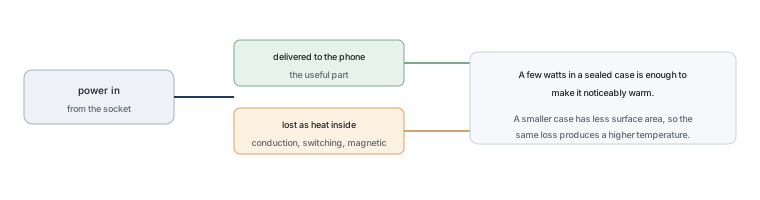 Why Does Your Phone Charger Get Warm?Knowledge
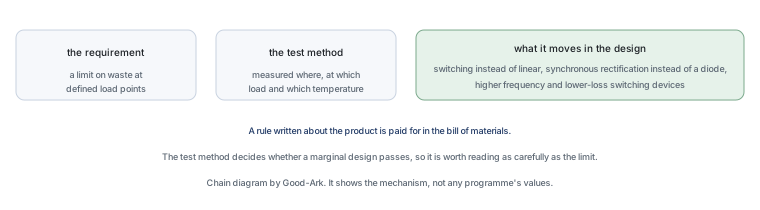 Energy Efficiency Rules Worldwide: How Regulations Shape Component ChoicesKnowledge
 Wide-Bandgap Semiconductors: Adoption Report 2026Knowledge
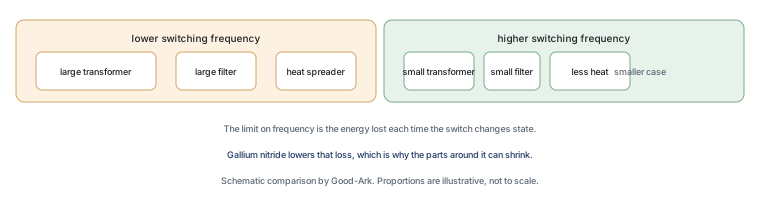 The GaN Charger Market: Why Your Next Adapter Is SmallerKnowledge
 Component Lead Times in 2026: What Is Actually Normal NowKnowledge
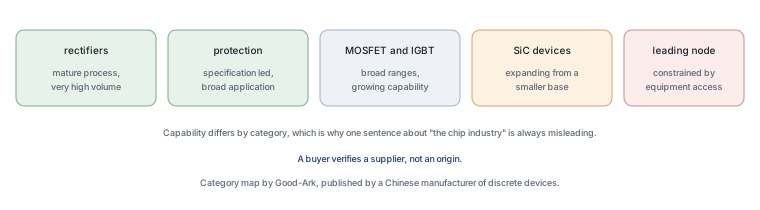 China’s Power Semiconductor Industry: Where It Stands in 2026Knowledge