Automotive Semiconductor Report 2026: Chips Per Car Keep Rising
Automotive semiconductor market 2026: which parts of a car keep gaining electronics, and why qualification rather than fabrication is the bottleneck.
Updated: October 27, 2026
Read automotive semiconductor demand as a planning input for topology and capacity—not as a precise forecast you can enter into an MRP system. Third-party market figures vary by scope; translate them into engineering actions: voltage class mix, package capacity, and lead-time risk.
For device-level follow-ups see power semiconductor market outlook 2026–2030 and silicon carbide market 2026.
| Market signal | Engineering response | Do not |
|---|---|---|
| Demand growth in a segment | Stress-test second sources and MoQ | Scale unique MPNs prematurely |
| Shift to higher V / WBG | Revisit derating and gate-drive | Copy Si designs unchanged |
| Regional capacity headlines | Map real lead times by package | Treat press CAGR as bookings |
| Efficiency regulation pressure | Budget conduction + switching loss | Optimize only sticker VF |
How to size this market
Any figure for this market has to state three things before it means anything. Which vehicle types are included, because a battery-electric car, a plug-in hybrid and a mild hybrid have different electronics. Whether the count is devices, revenue or silicon area, because those three do not move together. And whether the scope includes sensors and processors or only the power devices, because the two have very different cost profiles.
A second complication is that the same number appears at different points in the chain. A device sold to a tier-one supplier, the module built around it and the vehicle that finally contains it are three different measurements of one demand. When two reports disagree about the size of the automotive semiconductor market, the first thing to check is whether they are measuring the same point. For the engineering side of these vehicle numbers, the automotive power electronics hub links to related guides.
Where the content grows fastest
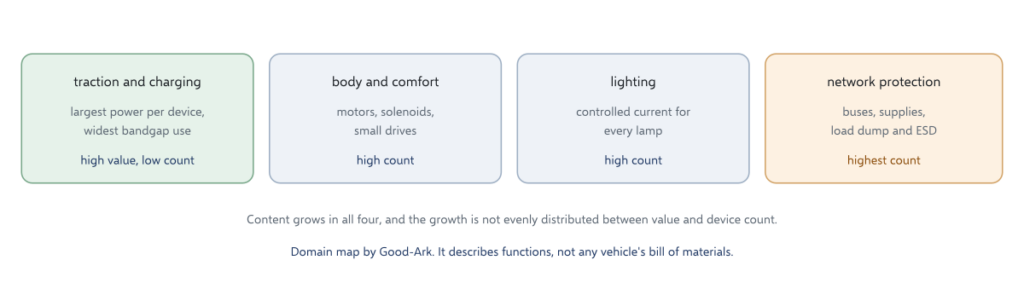
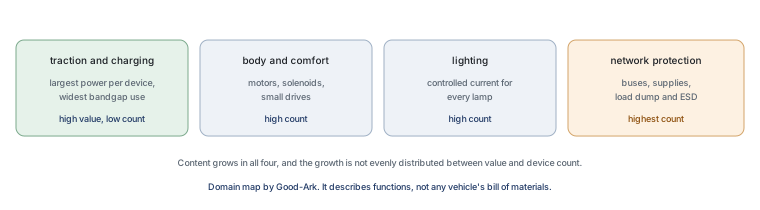
Four areas account for most of the growth. Traction and charging electronics exist only in electrified vehicles and represent the largest single addition of power devices. Advanced driver assistance adds sensing, processing and the power supplies that feed them, which is where the increase in low-voltage content comes from. Comfort and body electronics replace mechanical linkages with motors and switches, each of which needs a driver and often protection. And the lighting system has moved from switched bulbs to controlled current sources, which puts a power conversion stage behind every lamp.
The comparison that explains the pattern is a house that has been rewired. The rooms are the same size and the occupants are the same number, but the number of circuits, switches and protective devices has grown because more of what the house does is electrical. A car has gone through the same change, and the electrical architecture has had to be reorganised to carry it.
Discrete power devices in vehicles
The devices that appear most often in a vehicle are not the headline components. Rectifiers appear wherever alternating current is produced or consumed, including in the alternator of a conventional car and in the auxiliary circuits of an electrified one. Power MOSFETs switch loads, drive small motors and operate in every power supply on the vehicle. Transient suppressors and Zener diodes protect the networks that connect the modules, which is where the largest share of failures would otherwise occur.
The conditions these parts see are harsher than in consumer equipment, and that is the reason the automotive grade exists. Ambient temperatures under the bonnet can be far above a room, load dumps can push a supply rail to a multiple of its normal voltage for a fraction of a second, and the part has to survive those events for the life of the vehicle rather than for a warranty of two years.
| Domain | Function | Typical discrete devices |
|---|---|---|
| Traction and charging | Battery to motor and grid to battery conversion | IGBTs or SiC MOSFETs, gate drivers, fast diodes |
| Body and comfort | Windows, seats, mirrors, pumps | Power MOSFETs, small motor drivers, freewheeling diodes |
| Lighting | Controlled-current drive for LEDs | Rectifiers, MOSFETs, Schottky diodes |
| Network and modules | Protecting communication buses and supplies | Transient suppressors, ESD diodes, Zener diodes |
| Power distribution | Switching and protecting each circuit | Load-switch MOSFETs, reverse-protection devices |
What the shortage years taught buyers
The supply disruption that affected vehicle production in the early 2020s taught three lessons that have outlasted the event. The first is that a small, inexpensive device can stop a production line as completely as an expensive one, because a vehicle cannot be built without every part. The second is that visibility into sub-tier suppliers is scarce: buyers knew their direct supplier and often did not know who made the part inside the module.
The third lesson is more subtle and more useful. Design decisions made years earlier determined who could respond. A part designed into a system is not interchangeable without re-qualification, so the ability to switch to a second source depends on whether a second source was qualified at design time. Companies that had done that work found the disruption survivable; those that had not found that the schedule, not the price, was the binding constraint.
Regional capacity responses
Governments and companies have responded by adding capacity and by diversifying where it sits, and the automotive sector is prominent among the reasons. Two patterns are visible without needing a ranking. First, automotive-qualified capacity is being added close to the vehicle assembly regions, because a long supply line amplifies every disruption. Second, the back end of the chain — assembly and test — is more widely distributed than the front end, because it requires different capital.
A buyer should read those announcements carefully. A new assembly and test line increases capacity for the final step and does not by itself increase the availability of wafers. A new fab increases capacity but takes years to reach volume. Knowing which step an announcement describes is the difference between a real improvement in availability and a press release.
Qualification as a bottleneck
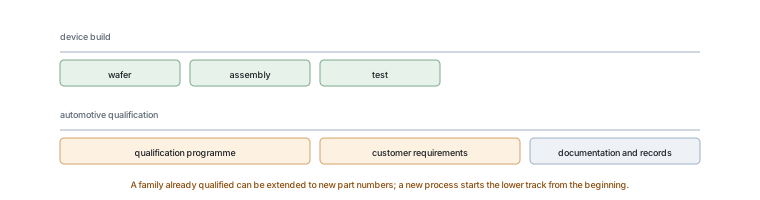
Qualification is the step that most often decides when a part can be used. An automotive component has to meet the relevant automotive standard for its device family, and then the customer’s own requirements, which usually include documented process control, change notification and traceability. Each of those takes time, and time is the one input that cannot be bought.
There is good news inside this constraint. A qualified family is usually qualified once and then extended, so a supplier that has already qualified a process can add a part number to it relatively quickly. That is why the useful question to a supplier is not whether it sells automotive parts but which qualifications it already holds for the package and process family you need. The details of what automotive qualification means for a buyer are in verifying an automotive part beyond the datasheet.
What could go wrong again
Four conditions could reproduce the disruption. A single-source device in a high-volume system, because there is no alternative when it slips. A demand surge concentrated in one package type, because capacity is added by package and process rather than generically. A qualification queue that is longer than the production queue, which happens when many customers qualify at the same time. And a logistics disruption that affects the back end rather than the front end, which moves the constraint rather than removing it.
None of those is a prediction. Each is a condition with a visible early signal: the second-source status of your own bill of materials, the lead time quoted for the specific package, the qualification lead time quoted by the supplier, and the shipping route the parts actually take.
Sources and limits
Figures for this market should be read with the definition, the vehicle scope, the period and the chain position attached. Statements about reliability, meantime between failures and field return rates belong to specific qualification programmes and specific suppliers, and generalising them across a vehicle is not supported by anything published here. Statements about device content per vehicle are estimates by nature, because nobody outside a manufacturer knows the complete bill of materials for a given model.
How to use this report without over-fitting
- Separate what is measured (shipments, ASP bands) from what is opinion (CAGR to 2030).
- Map claims to your BOM families: Si Schottky, FRD, MOSFET, IGBT, SiC.
- Prefer dual-source packages over single-source exotic outlines when volumes are uncertain.
FAQ
Are the market size numbers in articles exact?
Treat them as directional unless you have the primary analyst table and identical scope. Definitions of “power semiconductor” differ widely.
What should purchasing do with a bullish forecast?
Negotiate forecast flexibility, not only price. Ask for package-level lead times and PCN policy.
Does AI / EV demand change discrete diode selection?
It raises current density and thermal expectations in adjacent rails (48 V, AUX, sensors). The diode still needs a normal V/I/thermal worksheet.
Where should engineers go next?
Pair this overview with a concrete selection guide such as power MOSFET selection or power rectifier selection.
Continue through this engineering topic
- Power Semiconductor Market Outlook 2026 2030
- Silicon Carbide Market 2026
- Ai Data Centers Power Semiconductor Demand
- China Power Semiconductor Industry 2026
- Component Lead Times 2026
- Discrete Diode Market Explained
Topic hub: Power semiconductor market outlook 2026–2030 — related selection guides and application notes in this cluster.