Power Semiconductor Market Outlook 2026-2030: What Beginners Should Know
There is no single 2026 power semiconductor forecast. See the four verifiable drivers (demand, content, capacity, inventory) and why figures disagree.
Updated: October 27, 2026
Power semiconductor market outlooks for 2026–2030 should be read as scenario tools—demand drivers (EVs, renewables, industrial automation, AI power) plus technology mix (Si, SiC, GaN)—not as precise revenue guarantees.
Treat third-party market figures cautiously unless you can cite the source and scope. Related reading: silicon carbide market 2026, industrial applications, discrete power devices.
How to read this report
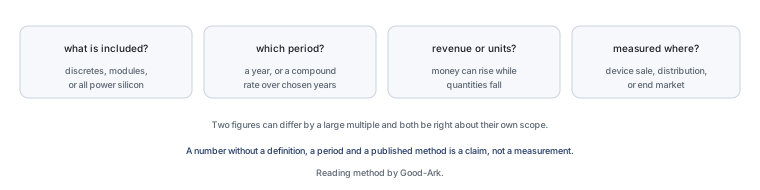
Start with the scope, because most confusion about market figures is a scope disagreement wearing a number. A power semiconductor market can mean discrete devices only, discrete devices plus modules, or everything that handles power including integrated power controllers. It can be measured in revenue or in units. It can cover one region or the world. It can be a historical estimate or a forecast, and a forecast can be stated in nominal or inflation-adjusted currency. Two figures that differ by a factor of two are often both correct about the thing they measure.
This report is a qualitative industry analysis rather than a purchased market study, and it deliberately publishes no market value of its own. Where a quantity appears below it is a technical constant — a bandgap, a voltage class, a temperature — that you can check in a textbook or a datasheet. Where a direction is described, it is described as a condition rather than a prediction, so that you can test it against the data you can see.
What counts as a power semiconductor
A power semiconductor is a device whose job is to control, convert or protect the flow of energy rather than to process information. The distinction is not about the material or the package; it is about the function. A small signal diode and a power rectifier can be the same kind of junction, and they belong to different businesses because one carries information and the other carries current.
The analogy that fits is a building with a computer room and a plant room. The processors, memory and interface chips are the computer room: they handle decisions and data. The rectifiers, MOSFETs, IGBTs, thyristors and protection devices are the plant room: they switch and steer power, and nothing works if they are undersized. Both are semiconductors, both are made in fabs, and they are sold into completely different conversations.
| Family | What it does | Where you meet it |
|---|---|---|
| Rectifier and Schottky diodes | Conducts one way, blocks the other | Every mains-powered product, charger and adapter |
| Zener and transient suppressors | Clamps or limits a voltage | Protection of rails, ports and automotive networks |
| Power MOSFETs | Switches current at high frequency | Switching supplies, motor drives, battery circuits |
| IGBTs | Switches high current at moderate frequency | Motor drives, induction heating, traction |
| Silicon carbide and gallium nitride devices | Switches at higher voltage or higher frequency | EV traction and charging, PV inverters, compact adapters |
| Modules and assemblies | Packages several devices with cooling and control | Traction inverters, utility-scale power conversion |
Demand drivers you can verify
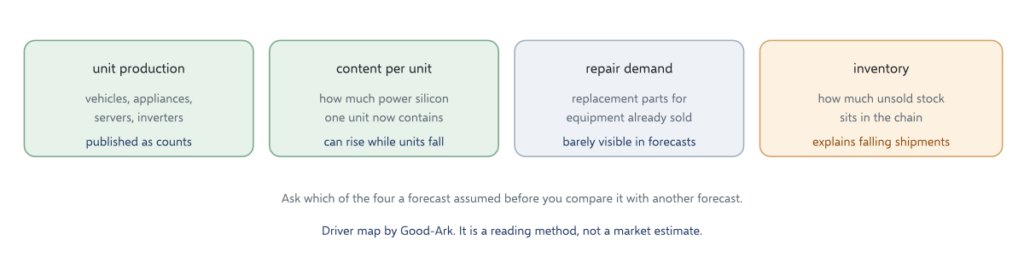
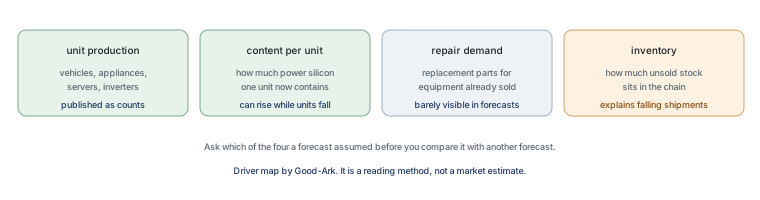
The first driver is the production volume of the equipment the parts go into. Vehicle output, appliance output, server shipments, inverter installations and industrial machinery output are all published as counts by industry bodies and statistical agencies. When someone predicts device demand, the first question to ask is which of those volumes they assumed. The solar side of this demand is examined in Solar Inverter Market 2026.
The second is content per unit, which is the number that makes power devices interesting. A car that was mechanically controlled contains a modest number of power devices; the same car with an electrified drivetrain, electric power steering and dozens of switching supplies contains many more. Content per unit can rise while unit volumes fall, which is why a demand forecast has to state both.
The third is replacement and repair demand, which behaves differently from new-production demand and is largely invisible in forecasts. The fourth is inventory, and it is the reason the same end-market data can produce opposite conclusions in two consecutive quarters: if distributors are holding three months of stock, shipment figures fall before consumption does.
Silicon versus wide bandgap split
Silicon remains the material of the overwhelming majority of power devices by volume, and it will stay that way for the parts where its properties are adequate. The technical reason wide bandgap materials matter is measurable: the bandgap of silicon is about 1.1 electronvolts, while that of silicon carbide is roughly three times larger, which allows a device of the same blocking voltage to be made in a much thinner and more lightly doped layer, and therefore with lower conduction loss.
Two consequences follow, and they are the reason the split follows applications rather than fashion. Silicon carbide devices are useful where the voltage is high and the current is large, such as traction inverters and solar conversion. Gallium nitride devices are useful where the frequency is high and the size matters, such as compact power adapters. Elsewhere — rectification at low voltage, protection, signal switching, most consumer supplies — silicon is neither displaced nor likely to be, because the gain from a more expensive material does not exist at those ratings.
Regional supply picture
The structure of the supply chain matters more than any single year’s ranking, and the structure is stable enough to describe. Wafer fabrication clusters where capital, process engineers and a supporting chemical and equipment industry already exist. Assembly and test, which is the back end where a die becomes a package, is more widely distributed and is concentrated in Asia. Substrates for silicon carbide add a third layer, because growing a crystal is a different process from fabricating a device on it.
The visible change over the past several years is the addition of mature-node and power-device capacity in more places, driven by policy support and by buyers who want a second source in a different country. That expansion changes the geography of supply without necessarily changing the technology. For a buyer the practical consequence is not a ranking but a question: how many independent sources exist for the part I need, and are they in more than one country?
Price and capacity cycles
Power semiconductor prices move in a cycle that has a simple cause. Capacity is added in large blocks and takes years to build, while demand can change in a quarter. When demand rises faster than capacity, lead times extend and prices firm. When the new capacity arrives into a softer market, the reverse happens and prices fall.
The comparison to a hotel is close enough to be useful. Rooms cannot be added overnight, so in a busy week prices rise and travellers change plans; two years later, when the new wing opens in a quiet season, rooms are discounted. Neither outcome says anything about whether travel is growing. In the same way, an extended lead time is evidence about capacity relative to demand, not a verdict on an industry’s future.
What the forecasts disagree about
Four disagreements account for most of the spread between published figures. The first is what the word power includes, which can change a market by a large multiple. The second is the period: a calendar-year estimate, a fiscal-year estimate and a five-year compound growth rate are three different statements, and a compound rate is extremely sensitive to which years are chosen as the ends of the range.
The third is currency and inflation, because a revenue figure can rise while the quantity shipped falls. The fourth is who is counting: a company that sells the device, a distributor that sells it again and a researcher who estimates the end market may be measuring the same demand at three different points in the chain.
There is also a practical warning about search results. For this topic the first page is dominated by forum threads, press-release aggregations and index pages rather than primary data, which means a search engine summary of “the market” may be summarising a summary. When a number appears without a definition, a period and a source that publishes its method, treat it as a signal about what people say rather than as evidence about what is happening.
What to watch next year
Watch your own lead times first, because they are the one indicator you can observe continuously and they respond before published statistics. Then watch capacity announcements for the packages you buy, because a new line takes years to matter. Watch distributor inventory for the same family, because it explains shipment figures that seem disconnected from demand. And watch regulation that changes what equipment is allowed to consume, because an efficiency rule can change a bill of materials faster than any demand forecast.
How engineers should use a market outlook
| Use | Do | Don’t |
|---|---|---|
| Technology bets | Track SiC/GaN adoption in your voltage class | Assume every design must jump to WBG |
| Sourcing | Watch lead times and second sources | Freeze a single-source SiC MPN early |
| Roadmaps | Align packages and voltages with platform reuse | Chase headline CAGR numbers into the BOM |
For device-level SiC decisions, prefer engineering guides such as what is silicon carbide over market slides alone. Figures mentioned in industry reports vary by scope (discrete vs module, region, captive vs merchant)—verify before citing externally.
FAQ
Will SiC replace silicon everywhere by 2030?
Unlikely. SiC grows where high voltage and efficiency pay back cost and drive complexity. Many cost-sensitive, moderate-frequency stages remain silicon.
How should buyers treat CAGR headlines?
Ask what product scope and regions are included. Use ranges and multiple sources; do not put a single forecast into a financial model unchallenged.
What demand drivers matter for discretes?
Electrified vehicles, charging, solar/storage, industrial drives, and efficient power supplies—each with different voltage/package mixes.
Where do discretes still win vs modules?
When flexibility, second sourcing, and board-level thermal design outweigh the integration of a power module for that power level.
Continue through this engineering topic
- Silicon Carbide Market 2026
- Ai Data Centers Power Semiconductor Demand
- Automotive Semiconductor Report 2026
- China Power Semiconductor Industry 2026
- Component Lead Times 2026
- Discrete Diode Market Explained
- EV Power Electronics Industry Report
- GaN Charger Market Report
Topic hub: Industrial applications of power semiconductors — related selection guides and application notes in this cluster.