China’s Power Semiconductor Industry: Where It Stands in 2026
China power semiconductor industry 2026: what changed in capacity and product mix, which technology gaps remain, and what a buyer should conclude.

Updated: October 27, 2026
Read China power-semiconductor industry structure as a planning input for topology and capacity—not as a precise forecast you can enter into an MRP system. Third-party market figures vary by scope; translate them into engineering actions: voltage class mix, package capacity, and lead-time risk.
For device-level follow-ups see power semiconductor market outlook 2026–2030 and silicon carbide market 2026.
| Market signal | Engineering response | Do not |
|---|---|---|
| Demand growth in a segment | Stress-test second sources and MoQ | Scale unique MPNs prematurely |
| Shift to higher V / WBG | Revisit derating and gate-drive | Copy Si designs unchanged |
| Regional capacity headlines | Map real lead times by package | Treat press CAGR as bookings |
| Efficiency regulation pressure | Budget conduction + switching loss | Optimize only sticker VF |
What this report covers
This report describes the structure of the industry rather than ranking it: which categories are served at scale, where the technical gaps lie, how domestic substitution works in practice, and what an international buyer should take from it. It does not publish a self-sufficiency percentage, a market share or a company ranking, because those figures depend on definition and on data that the plan does not carry.
The distinction between process nodes and product categories is the one that makes this subject readable. A “chip industry” describes both a memory fab working at an advanced node and a factory in Suzhou packaging rectifiers by the million, and the two have almost nothing in common in capital, technology or customer.
Capacity and product mix
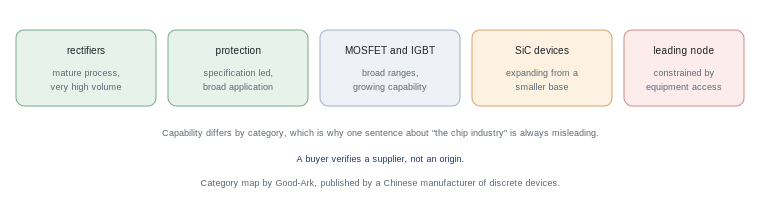
The categories where Chinese manufacturers have long been strong are the ones that need a mature process, high volume and disciplined cost control: rectifier diodes and bridges, protection devices, small signal devices, and a broad range of power MOSFETs. These are the parts that appear in every power supply, adapter, appliance and lighting product, and they are made in very large volumes for both domestic and export markets.
Two structural features follow from that. First, the industry is deep in the back end, because assembly and test is where a discrete device becomes a product and where a large share of the added cost sits at the commodity end. Second, the industry has a large number of suppliers across the same product families, which produces both competition and a wide range of quality practice. The comparison that helps a buyer is a mature manufacturing sector anywhere: a few excellent factories, a large number of competent ones, and a tail that should not be used for anything that ships.
| Category | Position | What that means for a buyer |
|---|---|---|
| Rectifiers, bridges, protection devices | Large-scale, mature process, many suppliers | Easy to source, and the diligence burden sits with the buyer |
| Power MOSFETs and IGBTs | Broad ranges, growing capability | Widely available; check qualification and documentation per part |
| Silicon carbide devices | Active and expanding from a smaller base | Availability is uneven by voltage class and package |
| Wide bandgap substrates | Investing heavily, still catching up on yield | The layer that constrains what the device layer can offer |
| Advanced logic at the leading node | Constrained by access to the newest equipment | Largely outside the scope of discrete power procurement |
Technology gaps that remain
Three gaps appear repeatedly. The first is in the newest wide bandgap material, where crystal growth and defect control are learned over years, and where a late start shows up as a yield difference rather than as an absence of capability. The second is in the equipment and materials that the newest process steps require, which constrains the leading edge more than it constrains mature production. The third is in the accumulated reliability data that automotive and industrial customers want before they will design a part in, because that data is built over years of field operation.
The third gap is the one that most often surprises observers, because it is not about technology at all. A factory can make a device that works, and a customer can still refuse it, because what the customer needs is evidence about how the device behaves over a decade. That evidence accumulates only with time in the field, which is why the automotive and industrial shift discussed in the automotive portfolio article moves more slowly than consumer adoption.
The domestic substitution wave
Substitution in this industry is a procurement process rather than a slogan, and it follows a predictable sequence. A customer identifies a part it wants to replace, finds a candidate with equivalent ratings, tests it in the application, qualifies it and only then changes the bill of materials. Each step takes time, and the step that fails most often is not the electrical one but the documentation and consistency check. For application-level guidance on choosing parts, see the application design center.
Two patterns are worth noting from a buyer’s perspective. Substitution proceeds fastest for parts where the function is simple and the parameters are easy to verify, which is why commodity rectifiers moved first. It proceeds slowest for parts where a failure is expensive and a long warranty applies, because the cost of being wrong exceeds the saving from the change.
Export patterns and trade friction
The commercial picture is that China both consumes and exports power devices, with the export mix weighted towards discrete and mature-process parts. Trade measures, tariffs and export controls change the cost and sometimes the route of those shipments, and they also change behaviour: buyers add a second source in another country, and manufacturers add capacity in another country to serve customers who need it there.
For a buyer, the practical consequences are about paperwork and planning rather than about technology. A tariff changes the landed cost, which changes whether a part is worth designing in. An export control changes what documentation accompanies a shipment. And a change in either can happen while a part is already designed into a product, which is the reason a second source in a different jurisdiction is worth qualifying during design.
Quality perception versus evidence
Perception and evidence are not the same thing, and both matter commercially. A buyer’s impression of an origin affects which suppliers are considered before any test happens, and that impression is often formed by a small number of experiences rather than by data. Evidence is what settles the question: documented qualifications, traceable lots, consistent marking and packaging, and a supplier that answers a technical question with a document rather than an assurance.
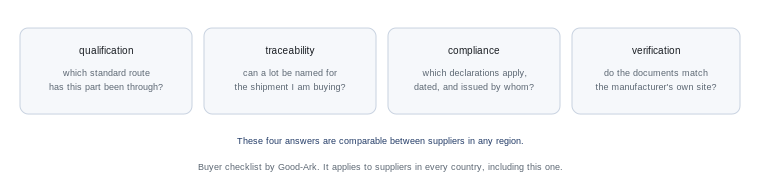
The three checks that make the difference for a buyer are the same everywhere. Ask for the qualification route the part has been through. Ask for the traceability information that will accompany the shipment, and check that the supplier can name a lot. And ask for the compliance documents that apply to your market, dated and issued by the organisation that controls the composition. Those are the questions in finding and verifying official documents.
What buyers should conclude
The conclusion is not about a country; it is about a process. A power device is a manufactured article, and whether it suits your application depends on the qualification route, the consistency of the process that made it, the traceability of the lot and the documentation that comes with it. Those four things can be asked of any supplier in any region, and the answers are what should decide a purchase.
The corollary is that a supplier who cannot answer them is unsuitable regardless of origin, and a supplier who can answer them is worth evaluating regardless of origin. That is a less exciting conclusion than a ranking, and it is the one that survives contact with an audit.
Sources and uncertainty
Statements about capacity, self-sufficiency and technology position in this industry are contested, and the sources behind them often have an interest in the conclusion. The honest position for a buyer is to treat those figures as claims, and to rely instead on things that can be checked directly: the qualification a part has, the traceability of a shipment, and whether the documentation matches the manufacturer’s own published material.
How to use this report without over-fitting
- Separate what is measured (shipments, ASP bands) from what is opinion (CAGR to 2030).
- Map claims to your BOM families: Si Schottky, FRD, MOSFET, IGBT, SiC.
- Prefer dual-source packages over single-source exotic outlines when volumes are uncertain.
FAQ
Are the market size numbers in articles exact?
Treat them as directional unless you have the primary analyst table and identical scope. Definitions of “power semiconductor” differ widely.
What should purchasing do with a bullish forecast?
Negotiate forecast flexibility, not only price. Ask for package-level lead times and PCN policy.
Does AI / EV demand change discrete diode selection?
It raises current density and thermal expectations in adjacent rails (48 V, AUX, sensors). The diode still needs a normal V/I/thermal worksheet.
Where should engineers go next?
Pair this overview with a concrete selection guide such as power MOSFET selection or power rectifier selection.
Continue through this engineering topic
- Power Semiconductor Market Outlook 2026 2030
- Silicon Carbide Market 2026
- Ai Data Centers Power Semiconductor Demand
- Automotive Semiconductor Report 2026
- Component Lead Times 2026
- Discrete Diode Market Explained
Topic hub: Power semiconductor market outlook 2026–2030 — related selection guides and application notes in this cluster.
Explore the related topic guides
Continue with the related selection, design and verification guides: