Component Lead Times in 2026: What Is Actually Normal Now
Semiconductor lead times 2026: a quoted time is a chain of four stages, not one number. How to read stock signals and plan a buffer without hoarding.
Updated: October 28, 2026
This page is a focused engineering note in the market industry cluster—use the checklists and links below to finish selection, not as a substitute for the datasheet.
Topic hub: Power semiconductor market outlook 2026–2030. Related deep-dives sit in the continue list at the end.
| Before release | Pass criteria |
|---|---|
| Ratings vs mission profile | Voltage/current/thermal margins recorded |
| Package & PCB | Rth path agreed with layout |
| Docs | Datasheet rev + PCN policy filed |
| Alternates | At least one workable second source or risk accepted |
What lead time really measures
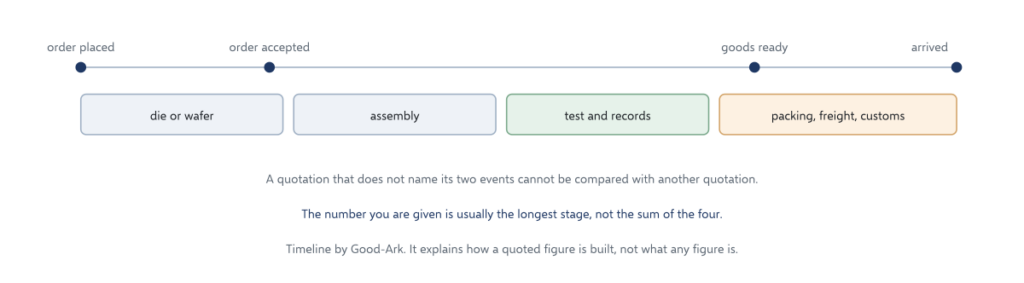
Formally, a lead time is the interval between two events, and most disagreements about a lead time are disagreements about which two. The clock can start when an order is placed, when it is accepted, when a deposit clears or when a production slot is confirmed. It can end when the goods are ready, when they leave the factory, when they clear customs or when they arrive at your dock. A quotation that does not say which pair of events it describes cannot be compared with another quotation.
The second thing a lead time measures is capacity relative to demand, at the moment it was written. When demand is rising faster than capacity, the number extends; when new capacity arrives or demand softens, it shortens. That makes it a lagging indicator of the market and a leading indicator of your own schedule, which is the opposite of how it is usually read.
The four stages behind a quoted number
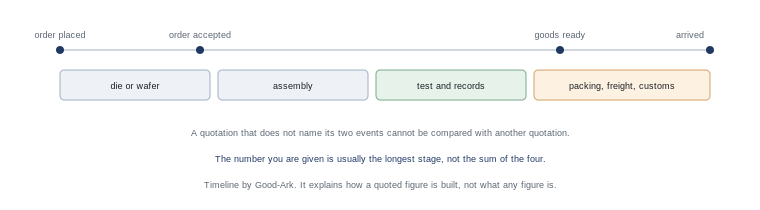
The chain has four stages and a quoted figure is usually an estimate of the longest one. Die or wafer availability comes first, and it is either satisfied from stock or from a production run. Assembly comes next, where the die is packaged. Test and documentation follows, and this is where lot records are produced. Packing, freight and customs close the chain, and this is the stage a buyer can most easily influence by choosing a faster shipping method.
Two questions settle which stage dominates. Is the part stocked as finished goods, in which case the clock starts at the last two stages? Or is it built to order, in which case the clock starts at the first? A part that is stocked can be shipped next week; the same part built to order has to be scheduled into a production line, and no amount of urgency changes the physics of a run.
Standard versus expedited parts
Many manufacturers offer more than one service level for the same device. A standard part is tested to the ordinary specification and shipped from normal production. An expedited option usually exists for customers who need samples or a first article sooner, and it can involve a separate test flow, a partial lot or a higher price. It is worth knowing that the expedited route is a different process rather than a faster queue, so it does not simply move you to the front of the same line.
The distinction matters for planning because expedited service is usually limited in quantity. It is a way to obtain samples or to bridge a gap, not a way to run production. A buyer who plans on expedited deliveries for a shipping product has moved a scheduling problem into the supplier’s hands without solving it.
Why the same family has different times
Three variables produce different lead times inside one product family. The package decides which assembly line is used, and a less common package has fewer lines and less buffer. The voltage or current rating decides which die is required, and a low-volume rating may not be in stock even when the popular ratings are. And the grade decides whether additional testing is needed, which adds a step that cannot be skipped for the order to be valid.
| Variable | Effect on the clock | What the buyer can do |
|---|---|---|
| Package | Chooses the assembly line and its queue | Check whether a compatible package is stocked |
| Voltage or current rating | Decides whether the die is on hand | Ask which ratings are stocked, not only which exist |
| Grade and screening | Adds test steps that cannot be omitted | Confirm the grade is genuinely required by the application |
| Packing | Tape and reel, tube or ammo pack have separate capacity | Ask whether the shipping pack can be substituted |
Reading a distributor stock signal
A distributor’s stock position is one of the few public indicators available to a small buyer, and it is easy to misread. A large quantity listed as available may be a single lot held in one location, which means one order can remove it entirely. A small quantity may be a cut-tape remnant rather than a production quantity. And a listing that shows a lead time alongside a stock figure is describing two different routes to the same part number.
Three signals are worth watching over time rather than in a single snapshot. Rising stock for a family while lead times extend elsewhere suggests a mix shift rather than a general shortage. Falling stock with stable lead times suggests the distributor is drawing down inventory rather than that the market is tightening. And a widening gap between quoted lead time and actual delivery is the most informative of the three, because it measures the reliability of the estimate rather than its value.
Planning buffer without hoarding
A buffer is a quantity of stock held to absorb a delay, and it has a cost: cash, space, and the risk that the parts are obsolete before use. A hoard is a buffer sized for a scenario nobody has quantified. The distinction is arithmetic rather than moral.
A workable method is to state the risk explicitly. If a delay of one delivery interval would stop a line, the buffer needed is one interval of consumption; if two suppliers exist and both would have to fail, the buffer can be smaller. Those figures come from your own production plan, and the exercise takes an afternoon. The numbers are imagined here only to show the shape of the calculation.
What to do when it slips
When a date moves, three things are worth doing in order. Ask which stage moved, because a slip in the assembly queue and a slip in customs have different remedies. Ask for the new estimate in writing, with the same start and end events as the original, so that the two numbers are comparable. And check whether the slip affects a stocked rating or a built-to-order one, because a stocked alternative may exist in a nearby grade or package.
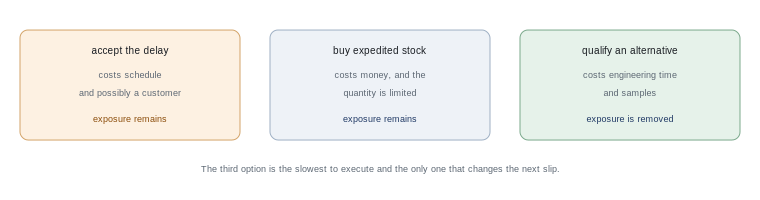
For a product already in production, the decision is usually a trade between three options: accept the delay, pay more for an expedited route that is limited in quantity, or re-qualify an alternative part. The third is the slowest to execute and the only one that permanently removes the exposure, which is exactly the argument for doing it before a slip happens.
Practical summary
Ask which events a quoted lead time describes and which stage sets it. Find out whether the part is stocked or built to order. Watch the gap between quoted and actual delivery for the parts you buy, because that is the reliability measure. Size a buffer from your own consumption and your own tolerance for a delay, and treat expedited service as a bridge rather than a plan. None of those steps requires a forecast, and all of them produce a schedule you can defend.
Release checklist
- Re-read absolute maximum ratings against worst-case spikes.
- Confirm pinout/package drawing matches the footprint library.
- Capture why this MPN beat the next alternative (loss, cost, lead time, or qualification).
FAQ
How should buyers read lead-time headlines?
Treat published ranges as directional; confirm allocation, MOQ, and PCN risk with your authorized channel for the exact MPN.
What drives power-device lead times in 2026?
Capacity mix, automotive pull-ins, and package bottlenecks—varies by voltage class and package family.
Any financial or capacity claims here?
This page stays qualitative; verify numbers with primary suppliers and public filings rather than secondary summaries.
Market hub?
Power semiconductor market outlook 2026–2030.
Continue through this engineering topic
- Discrete Diode Market Explained
- What is silicon carbide
- Ai Data Centers Power Semiconductor Demand
- Energy Efficiency Rules And Components
- Industrial applications of power semiconductors
- Automotive Semiconductor Report 2026
Topic hub: Power semiconductor market outlook 2026–2030 — related selection guides and application notes in this cluster.
Explore the related topic guides
Continue with the related selection, design and verification guides: