Why 800 V Electric Cars Need Silicon Carbide
800 V EV platform SiC: raising the pack voltage halves the current for the same power at 800 V, so why silicon struggles and what the swap buys.
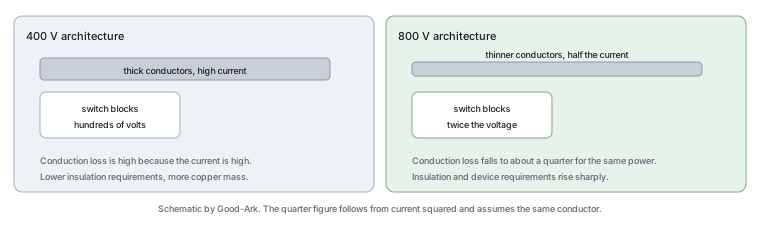
Doubling the battery voltage looks like a simple change and behaves like a redesign. It halves the current needed for the same power, which is why it is attractive; it also changes what the semiconductors have to block, which is why silicon carbide ends up in the design rather than silicon.
Last updated:
Two ways to deliver more power
Power is voltage multiplied by current. If you want a converter to deliver twice the power, you can double the current, double the voltage, or increase both. Twice the current means heavier cables, larger connectors and more heat in every conductor; twice the voltage means the same power through the same current, with the difficulty moving into insulation and the devices.
That is the whole argument for higher-voltage platforms. The analogy is delivering water: you can push more volume through a wider pipe at the same pressure, or the same volume through the same pipe at higher pressure. The wider pipe is the 400 V answer, the higher pressure is the 800 V answer, and the trade is between plumbing and pressure containment.
Why higher voltage means thinner wires
Conductor loss depends on current squared, so halving the current cuts the loss to a quarter for the same conductor. That means cables can be thinner and lighter for the same delivered power, which matters in a vehicle because every kilogram of copper is a kilogram that does not contribute to range. Higher voltage also allows higher charging power through the same connector, because the connector’s current rating is the limit.
None of that is specific to a particular vehicle; it is arithmetic. The reason the industry did not simply do it earlier is that the components around a higher-voltage bus — insulation, contactors, converters, and the switches themselves — all have to be re-specified, and the semiconductor part of that list was the hardest.
The problem silicon has at 800 V
A power switch has to block the full bus voltage when it is off, plus margin for transients. At 800 V, a silicon device needs a thick, lightly doped drift region to withstand the field, and that thickness is directly proportional to its resistance when conducting. The result is a switch that blocks the voltage and wastes a substantial amount of energy as heat every time it carries current.
There is a second penalty that is easy to miss. Silicon diodes recover slowly, and at high voltage the reverse-recovery current is large enough to become a significant loss and a source of electrical noise. So at 800 V, silicon imposes both a conduction penalty and a switching penalty, and both get worse the harder the converter works.
How SiC solves it
Silicon carbide withstands a much higher electric field than silicon, so it blocks the same voltage with a much thinner region. Thinner means lower resistance, and lower resistance means less heat at the same current — which is exactly the problem the higher-voltage bus created. Silicon carbide Schottky diodes remove the reverse-recovery penalty at the same time, which reduces both loss and noise in the freewheeling paths.
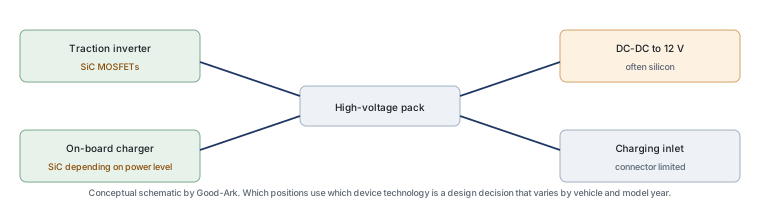
The combined effect is a converter that handles twice the voltage without paying twice the loss. Practically, that is what makes an 800 V traction inverter feasible in a package that fits a car: the switches have to block more and waste less, and only a wide-bandgap device does both.
| Property | At the lower voltage | At the higher voltage |
|---|---|---|
| Current for the same power | Higher | Halved |
| Conductor mass and loss | Heavier, higher losses | Lighter, roughly a quarter of the loss for the same conductor |
| Voltage each device must block | Modest | Doubled, plus transient margin |
| Device loss at that voltage | Manageable in silicon | Needs a wide-bandgap device to stay manageable |
| Insulation and clearance | Standard automotive practice | Stricter, and a safety-critical design area |
| Charging power through one connector | Limited by connector current | Higher for the same connector, because power scales with voltage |
What drivers actually notice
The most visible effect is charging: for a given connector current limit, an 800 V vehicle can accept more power at the same current, which shortens a stop on a long journey. The second is efficiency, which shows up as a modest range benefit. The third is less obvious and arguably more valuable to a manufacturer: a lighter, smaller power electronics package, which frees space and mass elsewhere in the vehicle.
What drivers do not notice is everything the higher voltage costs. Insulation clearances are larger, connectors and contactors are different parts, and the safety design around a higher-voltage bus is more demanding. None of that is visible, and all of it is why the transition was slower than the arithmetic suggests.
Charging infrastructure implications
A higher-voltage vehicle needs a charger that can supply a higher voltage, not just more current. Charging stations have to support the voltage range of the vehicles they serve, and early stations designed around a lower bus voltage may not reach the full power a newer vehicle could accept. That mismatch is why the vehicle’s advertised peak charging rate is often limited in practice by the equipment rather than by the car.
The connector matters too. Since power equals voltage times current, doubling the voltage doubles the achievable power through the same cable for the same thermal limit in the conductor. That is the physical reason the industry cares about higher-voltage platforms: it improves charging without inventing a heavier cable or a connector that a person cannot lift.
Two external references are useful when checking a claim about a high-voltage vehicle. The device class that does the switching is described under power MOSFETs, and the material under silicon carbide. Charging-system standards and connector definitions come from the International Electrotechnical Commission, vehicle-level test expectations from the ISO automotive standards series, electrical safety requirements from NIST, charging and efficiency programmes from the US Department of Energy, and sector-level reporting from the Semiconductor Industry Association. Wide bandgap and sector background is published by JEDEC.
One more thing is worth saying plainly about the transition. A higher-voltage platform is not simply a battery decision: it changes the specification of every component on the bus, from the insulation on a cable to the contactors that disconnect the pack in a fault. That is why the move happened in generations rather than overnight, and why the semiconductor part of the change — the switches that had to block more and lose less — was the constraint that made silicon carbide necessary rather than merely attractive.
Where the technology is heading
Two trends are visible without forecasting. First, devices are being developed for higher voltage classes, which matches the direction of the platforms. Second, manufacturers continue to look for ways to reduce the quantity of expensive material used, which is a sign that the technology has moved from a novelty to a cost-optimised commodity. Both point to wider adoption rather than retreat.
The honest caveat is that architecture choices are commercial decisions. A manufacturer may use a higher-voltage platform for one model and a lower-voltage platform for another, depending on the market, the charging network and the cost target. The direction of travel is clear; the timetable is not.
FAQ
What is the SIC code for an EV charging station?
This is the Standard Industrial Classification meaning of SIC, not silicon carbide. Charging-station operation generally falls under retail sale or distribution of electricity categories, and the newer classification systems have more specific codes for electric power generation and for charging services. Because the codes differ by country and are revised periodically, check the current list for your jurisdiction. The acronym collision with silicon carbide is explained in more detail in our article on silicon carbide in solar inverters.
What EVs have 800 V architecture?
Several manufacturers now offer vehicles with 800 V-class platforms, and the list changes every model year as new generations are released, so a list written here would be out of date quickly. The useful approach is to check the specific model’s technical specification for its nominal pack voltage and its peak charging power, rather than relying on a general statement about a brand. A manufacturer can also offer both voltage classes across its range at the same time.
Are Teslas 400 V or 800 V?
The company’s mainstream models have historically used a nominal pack voltage in the 400 V class, while higher-voltage architectures have appeared in newer products. Because this varies by model and by year, and because the company has also discussed changing the amount of silicon carbide it uses, the reliable answer for any particular vehicle is its own specification sheet rather than a general statement about the brand.
Will extended-range electric vehicles be available in a given year?
Extended-range electric vehicles — where a combustion engine acts only as a generator for the battery — already exist in some markets, and their availability depends on regional emissions rules, buyer preferences and each manufacturer’s product plan. We cannot verify future model-year availability, and any list would be out of date quickly. What can be said is that the architecture uses the same high-voltage power electronics as a battery-electric vehicle, so the device questions are similar.
Does an 800 V car charge twice as fast as a 400 V car?
Not automatically. Doubling the voltage doubles the power a given current can deliver, but the car’s actual charging rate is set by the lowest of three limits: what the charging equipment can supply, what the vehicle’s electronics can pass, and what the battery will accept at that state of charge. A higher-voltage architecture raises the ceiling on the second limit only, and a battery that will not accept the current becomes the binding constraint instead.
What to do next
If you are evaluating a vehicle, look at nominal pack voltage and peak charging power together, and check what the charging equipment you will actually use can supply. If you are designing power electronics for a high-voltage bus, the device question is upstream of almost everything else: our guide to what to check in high-voltage SiC MOSFETs covers the parameters in order.
Give Good-Ark the bus voltage, the transient margin and the thermal budget, and we can point to the SiC families that fit and the qualification documents that go with them.
Email sales@goodark.com, or start from the SiC portfolio page.
This article is published by Good-Ark, a manufacturer of silicon carbide devices. It describes the general engineering reasons behind higher-voltage vehicle platforms and does not name current models, because model specifications change every year.
Continue through this engineering topic
For the complete selection, design, verification, and troubleshooting path, explore the Silicon Carbide and Wide Bandgap Hub.
Recommended
 Why Do Diodes Get Hot? Conduction and Switching Losses ExplainedInfoStandard, Fast Recovery, and Schottky Diodes: What’s the Difference?Info
 What Is a Fast Recovery Diode? Understanding “Fast Recovery”Info
 What Is a Diode? A Beginner’s Guide to How It WorksInfo
 Automotive Semiconductor Report 2026: Chips Per Car Keep RisingKnowledge