MOQ and Lead Time: What Beginners Should Know Before Their First Component Order
MOQ and lead time explained: why minimum quantities exist, why a lead time is an estimate, how to ask for samples, and the mistakes first buyers make.
A minimum order quantity is the smallest quantity a supplier will sell in one transaction, and a lead time is the delay between placing that order and receiving it. Both exist for the same reason: the cost of handling an order barely changes with its size, so a supplier with a fixed cost per order has to set a floor. Neither number is fixed in the way a datasheet value is, and both can be worked with once you know what they are made of.
What MOQ protects and what it costs
The comparison that explains it best is a print shop. Printing one poster costs almost the same in setup as printing five hundred, so the shop charges a minimum order rather than a per-unit price for a single sheet. Component sellers face the same arithmetic: a reel has to be opened, a bag has to be sealed and labelled, a test record has to be raised, an invoice has to be issued and a shipment has to be booked, and those steps cost roughly the same for one hundred pieces as for five thousand.
For the supplier the minimum protects handling cost, and it also protects quality control: it is impractical to open a sealed production lot to extract a handful of pieces, because the remaining partial lot becomes harder to trace and harder to store. For the buyer the cost is cash tied up in stock, the space to store it, and the risk that the parts are obsolete before they are used. That last point matters more than beginners expect, because a design change can strand an entire minimum-order quantity.
Why the number changes with package and family
The minimum is usually the packing unit of the product rather than a round business decision. Surface-mount devices arrive on tape and reel, and a reel holds a fixed number of parts that depends on the package size. Through-hole parts arrive in ammo packs or boxes, and large packages arrive in tubes holding a small number of pieces. A quoted minimum of 200 is often exactly one tube, and a quoted minimum of 5,000 is often exactly one reel.
| Part shape | Usual presentation | Why the minimum lands there |
|---|---|---|
| Small surface-mount diode or transistor | Tape and reel, thousands per reel | The reel is the smallest unit the assembly line can feed |
| Larger surface-mount package | Tape and reel, fewer per reel | Fewer parts fit across the tape width |
| Axial through-hole diode | Ammo pack or box, often a stated count | The pack is the shipping unit |
| Bridge rectifier or module | Tube or tray, single or double figures | A small number fills the tube |
| Wafer, die or custom part | Per project | Process setup dominates, so the minimum is a project conversation |
This is why the same supplier can quote a hundred pieces on one line and several thousand on the next, and it explains a question that comes up constantly: what does a minimum of 200 pieces mean? It means the seller will not break a smaller quantity out of that pack. Sometimes a seller will agree to a cut quantity from an already opened pack, and asking is free.
How to ask for samples
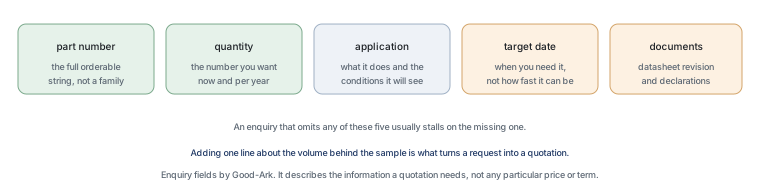
Sample requests work best when they are treated as a small order rather than a favour. A request a supplier can act on states the exact orderable part number, the quantity wanted, what it is for, whether you will pay, who pays the freight and when you need it. A request that only says you would like to try the part goes to the back of the queue, because it cannot be entered into any system.
Two details make sample requests succeed more often. Accept a cut quantity from an opened pack, which removes the objection about breaking a sealed lot, and say what happens next: a buyer who explains that a successful sample leads to production is describing a commercial relationship, and suppliers price their effort against that.
What determines lead time
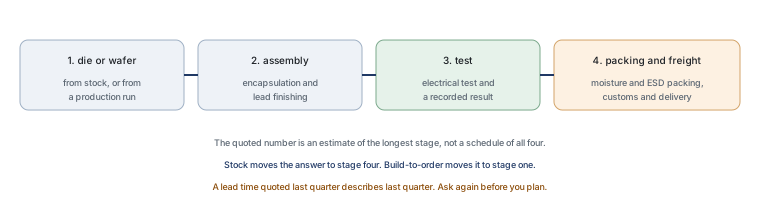
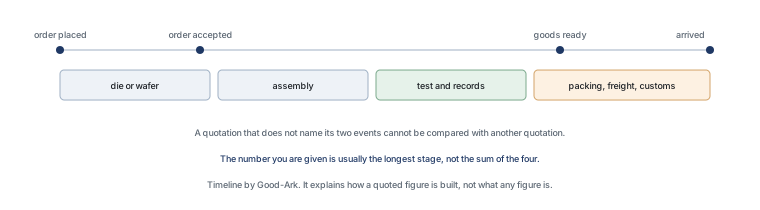
A quoted lead time is a chain of four stages, and the number you are given is usually an estimate of the longest one. The wafer or die has to be available, either from stock or from a production run. The parts have to be assembled into the package. They have to be tested and the results recorded. Then they have to be packed, shipped and cleared through customs. Each stage has its own waiting time, and a shortage at any stage sets the total.
That is why two parts from the same family can carry very different lead times. A device held in finished-goods stock ships in days. The same device built to order can take a full production cycle, because it has to be slotted into a schedule. The number also moves: it lengthens when demand rises across the industry and shortens when inventory builds up, which is why a lead time quoted two months ago is a historical document rather than a current fact.
Planning your first order
Lead time determines how much safety stock a project needs, and the arithmetic is simple once you know the demand rate. If a build consumes a part every week and the lead time is four weeks, buying four weeks ahead keeps the line running and eight weeks ahead survives one slipped delivery. The numbers here are invented to show the method; the real values come from your own plan and the supplier’s quote.
Two concepts from inventory management are worth knowing by name. Economic order quantity is the order size that balances the cost of holding stock against the cost of placing orders, and it usually produces a number larger than a project needs. Minimum order quantity is the floor the supplier imposes. When the two point in different directions, the minimum wins, because it is a constraint rather than a preference, and the practical response is to plan for a larger purchase than the project strictly requires.
Payment and shipping basics
A first order is usually paid before shipment, because the seller has no credit history to work with. Later orders may be offered on terms once a relationship and a payment record exist. Bank charges on an international transfer are worth checking before the invoice is agreed, because on a small order they can be a visible fraction of the value.
Incoterms are the three-letter codes that say where the seller’s responsibility ends. In plain language: a term beginning with E leaves almost everything to the buyer, F or C puts the main freight on the seller with the risk at a defined point, and DDP means the seller delivers with duty paid. Whoever is named in the term pays the duty and the tax, which matters because an unexpected customs bill can cost more than the parts.
One technical point belongs here. Semiconductors are electrostatic-discharge sensitive and many packages are moisture sensitive, so the packing is part of the quality of the goods. A supplier who ships a moisture-sensitive part without a barrier bag and a humidity card is telling you something about process control.
Mistakes first-time buyers make
The same handful of errors appear again and again, and every one is cheap to avoid.
- Ordering by description rather than by the full orderable part number, and receiving a different package or grade.
- Asking for a few pieces from a sealed production lot, then reading the refusal as unwillingness rather than as traceability practice.
- Treating a quoted lead time as a delivery date instead of a current estimate.
- Forgetting to agree who pays the duty, then discovering it at the door.
- Choosing the cheapest freight for parts that need moisture protection or ESD-safe packing.
- Not asking whether a second source exists, which becomes urgent only when the first one slips.
Sample inquiry template
A message that can be processed in one reading gets answered faster. The structure below works for a first approach to any manufacturer.
Subject: Sample request — full orderable part number — quantity — target date
Hello, we are evaluating this part for a new design. Please quote the exact orderable part number as listed in your datasheet, a quantity of the packing unit you can supply, and your current lead time.
Application: what the part does and the conditions it will see. Annual quantity: the volume we expect if the design goes ahead. Sample timing: the date we need them. Shipping: who pays duty and tax. Documentation: the datasheet revision and the declarations that would accompany the shipment.
We can accept a cut quantity from an opened pack if that is easier for you.
FAQ
What does MOQ mean?
Minimum order quantity: the smallest amount a supplier will sell in one transaction. It is set by the cost of handling an order and by the packing unit of the product, so it is often exactly one reel, one tube or one box rather than a round number chosen for commercial reasons.
What does a four-week lead time mean?
It means the supplier’s current estimate of the time between your order being accepted and the goods being ready to ship, or delivered, depending on how the quotation is worded. It is an estimate rather than a promise, and it moves with industry conditions. The quotation should say which event starts the clock and which one ends it, because a four-week figure that excludes freight is a different date from one that includes it.
How do I calculate lead time for an order?
Ask the supplier for the stage that is driving the number: whether the parts are in stock, whether they have to be assembled, and whether a test step is required. Then add your own handling and freight time. The result is your planning figure. Adding a buffer of one delivery interval on top is normal practice for a first order, because a first delivery rarely arrives early.
What is the difference between EOQ and MOQ?
Economic order quantity is the order size that minimises the total of holding cost and ordering cost, so it is a calculation you do. Minimum order quantity is a constraint the supplier imposes, so it is a limit you work within. When the economic size is below the minimum, the minimum decides the order, and the planning question becomes whether to buy the extra and store it.
Can I get a single sample instead of a full pack?
Often yes, and it usually takes the form of a cut quantity or an engineering sample rather than a normal order line. The reason it is not automatic is traceability: a sealed production lot that is opened to extract a few pieces is harder to account for afterwards. Say in the enquiry that you can accept a cut quantity, and say what volume a successful sample leads to.
What to do next
Write the enquiry with the five fields above, ask for the current lead time rather than an older one, and ask which stage is driving it. That is enough to turn a vague plan into a schedule. The documents that should accompany the resulting shipment are listed in our guide to compliance and quality documentation, and the channel question that sits in front of the first order is covered in samples, quotations and authorised channels.
Regulatory and standards background is available from ISO for quality management, IPC for packaging and handling expectations, JEDEC for device-level standards, the Semiconductor Industry Association for sector context, and general background on supply chains and part numbers for readers who want the definitions in a wider setting. Regulatory and quality background is published by the European Commission and ECHA.
Send Good-Ark the part number, the quantity you need now and the volume you expect, and ask for the current lead time and the packing unit for that specific part.
Email sales@goodark.com, or start from the samples and quotations guide.
This article is published by Good-Ark, a manufacturer of discrete semiconductor devices. It explains how minimum order quantities and lead times are constructed and publishes no figures of its own, because both are quoted per part number and per enquiry.
Recommended
 Why Does Your Phone Charger Get Warm?Knowledge
 Energy Efficiency Rules Worldwide: How Regulations Shape Component ChoicesKnowledge
 Wide-Bandgap Semiconductors: Adoption Report 2026Knowledge
 The GaN Charger Market: Why Your Next Adapter Is SmallerKnowledge
 Component Lead Times in 2026: What Is Actually Normal NowKnowledge
 China’s Power Semiconductor Industry: Where It Stands in 2026Knowledge