What Documents Should Come With a Semiconductor Order?
Semiconductor order documentation: invoice, packing list, certificate of conformity, declarations and traceability, and what each document actually proves.
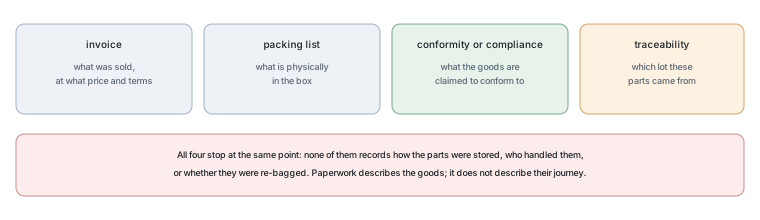
A normal component order arrives with four documents: the invoice, the packing list, a certificate of conformity or a compliance declaration, and the information that links the parts to a production lot. Everything else is either specific to the part — a test report, a qualification report, a handling instruction — or specific to your own customer’s requirements. The useful skill is not memorising the list; it is knowing what each document can prove and what it cannot.
The four documents that matter most
These four arrive with almost every order, and each answers a different question. The invoice answers what was sold and for how much. The packing list answers what is physically in the box. The conformity or compliance document answers what the goods are claimed to be. The traceability information answers which production lot they came from. The comparison to remember is a parcel receipt: it proves something was sent and accepted, and none of it proves what is inside.
| Document | The question it answers | Normally issued by |
|---|---|---|
| Invoice | What was sold, at what price, on what terms | The seller |
| Packing list | What is in this box, in what quantity and packing | The seller or the warehouse |
| Certificate of conformity or declaration | What the goods are claimed to conform to | The manufacturer, or the seller under its own name |
| Traceability information | Which production lot these parts came from | The manufacturer, through the supply chain |
The reason the third and fourth are separated in this list is that they are often confused. A conformity document is a statement about what a part is. A traceability record is a statement about where it came from. A genuine part can arrive with the first and without the second, and a part of unknown origin can arrive with both.
Invoice and packing list
The invoice is the commercial and legal document. It carries the seller’s and buyer’s details, the order reference, the line items with their part numbers, quantities and prices, the currency, the payment terms, the incoterms and the date. When a dispute arises about what was agreed, the invoice and the purchase order are the two documents that are read against each other.
The packing list is the physical document, and its job is to let somebody check the box without opening every bag. It lists the part numbers, the quantities, the packing type and usually the lot or date codes. Two habits make it useful: check that the packing list and the carton label agree, and check that the packing list and the invoice agree. A disagreement between any two of the three is the most common paperwork error there is, and it is far cheaper to resolve on the dock than after the parts are consumed.
Certificate of conformity
A certificate of conformity is a statement that the goods supplied conform to the specification or the order. It is a short document: it names the parts or the order, states the specification or standard they are being declared against, gives the date, and is signed by someone with authority to make the statement. Its value is that it is specific. A certificate that names a product family rather than the orderable part number you bought has answered a slightly different question.
It is worth knowing what a certificate of conformity is not. It is not a test report, because it does not usually contain measurements. It is not a quality management certificate, because that certifies a system rather than a shipment. And it is not a substitute for a compliance declaration, because conformity with a purchase specification and conformity with a substance restriction are two different claims. When somebody asks for “the CoC”, it is worth confirming which of those three they mean.
Compliance declarations
Compliance documents state that a part meets a named restriction applicable to its market. For electronics sold into Europe the two that appear most often are the restriction on hazardous substances in electrical equipment and the chemical regulation that sits alongside it, and both are usually supplied as statements covering a defined scope of part numbers with a date. The details of what each one claims, and why they are not interchangeable, are covered in our explanation of the two European regimes.
When a compliance declaration arrives, check three things before filing it: that it names the part number rather than only a family, that the date is recent enough to reflect the composition currently shipping, and that it was issued by the organisation that controls the composition. A declaration that a distributor has retyped is a useful indication and is not the same document as one issued by the manufacturer.
Test reports and where they come from
Test documentation comes in three kinds and they are not interchangeable. A qualification report is generated once, when a device family is released, and covers the environmental and lifetime tests the family was put through. A lot-based test record is generated against a specific production lot, and it says what that lot was screened for. A third-party laboratory report is generated against samples that somebody submitted, usually to settle a specific question.
The practical point is who can produce them. Only the organisation that made the parts can issue a qualification report or a lot record, and only an accredited laboratory can issue a laboratory report. A seller further down the chain can pass those documents on and cannot create them. That is the reason a request for a test report is really a request about the supply chain, and why it is easier to answer it before the order than after. Automotive parts add a further layer of expectation, described in verifying an automotive part beyond the datasheet.
Traceability: what to ask for
Traceability means being able to connect the parts in your hand to the production run they came from, and it rests on three pieces of information: the part number, the date code and the lot or batch code. The part number identifies what the device is, the date code says roughly when it was made, and the lot code identifies the group of units produced together. A shipment with all three can be investigated later; a shipment without them can only be described.
What to ask for is a chain rather than a promise. Ask which lot codes are included in this delivery, ask for those codes to appear on the packing list, and ask whether the manufacturer will confirm the lot on request. For products that will be recalled or audited, the useful record is the mapping in both directions: from your order number to the lot codes, and from the lot codes back to the order and the date. That mapping is what an investigator asks for first.
What to keep for audits
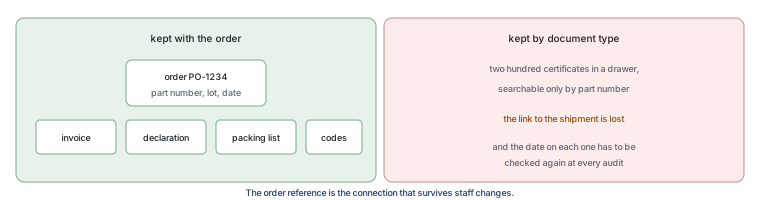
Keep the documents with the order record rather than in a folder of certificates. The distinction sounds pedantic and it is the one that decides whether a file is usable: a document filed next to the purchase order it belongs to can be produced in a minute, and the same document in a drawer with two hundred others cannot prove anything, because nothing connects it to the parts.
Four rules keep the file usable. Store the documents with the order reference, so the link survives staff changes. Keep the dated version, so it is clear which composition was declared. Keep the packing list alongside the invoice, because the two together describe what was actually delivered. And note in the record any request that could not be answered, because an unanswered question is more useful to a later investigation than a missing one.
Checklist
Run this list when the box is opened, before the parts go into stock.
- Match the carton label, the packing list and the invoice, and confirm that part numbers and quantities agree.
- Record the lot and date codes that are printed on the bag, the reel or the tube.
- File the certificate or declaration against the order, and check that it names the orderable part number.
- Check the date on each compliance document, and request a reissue if it predates the composition now shipping.
- Note which test or qualification documents exist for this part, and which of them you could obtain later.
- Store everything under the order reference, together with a note of any request that went unanswered.
FAQ
What is a certificate of conformity for components?
It is a short statement that the goods supplied conform to the order or to a named specification, issued by the supplier or manufacturer and dated. It normally names the parts, the specification being declared against and the signatory. It is a claim rather than a measurement, which is why it is often accompanied by, rather than replaced by, test documentation.
What is the difference between a certificate of conformity and a test report?
A certificate states that goods conform. A test report contains the measurements behind a claim, at the level of a lot, a qualification programme or specific submitted samples. A certificate can be issued by the supplier; a qualification report or a lot record can only come from the organisation that made the parts, and a laboratory report only from a laboratory.
Which documents should I keep, and for how long?
Keep the invoice, the packing list, the conformity or compliance documents and the lot codes, filed together under the order reference. How long depends on your own obligations and those of your customers, so it belongs in your quality procedure rather than in a general rule. The habit that matters is keeping the connection between the documents and the shipment, because that connection is what makes a file useful later.
Do I need compliance declarations for every order, or just the first?
Keep one current set per part number and re-check it when composition or the applicable list changes, rather than requesting it with each delivery. The date on the document is what tells you whether it is still current, so a file that holds one undated declaration per part is weaker than a file that holds a dated one.
Why do search results for this topic talk about export controls?
Because the words in the question also belong to other subjects: trade rules that govern the export of manufacturing equipment, and software that reads documents inside factories. Those are real topics and they are not the question a buyer is asking. For order paperwork, the useful sources are the manufacturer’s own document set and the public standards bodies, not a general search page.
What to do next
Decide now, before the next order, where the documents will be filed and what will be attached to them. A folder named after the purchase order takes a minute to create and answers an auditor’s question in seconds. If you are specifying documents for a first purchase, the list of declarations and certificates a manufacturer can supply is set out in our guide to compliance documentation, and the terms used on those documents are decoded in datasheet terms explained.
Standards background is available from ISO for the quality management requirements a supplier is audited against, JEDEC for device-level test methods, IPC for marking and traceability expectations, NIST for measurement and conformity material, the European Commission for the substance restriction that appears on declarations, and ECHA for the chemical framework beside it.
Tell Good-Ark the part number and the market you are selling into, and we will confirm which declarations, certificates and traceability information accompany that part.
Email sales@goodark.com, or start from the quality knowledge section.
This article is published by Good-Ark, a manufacturer of discrete semiconductor devices. It describes document types at a general level and reproduces no specific certificate or declaration; the exact set supplied depends on the part, the grade and the customer’s own requirements.
Recommended
 Why Does Your Phone Charger Get Warm?Knowledge
 Energy Efficiency Rules Worldwide: How Regulations Shape Component ChoicesKnowledge
 Wide-Bandgap Semiconductors: Adoption Report 2026Knowledge
 The GaN Charger Market: Why Your Next Adapter Is SmallerKnowledge
 Component Lead Times in 2026: What Is Actually Normal NowKnowledge
 China’s Power Semiconductor Industry: Where It Stands in 2026Knowledge