AWSS10H60: 10 A, 60 V Schottky for High-Current Automotive Lighting
AWSS10H60 appears in the Good-Ark new-release table as a 10 A, 60 V Schottky rectifier in eSGC (TO-277). The main design question…
AWSS10H60 appears in the Good-Ark new-release table as a 10 A, 60 V Schottky rectifier in eSGC (TO-277). The main design question is how the installed board handles a higher-current conduction path. The 10 A catalog label must be tied to a waveform, a mounting condition and a thermal limit.
Last updated:
Start with conduction loss, then solve the heat path
For a first estimate with approximately constant conducting current, forward loss is current multiplied by forward voltage. For an assumed 8 A conduction current and an assumed 0.45 V forward drop, the estimate is 3.6 W. The voltage is an illustrative input, not an AWSS10H60 specification; replace it with applicable manufacturer data.
If the thermal budget allowed a 60 °C rise from the chosen reference point, 3.6 W would require an effective thermal resistance no greater than about 16.7 °C/W for that simplified loss alone. This does not establish a product junction limit or a universal junction-to-ambient value. Recovery, leakage, tolerances and the actual temperature-dependent waveform can change the result.
Define the reference point behind a thermal number
A junction-to-case or junction-to-lead resistance cannot be used as junction-to-ambient without the remaining path. Identify which temperature is measured and how the device transfers heat into the PCB and enclosure. Keep that boundary condition with every resistance value.
The TO-277 board-design guide covers pads and thermal integration. Use the exact package drawing and assembly guidance for the ordering code, rather than copying a neighboring footprint because both parts use the eSGC name.
Check whether a higher current class solves the actual limit
Compare AWSS5H60 when the lower current class might be adequate under its own rating conditions. Consider AWSS10H100 only when the reverse-voltage review also calls for the higher class. Neither option removes the need to examine startup, surge repetition and the initial temperature.
The AWSS family guide owns the common matrix. Keep the board temperature calculation and mounting evidence with this higher-current review.
Obtain the exact model documents
Use the AWSS10H60 product page to locate the manufacturer entry. Obtain the current datasheet revision and resolve any missing operating, thermal, surge or qualification limit before approving the part.
Continue through this engineering topic
For the complete selection, design, verification, and troubleshooting path, explore the Automotive Power Electronics Hub.
- Practical guide: Solder Joint Reliability for TO-277 in Automotive LED Modules
- Practical guide: AWSS5H100: 5 A, 100 V Schottky for Automotive Lighting Modules
- Practical guide: The AWSS Family: Matching 5/10 A and 60/100 V Parts to Your Automotive Load
- Ask Good-Ark technical support about this application
Recommended
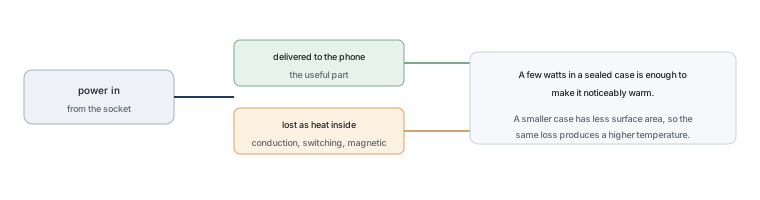 Why Does Your Phone Charger Get Warm?Knowledge
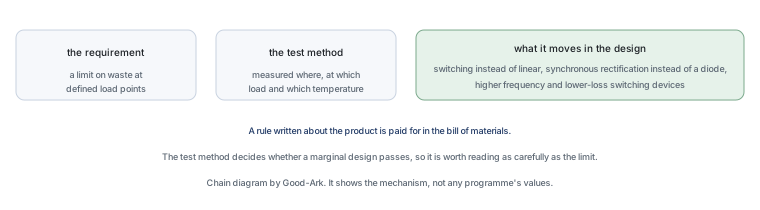 Energy Efficiency Rules Worldwide: How Regulations Shape Component ChoicesKnowledge
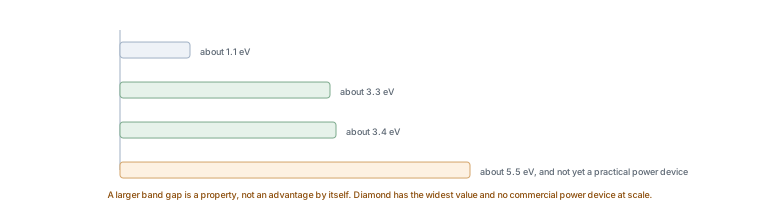 Wide-Bandgap Semiconductors: Adoption Report 2026Knowledge
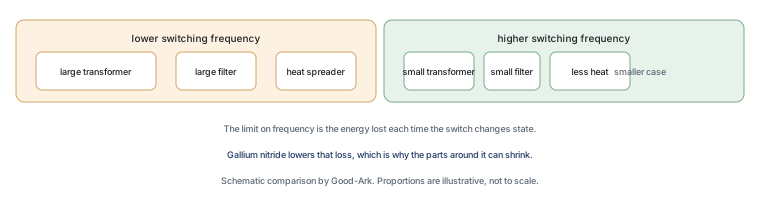 The GaN Charger Market: Why Your Next Adapter Is SmallerKnowledge
 Component Lead Times in 2026: What Is Actually Normal NowKnowledge
 China’s Power Semiconductor Industry: Where It Stands in 2026Knowledge